

Amid scuffles, Beit Shemesh cuts short operation to remove ‘modesty’ signs
‘Due to violent disorderly conduct’ by some ultra-Orthodox men, city cuts short court-ordered work to take down notices ordering men and women to walk on separate sides of street
 Add ToI as a Preferred Source on Google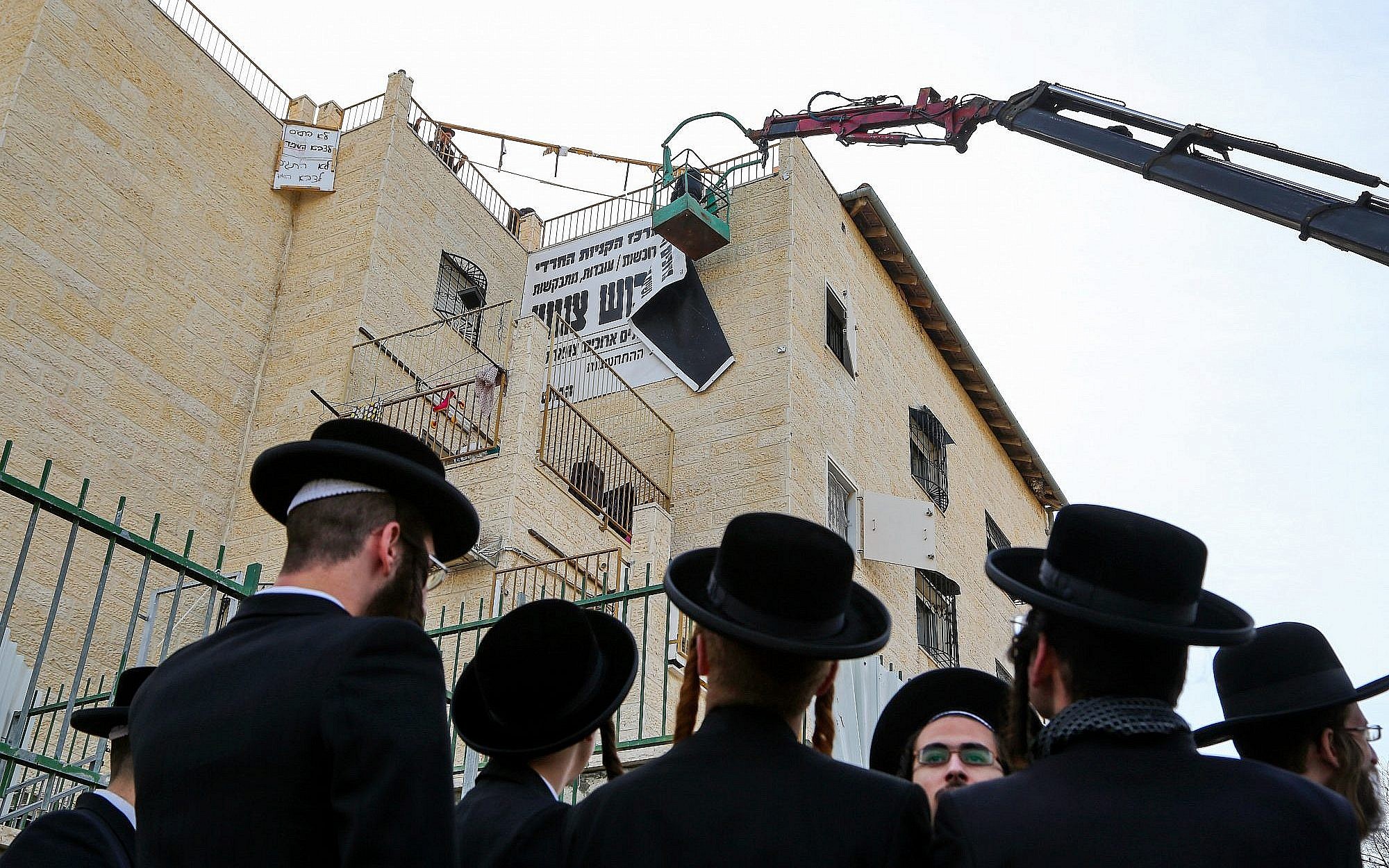
The municipality in the central Israeli city of Beit Shemesh began the court-ordered removal of “modesty” signs, leading to minor scuffles between police and ultra-Orthodox men.
The signs, which instruct men and women to walk on separate sides of the street, were ordered taken down last week by the High Court of Justice, which gave the municipality two weeks to remove them.
A large number of police officers were deployed Monday to escort the municipal workers tasked with taking down the signs from ultra-Orthodox residents protesting their removal. Video showed minor scuffles between police and the demonstrators.
The municipality said six out of a total of eight signs in the city’s ultra-Orthodox neighborhoods were taken down, but it was forced to cease their removal “due to violent disorderly conduct.”
Shortly after one of the signs was removed from Nahar Hayarden Street in the neighborhood of Ramat Beit Shemesh, spray-painted instructions appeared on a nearby wall ordering residents to keep the sidewalks gender segregated.
תגובת הקנאים בבית שמש להורדת שלטי הצניעות הבוקר pic.twitter.com/rFLeG46zOU
— מחאות החרדים (@mechaot_h) December 11, 2017
Last week’s court ruling came in response to an appeal by the municipality of a lower court order in July to remove the signs. The court ruled the signs, which the justices say exclude women from the public sphere, must come down by December 12, the Ynet news site reported.
Beit Shemesh, a city of some 110,000 people 19 miles west of Jerusalem, was to have been fined NIS 10,000 a day, nearly $3,000, for every day the signs remained posted.
In its appeal, the municipality said the signs demanding conformity to ultra-Orthodox dress are just “ideological signs.”

Beit Shemesh was first ordered to remove the signs in 2015, when the High Court said that they “cause serious harm to human dignity, equality, personal choice and autonomy,” Ynet reported.
Two years later, when the signs were not removed, the women who filed the original lawsuit turned to an administrative court to enforce the ruling.
Beit Shemesh has seen conflict between ultra-Orthodox, non-ultra-Orthodox and secular residents over restrictions on women’s dress and gender-segregated seating on public buses. In a widely publicized incident in 2011, an 8-year-old Orthodox girl was spat on by ultra-Orthodox men on her way to school for her perceived immodest dress.
JTA contributed to this report.










The Times of Israel Community.