

Catalonia braces for protests as separatist leaders held
Two senior members of independence movement face up to 15 years behind bars on sedition charges
 Add ToI as a Preferred Source on Google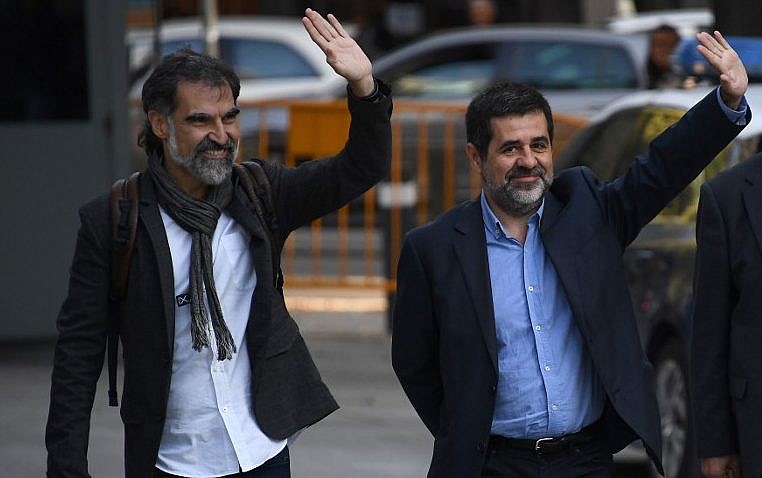
BARCELONA, Spain (AFP) — Catalonia braced for protests Tuesday after a judge ordered the detention of two powerful separatist leaders, further inflaming tensions in the crisis over the Spanish region’s chaotic independence referendum.
The National Court in Madrid moved late Monday to keep Jordi Cuixart and Jordi Sanchez behind bars on sedition charges, prompting hundreds of their supporters to take to the streets of Barcelona overnight in protest.
“Unfortunately, we have political prisoners again,” tweeted Catalan President Carles Puigdemont, whose standoff with the central government has shaken stock markets and sent ripples of anxiety through the European Union.
Cuixart and Sanchez are the leaders pro-independence citizens’ groups Omnium Cultural and the Catalan National Assembly (ANC) respectively, both of which count tens of thousands of members in the wealthy northeastern region and have emerged as influential players in the crisis.
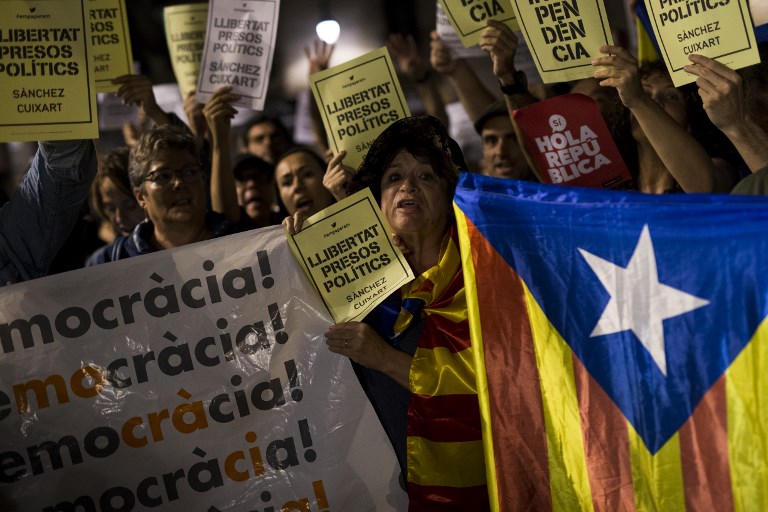
Omnium and the ANC called on workers across Catalonia to briefly down tools at noon in protest against the jailing of the pair nicknamed the “two Jordis,” with a candle-lit protest in central Barcelona due at 8:00 p.m.
Further protests were due in the afternoon in front of Spanish central government offices in four provincial Catalan capitals — Tarragona, Lleida, Gerona and Barcelona.
“If you’re watching this video, it’s because the state has decided to deny me my freedom,” Cuixart said in a message recorded before the court decision, adding that his organization would work “underground” if necessary.
He and Sanchez are accused of encouraging a major protest last month as Spanish police raided Catalan regional government offices in the run-up to the banned independence referendum on October 1.

Police officers were trapped for hours and their vehicles vandalized as protesters ringed the building, with Cuixart and Sanchez standing atop a police car calling for “permanent mobilization” against the Spanish state.
The crime of sedition can carry up to 15 years in prison.
Catalan police chief Josep Lluis Trapero, charged with the same offense, has been allowed to walk free but is banned from leaving Spain.

Enric Millo, the government’s representative in Barcelona, insisted that the judge’s decision had been made independently.
“There is a separation of powers here,” he told Catalunya Radio.
Economy takes a hit
Tuesday’s protests come as the central government and Puigdemont’s separatist regional administration fail to break the deadlock in Spain’s worst political crisis since it returned to democracy in 1977 following the death of dictator Francisco Franco.
Madrid had ordered Puigdemont to clarify by Monday whether he was declaring independence following the referendum, which resulted in a 90 percent Yes vote — although turnout was only 43 percent as many supporters of Spanish unity stayed away.
Puigdemont, however, stopped short of giving a definitive response and instead repeated his call for talks with Prime Minister Mariano Rajoy — who gave the Catalan leader three days to “return to legality” or face the consequences.
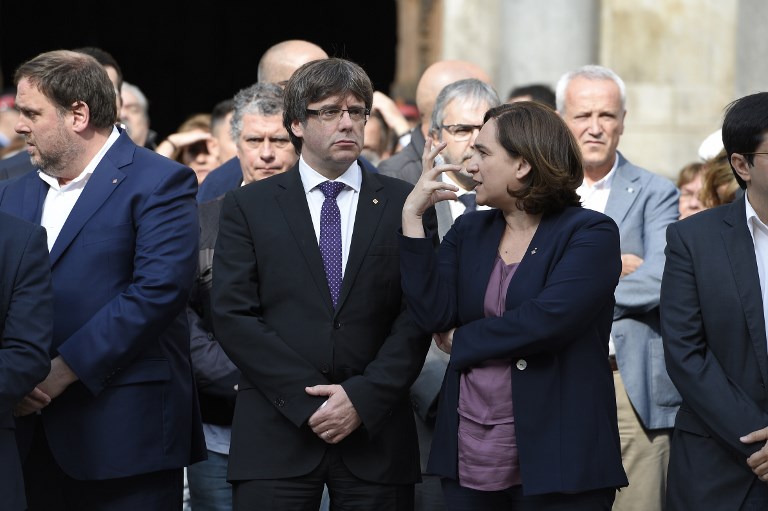
Anything less than a full climb-down from Puigdemont is likely to prompt moves by the central government to impose unprecedented direct control over the semi-autonomous region — the so-called “nuclear option.”
Madrid and its EU partners are worried that the prolonged uncertainty is damaging Spain’s economy as it emerges from the financial crisis.
The government announced late Monday that it was cutting its growth forecast for next year from 2.6 percent to 2.3% — partly over the standoff in Catalonia, which makes up about a fifth of Spain’s economic output.
Nearly 700 companies have moved their legal headquarters to other parts of Spain since the referendum, according to official figures, while ratings agency Standard and Poor’s has warned of a recession in the wealthy region if the crisis drags on.
With its own language and culture, Catalonia is proud of its autonomy but its 7.5 million people are deeply divided over whether to break definitively from the rest of Spain.
Supporters of independence say the region pays more into Spanish coffers than it gets back and could prosper by going it alone, but their opponents say secession would spell political and economic disaster.









The Times of Israel Community.