

Exit polls stir elation and trepidation for rising Joint List
Projections show mainly Arab party reaching as high as 15 seats, thanks to high turnout, but Likud close to forming right-wing coalition anyway, sowing unease
 Add ToI as a Preferred Source on Google
Adam Rasgon is a former Palestinian affairs reporter at The Times of Israel
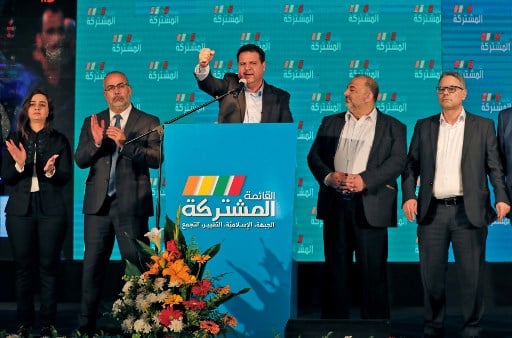
Leaders of the Joint List, an alliance of the four largest Arab-majority parties, cheered joyfully Monday evening after exit polls predicted that the results of the national elections would increase their representation in the Knesset.
But several Joint List officials also expressed concern about the possibility of Netanyahu cobbling together a right-wing government anyway following the final tally of votes.
Exit polls put the Joint List at a record 14-15 seats, up from the 13 it has now, but also gave Likud an astonishing 36-37 seats, leaving it and its right-wing partners just a seat or two shy of a governing coalition.
“The turnout for our public this time was the highest since 1999,” Joint List chairman Ayman Odeh said, speaking before a couple hundred Joint List supporters. “The number of seats we obtained was the most since the first Knesset elections until today — a major achievement.”
Aaed Kayal, a strategic adviser to the Joint List’s campaign, said the coalition estimated 65-66% of eligible Arab voters cast ballots.
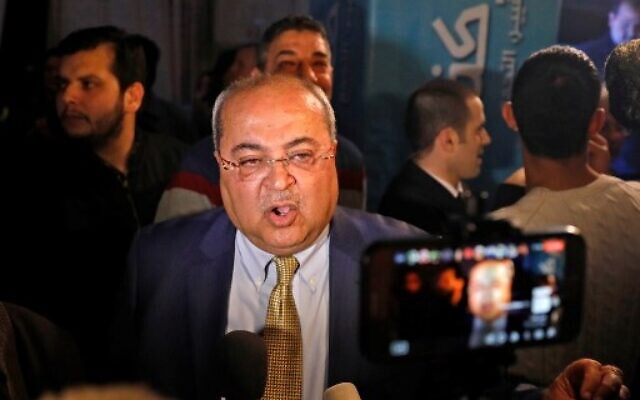
Ahmad Tibi, the Joint List’s third-highest ranking MK, said that the exit polls gave him “a complex feeling.”
“[The results] are a major success for the Joint List that executed the biggest election success in decades,” the lawmaker said, addressing the Joint List supporters.
“But there is the news about the right-wing bloc and the Likud and Benjamin Netanyahu’s accomplishment, which is worrying because if they obtain another seat overnight or from the soldiers, we will have arrived at a dark future,” he stated.
All the exit polls initially granted 60 seats to Likud and its right-wing allies, with the former receiving the largest number of mandates out of any party.
Early Tuesday morning, however, Channel 12 and Channel 13 updated their exit polls, giving the Likud and its right-wing allies 59 seats.
The final tally of votes, including those of soldiers, usually takes several days to determine.

Tibi also blamed Blue and White chief Benny Gantz and his party for “failing to repel Benjamin Netanyahu and the rise of the fascist bloc.”
The exit polls only gave between 32-34 mandates to Blue and White, and likely left it short of being able to pull together a coalition even with the Joint List’s support.
Ibrahim Hijazi, a leading member of the Joint List’s campaign, said that Gantz had made a strategic error in attempting to appeal to right-wing voters.
“Once he tried to enter Netanyahu’s playground, he had lost the battle,” he said in an interview. “He showed that he is a beginner. He should have stayed on the path he started on.”

In contrast to the last two elections in April and September 2019, Blue and White made a concerted and consistent effort to reach out to right-wing voters.
Hijazi said that he “definitely” was now concerned about the prospect of Netanyahu forming a right-wing government, but vowed that the Joint List and its supporters would take to the streets — if any Israeli government makes moves to annex parts of the West Bank or promote discriminatory policies.
Netanyahu has pledged to annex the parts of the West Bank in agreement with the US, whose recently revealed plan to resolve the Israeli-Palestinian conflict proposes giving it significant parts of the territory.
Kayal contended that the exit polls indicated that the Joint List’s campaign had succeeded.
“We did everything we could to succeed and reached out to several different groups across the spectrum, including Russians, Ethiopians, Haredim and others,” he said.






The Times of Israel Community.