

How the Exodus story subverts pharaonic texts to mock ancient Egypt
According to Bar-Ilan University’s Joshua Berman, who curated the new hagaddah ‘Echoes of Egypt,’ the biblical narrative ‘culturally appropriates’ facets of Egyptian culture — by design
 Add ToI as a Preferred Source on Google
Rossella Tercatin is The Times of Israel's archaeology and religions reporter.

On Wednesday at nightfall, Jews across the world were gathering around the seder table to celebrate the liberation of the Jewish people from slavery in Egypt, and how God saved them with “a mighty hand and an outstretched arm.”
The words come from the Torah’s description of the Exodus from Egypt and are repeated multiple times in the text of the haggadah, the book featuring the liturgy of the special Passover meal, the seder (Hebrew for “order”): “God freed us from Egypt by a mighty hand, by an outstretched arm and awesome power, and by signs and portents,” reads Deuteronomy 26:8 (translation by JPS).
But what if, hypothesizes Prof. Joshua Berman of the Zalman Shamir Department of Bible at Bar-Ilan University, the biblical tale was mockingly subverting an earlier Egyptian text?
“[In Egyptian sources, there are references to how] Pharaoh defeated his enemies, the Libyans to the west, with a mighty hand, or Pharaoh was walking and he discovered at his feet a diamond the size of his fist, and he picked it up with his outstretched arm,” said Berman, who hosts the university’s “Bible Bar” podcast.
“There are hundreds of references like these. It is clear that what the Torah is doing here is what we call ‘cultural appropriation,’ stealing the thunder of your opponent.”
According to Berman, one could expect the same wording to be used in many situations in which God performs miracles or saves the Israelites from their enemies. Yet it is not; it appears only in the context of the Exodus.
In the new “Echoes of Egypt: A Haggada,” curated by Berman and recently published by Koren, the scholar argues that the term “a mighty hand and outstretched arm” represents just one of the many examples where the Torah seems to employ tools of the Egyptian narrative or propaganda and use them against the very people who enslaved the ancient Israelites.
“Go tune into what was happening in Egypt when Israel was there,” Berman told The Times of Israel over a video interview.
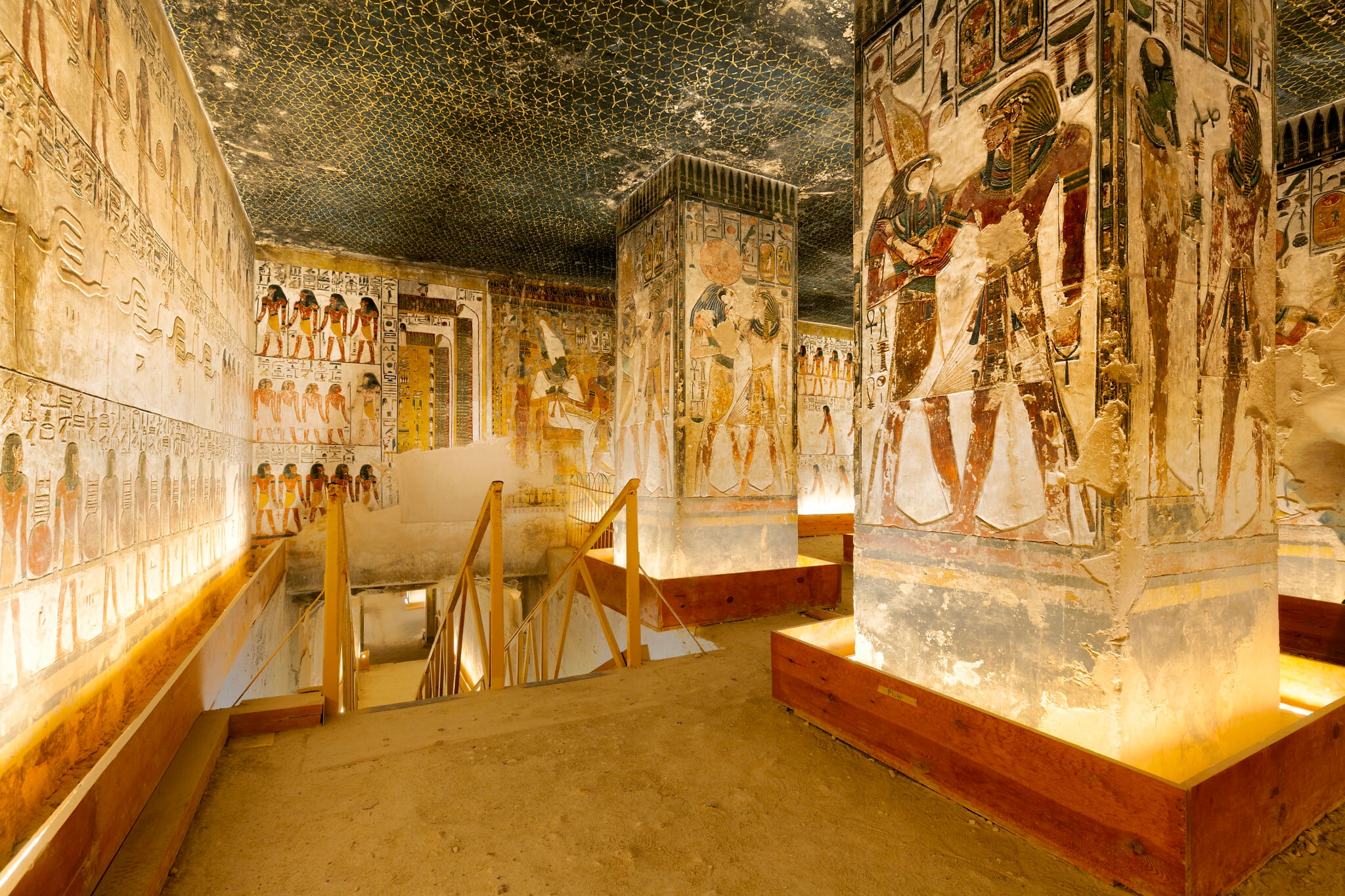
In the academic world, some believe that the Israelites’ slavery and Exodus from Egypt never took place, while others suggest several possible datings. For Berman, the events occurred around roughly 1500 and 1200 BCE.
“I follow the school of thought according to which the pharaoh of enslavement was Rameses II [circa 1279–1213 BCE], and the pharaoh of the plagues and of the Exodus is Merneptah [c. 1213–03 BCE],” Berman said.
“The precise dates are not so important, but we are certainly talking about what is known as the Egyptian New Kingdom, the zenith of Egyptian civilization,” he explained.
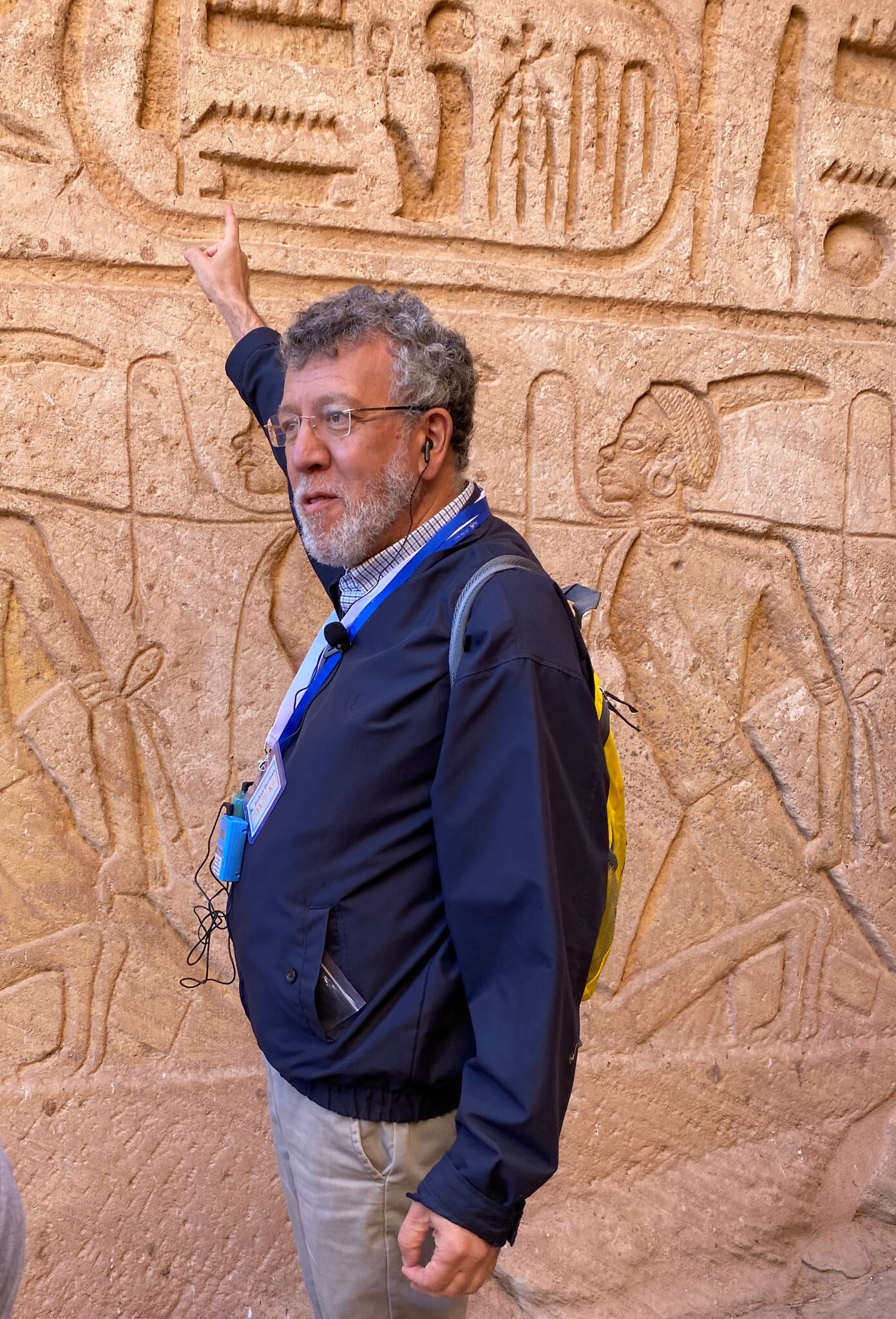
“Echoes of Egypt,” which includes both the Hebrew text and the English translation and commentary, is the result of several years of research into the influence of Egyptian culture on the history of the Exodus and the Passover celebration, also through the use of pictures and illustrations, which, according to Berman, are one of the pillars of the work.
“There had never been a haggadah that tried to investigate what the world in which our forefathers resided in Egypt was like,” Berman said. “What were the pharaohs like? What was servitude like? What are the polemics that the Torah engages in against Egyptian theology?”
For Berman, part of the motivation for this work was also trying to bridge what he described as a gap many experience between their faith and their intellect.
“A lot of people live a kind of bifurcated spiritual existence,” he argued. “There is a part of them that is religious and experiences the rituals, at synagogue, at home, and especially at the seder. Then there is the other side, their intellectual seriousness, academic, and historical thinking. For many, it’s not clear that these two worlds merge in any way.”
According to the scholar, for a lot of people, keeping their spirituality alive means feeling forced to set aside their intellectual side.
“It does not work,” he said. “I don’t live this way, and all my work is dedicated to fusing those parts of our identity.”
Face-to-face with… plagiarized paganism?
According to Berman, another echo of Egyptian imagery in the Torah appears when Moses recalls God giving the Israelites the Ten Commandments at Mount Sinai.
“Face to face God spoke to you on the mountain out of the fire,” reads Deuteronomy 5:4 (translation by JPS).
“Elsewhere in the Torah, we read that it is not possible for a person to see God and live,” Berman noted. “So how can Moses describe this encounter as ‘face to face’? Because this is how the Egyptians depicted the pharaohs and the gods.”
The scholar pointed out how in hundreds of images, Egyptians kings and gods are portrayed in identical sizes, with similar facial features, looking at each other and embracing.
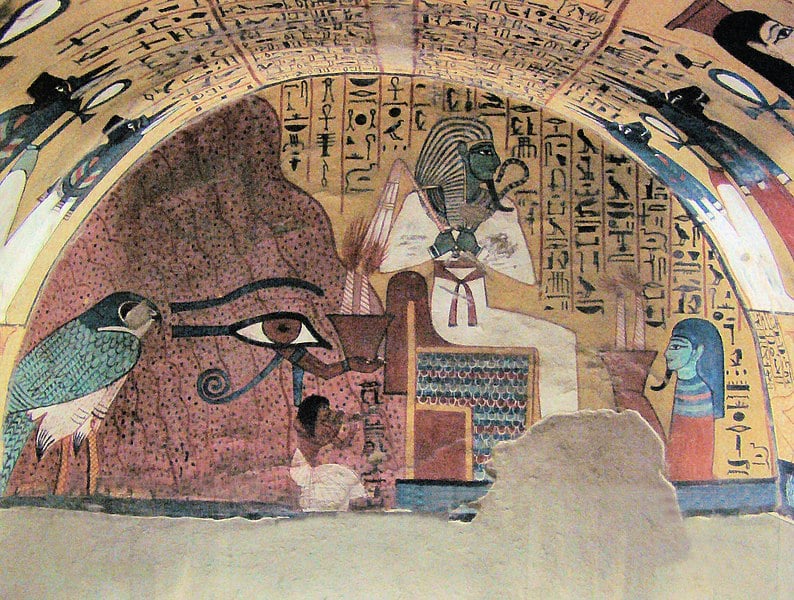
One of such images, featuring a relief of Pharaoh Seti I (13th century BCE) and the goddess Hathor, from the tomb of Sethi I, appears on the haggadah cover.
Berman explained that the Torah twists the image by giving the whole people of Israel a status similar to that of kings.
“These images, which were ubiquitous throughout Egypt, were designed to demonstrate the chosenness of the pharaohs, how beloved the pharaohs were to the gods,” he said. “Along comes the Torah and says, ‘God is not interested in the powerful, God is interested in the common people, and he looks at you face to face in the way that you saw in hundreds of images around you when you were slaves in Egypt.’”
According to the scholar, another Egyptian symbol of power that was used in the Exodus was Moses’ shepherd’s crook, which he employed to perform miracles.
“A shepherd’s crook is a super iconic image in ancient Egypt,” Berman said. “The image of pharaohs with their arms crossed, holding a shepherd’s crook, is ubiquitous. That is the symbol of his authority and governance.”
A biblical name for Egypt

Berman also explores the meaning of the Hebrew word for Egypt, “Mizraim,” which is also similar to the modern Arabic name of the country, “Mizr.”
“Mizraim is not an ancient Egyptian word,” Berman noted. “Several scholars believe that the country is actually called this way because one of the earliest communities in Egypt, the Coptic [Christians], translated the Bible into Coptic. In the case of the name of the country, they transliterated it, and the name remained even after the Muslim conquest [in the 7th century CE].”
The meaning of the name, according to the scholar, derives from the Aramaic word “mizrah,” which means the boundary of the civilized world.
“In ancient times, the Nile was the boundary because after that, you had the Sahara desert,” he said. “You could not travel more than 40 miles from it on a donkey if you wanted [to have enough water] to come back.”
Berman explained that he really wanted to show the concept through an image and ended up finding, he said, one of his favorite pictures in the haggadah.
“I was enchanted by this idea that Egyptians call their country Mizr because of the Torah, but how was I going to bring this alive? Then I found this great image [of Egypt at night] from NASA. There you see that Egypt is a shoestring because everybody lives along the Nile, and west of the Nile is pitch black, even to this day. The Nile is still the edge of the world.”

During his research, Berman personally traveled to Egypt several times and explored artifacts and sources that might be relevant for the haggadah.
In his trips, he had the opportunity to see firsthand the archaeological artifact carrying the earliest reference to the people of Israel ever discovered, the Merneptah Stele (circa 1206 BCE), on display in a museum in Cairo.

“In the stele, Merneptah describes the battles he had with various enemies, and in one little line at the end, he says, ‘I went to Canaan, and I defeated Gezer, and I defeated Yoknam, and Israel, his seed shall be no more,’” Berman said.
“Egyptologist Frank Yurco noticed that in ancient Egyptian, political entities, national entities, cities are always feminine, but Israel is male, and the reference to ‘his seed’ is also male. According to Yurko, this could be because the children of Israel referred to themselves as the descendants of a forefather, Israel [the name given by God to biblical patriarch Jacob], and the Egyptians knew the person Israel as a man.”
Berman emphasized how much it meant for him to be in the same room with the artifact.
“To see, with your own eyes, Israel spelled in this high relief, takes the mythic and makes it real,” he said.









The Times of Israel Community.