

Iconic gold-encrusted Haggadah goes on display in Jerusalem for the first time
Original manuscript of the renowned Passover text created by artist David Moss is exhibited at the National Library of Israel
 Add ToI as a Preferred Source on Google
Rossella Tercatin is The Times of Israel's archaeology and religions reporter.
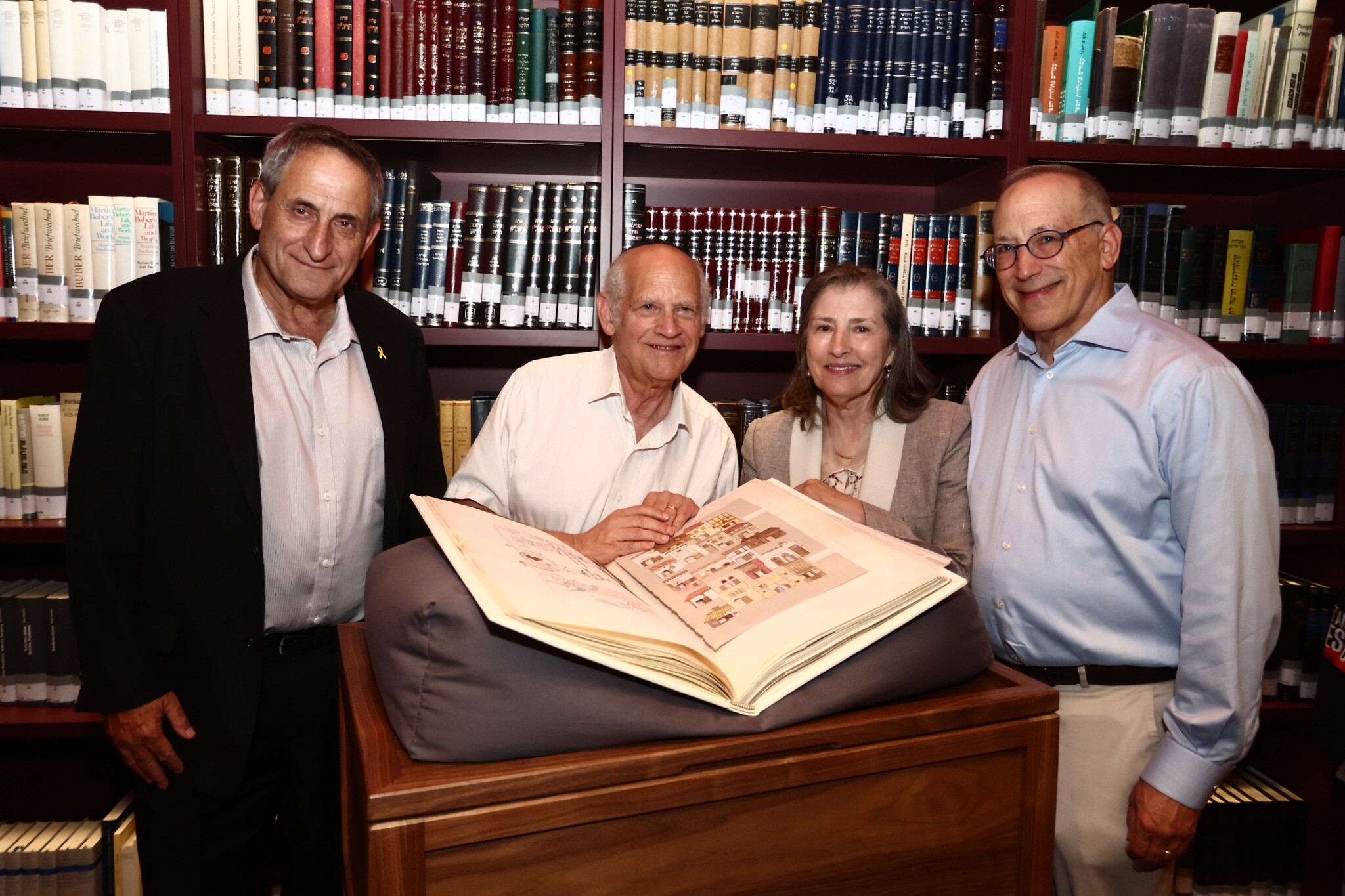
The original manuscript of the renowned Moss Haggadah, with its decoration featuring gold leaves, inlaid mirrors, parchment cuts, egg tempera and natural pigments, is on display for the first time at the National Library of Israel in Jerusalem, the library announced on Monday.
In 1980, a Jewish family from Florida asked Judaica artist David Moss to create a new Haggadah. Over the years, it became a beloved edition of the collection of texts read during the Passover Seder, reprinted in hundreds of copies and exhibited, among other venues, at the Library of Congress and the New York Public Library. US president Ronald Reagan donated a copy of the Moss Haggadah to his Israeli counterpart, Chaim Herzog, during a state visit in 1987.
“I began the Haggadah in Jerusalem, knowing well that it would be sent into the Diaspora, but even over 40 years ago, I had a strong desire that somehow, sometime, my manuscript would return to Jerusalem,” Moss recently told the NLI publication The Librarians. “So, of course, it was an unimaginable thrill to actually witness the return of the Haggadah back to Jerusalem.”
In 1980, Moss was living in San Francisco, but he started spending extended periods in Israel for his research ahead of the project (including at the National Library to familiarize himself with historical Haggadot).
By 1983, he moved to Jerusalem, where he has lived ever since.
When Moss was faced with the challenge of creating the new Haggadah, he knew that one of the fundamental principles of the Jewish holiday of Passover was for everyone to see themselves as if they were the ones liberated from Egypt.

“LeDor VaDor, Generation by generation, each person must see himself as if he himself had come out of Egypt,” reads an excerpt of the Haggadah. “It was not only our ancestors whom the Holy One redeemed; He redeemed us too, along with them.”
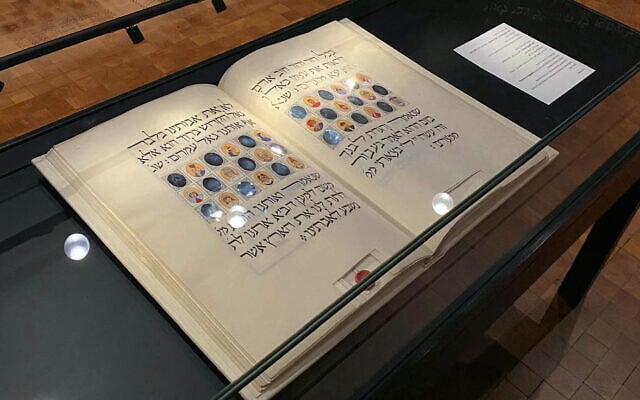
Moss wanted his work to physically embody the concept. Therefore, the relevant pages carrying the text are decorated with miniature portraits of 18 Jewish men and women from different times interpolated by 18 small mirrors.

“The reader now is facing all the mirrors and actually sees him or herself reflected dozens of times between and among the historical Jews, literally exemplifying the texts,” he told The Librarians.
The Levy family, who commissioned the Haggadah, only required that it be large in format, with the final manuscript measuring 45,8 x 29,2 centimeters (18 x 11½ inches). Its size allows NLI visitors to see themselves reflected in the text, as the Haggadah rests open on the LeDov VaDor pages.
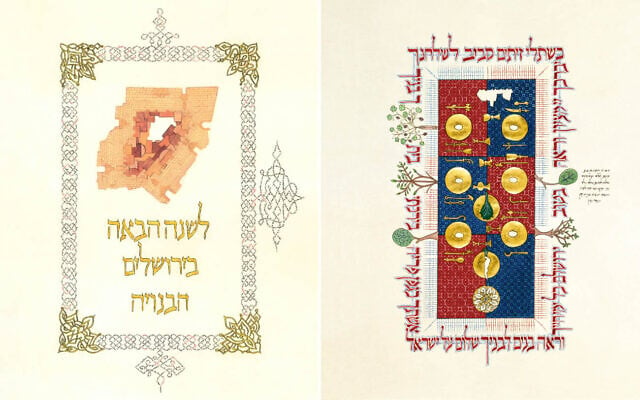
To create the manuscript, Moss used a variety of techniques, choosing the method he believed was the most suitable to express a notion or illustrate a passage of the text. These techniques included calligraphy, micrography, painted miniatures and designs using pigments, acrylics, parchment cuts and burnished gold leaves.
“I basically wanted to allow the text itself to reveal new insights, unique ways of approaching the text, fresh insights that had never been done before,” the artist told The Librarians.
In one case, he used silhouettes on both sides of one page.
“The silhouettes are identical, but the first side of the page shows the slavery in Egypt. When turned, the same cut-out silhouettes show the baking of the matzah: divine service,” he said.
The manuscript was donated to the NLI by philanthropists Trudy Elbaum Gottesman and Robert Gottesman in August.
“The Moss Haggadah has a dual significance,” Dr. Chaim Neria, curator of the NLI Haim and Hanna Solomon Judaica Collection, said in a statement. “It is both a commentary on the traditional text and, at the same time, a commentary on our collective historical memory and its meaning.”









The Times of Israel Community.