

In a bad place
The plight of people in Gaza (and Yemen and Houston) takes center stage, but who in Gaza needs more help remains up for debate
- See more Times of Israel on Google - add us as a Preferred Source
Joshua Davidovich is The Times of Israel's Deputy Editor
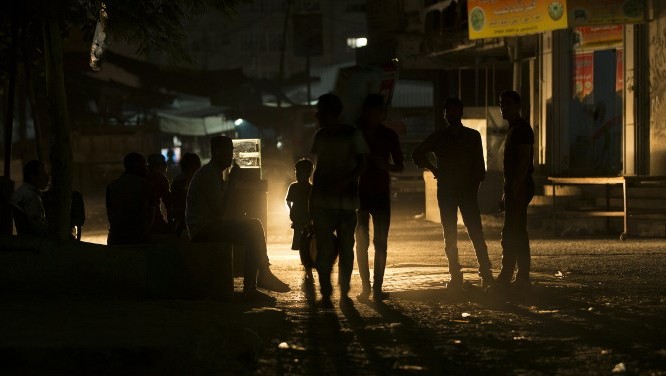
Efforts to save people in dire conditions in the Gaza Strip (and elsewhere) are the center of attention in Israel’s major Hebrew dailies Monday morning, but papers are far from in agreement about who it is that needs help.
While both Israel Hayom and Yedioth Ahronoth focus on fighting between the families of two soldiers whose bodies are being held by Hamas in the Strip and Defense Minister Avigdor Liberman and the government, Haaretz’s lead story deals with UN chief Antonio Guterres being expected to press Prime Minister Benjamin Netanyahu on easing hardship conditions in the Palestinian enclave.
Most of Israel Hayom’s front page is occupied by a column by Yoav Limor taking up the cause of the families of Hadar Goldin and Oron Shaul and calling for the government to repair frayed ties with them and appoint a new coordinator to head up efforts to negotiate their release after the last person suddenly quit last week. (Nearly forgotten are three living Israelis also being held in Gaza who have the misfortune of not being soldiers).
Limor writes that the Leah Goldin’s claim that the the government refused to give backing to Lior Lotan, who was heading up the government’s efforts to negotiate for those held in Gaza, should be a red flag, and that her anger is justified. But he also says that Israel needs to act smartly and not only with its gut, making sure that families accept that their children are not still alive, which could end up giving the captors wiggle room to raise the price.
“There is an immediate need to repair the rift with the families and to appoint a new negotiator, experienced, expert and sensitive, who will hear them out and give them a voice and involve them in the decision making process. The unwritten golden rule in Israel says that you don’t argue with bereaved parents since they paid the ultimate price, but that doesn’t mean you have to agree with them or do everything they demand; on the other hand, the idea that Israel will ‘do everything’ needs to be valid, certainly worth something, for those sent to fight, and no less so for those who will sent to fight in the future,” he writes.

Yedioth reports that the sudden departure of Lotan could harm already stagnating efforts to free the bodies and the others. The paper leads off its news coverage not with the Goldins but with Liberman’s comment that Israel can’t do another deal like it did for Gilad Shalit — giving up over 1,000 prisoners for one soldier — calling the argument between Liberman and the Goldins “heartbreaking.”
Columnist Shlomo Pyoterovsky also sides with the bereaved families, saying Liberman’s comments built up a straw man, as neither family has called for a deal that is unreasonable, and that there are other ways of dealing with the problem.
“As opposed to Liberman’s spin, one doesn’t need to give in to Hamas to get the boys back. Israel has many methods of putting pressure on Hamas — you just need the courage do to it. But the defense minister, who [once] threatened to assassinate Ismail Haniyeh in 48 hours if the sons are not returned, is seemingly unable to take even the simplest steps,” he writes, flubbing Liberman’s actual threat to take out the Hamas leader 48 hours after the first rocket. “So he turns to the spin machine.”
Pyotorevsky doesn’t detail what kind of pressure he’s talking about, likely because it’s probably terrible things that will make life in Gaza hellish. That’s not to say it’s all peaches and roses in the Strip now, and Haaretz leads off with a report that Guterres, the UN chief, will make putting pressure on Israel and the Palestinians Authority to ease pressure on Gaza a central tenet of his trip here.
“An Israeli official said one of Guterres’ main objectives on this tour is the visit to Gaza, where he will look into the worsening humanitarian situation. He is expected to demand that Israel allow a greater number of Palestinians requiring medical assistance in Israeli hospitals to enter from Gaza. Guterres is also likely to ask for an increase in the amount of goods Israel allows into the Strip,” the paper reports.
Haaretz also looks at the fate of a place that may be even worse off than Gaza yet has been flying beneath the radar: Yemen, which it reports is dying a slow death thanks to the civil war there.
Columnist Zvi Bar’el notes that Yemen should be more important strategically than Syria, but for some reason is not considered so, leaving it in the trash heap of the garbage bin of history.
“Ostensibly, Yemen is a much more important arena than Syria, especially because of its geographical location and its control over the entrance to the Red Sea. But control over Syria gives a direct or indirect ruler access to the entire Middle East. Neither country is an oil or gas superpower, neither has precious natural resources, outside of the Yemen-grown drug khat and the best honey in the world, which Yemen produced until the war started. Syria doesn’t even have these resources,” he writes. “And yet Syria has managed to maintain the image of a tempting country strategically speaking, while Yemen is considered marginal, in need only of a small fleet to keep the Red Sea open. This is the reason for Yemen’s status as a country worthy of rehabilitation and assistance. In contrast, humanitarian aid to the citizens of Syria is an inseparable part of the political discussions, while Yemen is considered a bottomless pit. That is the tragedy of its 27 million citizens, who have almost no diplomatic leverage with the international community.”
All my ex-pats live in Texas
The attention paid to both Syria over Yemen and the dead Israeli soldiers over alive minorities held in Gaza points to a well-documented trend of coverage being biased toward white tragedy. That is also the reason why Hurricane Harvey wreaking havoc on a city thousands of miles away gets oodles more coverage in the Israeli press than much worse natural disasters hitting third world countries.
Pictures of flooded Houston streets loom large on the front pages of both Haaretz and Yedioth, though in Israel Hayom, they have already moved on to “the day after,” burying a small story deep inside the tabloid.
It’s not just sad for Texans, though. As anyone who has been to Houston or the beach cities dotting the Gulf Coast knows, you can’t throw a lasso without hitting an Israeli. Yedioth includes a short item on all the ex-pats living in Texas, some 10,000 in the Houston area by its count, who are in dire need of help. (Though an accompanying picture of a flooded bathroom looks like it was taken in Israel, judging by the tiling and products visible).
“We awoke to a morning of flooding. There’s no electricity and cars are strewn about the road,” one Israeli is quoted saying. “The Jewish community has been very hard hit, but through the consulate Israelis whose homes are damaged are being evacuated to Dallas.”








The Times of Israel Community.