

In crowdsourcing for weddings, new methods for an old idea
It has always taken a village to get married, it’s just that now the village looks quite different
- See more Times of Israel on Google - add us as a Preferred Source
NEW YORK (JTA) — When Amanda Melpolder began planning her wedding to Jeff Greenberg, she hoped the ceremony would be unlike others.
Melpolder had become involved in an independent minyan in Brooklyn after converting to Judaism several years ago, and she and Greenberg wanted their their wedding this June to reflect the prayer group’s community spirit and sense of do-it-yourself camaraderie.
Friends were asked to lead prayers and narrate the signing of the ketubah, or marriage contract. Melpolder, a chef, solicited recipes from guests that would be bound in a souvenir cookbook. Assignments were given to friends based on personalities and interests.
“Since our Jewish community is one that we created and are actively part of, it made sense that our wedding would be the same theme, with people leading different parts of the ceremony,” Melpolder said.
Such participatory approaches to wedding planning might seem like a feature of the information age but may be just the latest incarnation of an older Jewish tradition.
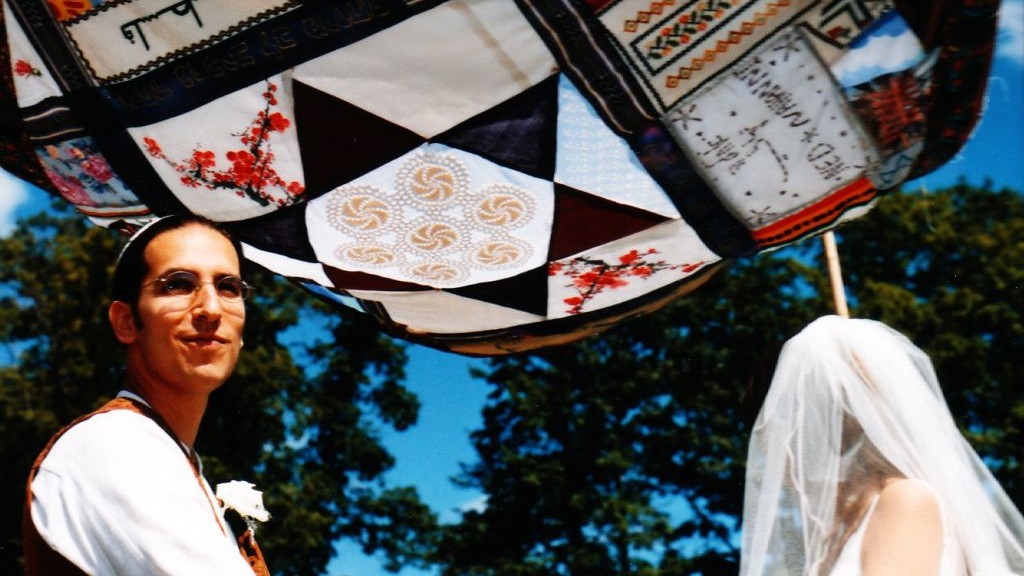
“The word ‘crowdsourcing’ is a new word for an old thing,” said artist Nahanni Rous, who creates custom chuppahs, or wedding canopies.
“We are pretending that we just invented this idea of the shtetl. It’s like everybody would come to the wedding, and that was how a community got together to celebrate.”
In other words, it has always taken a village. It’s just that now the village looks quite different.
Based in Washington, DC, Rous often incorporates crowdsourcing into her work, such as asking friends to submit fabric swatches.
Her chuppah-making career began, appropriately enough, at her own wedding. She and husband Ned Lazarus, who met in Israel and married in 2004, had two ceremonies, in Jerusalem and New Hampshire, to accommodate friends in far-flung locales. Each guest was asked to bring fabric that was pinned to a sheet at the wedding.
‘We had everything from a kippah with a Magen David knitted on it to a Palestinian flag to a piece of someone’s wedding dress and a map’
“We had people from every region of Israel and the Palestinian territories at the ceremony. We had everything from a kippah with a Magen David knitted on it to a Palestinian flag to a piece of someone’s wedding dress and a map,” Rous said. “It was a really beautiful hodgepodge.”
Since then, Rous has worked with couples to create custom chuppahs, incorporating everything from traditional Jewish symbols to quotes from poets such as e.e. cummings and Pablo Neruda. Some of her clients aren’t even Jewish but like the concept of the chuppah.
In some cases, crowdsourcing is a way to make guests feel more involved in a ceremony, but it can also be a way to make logistics a little easier for the bride and groom.
When Caroline Waxler and Michael Levitt married last summer, they came up with a Twitter hashtag for their wedding guests. Waxler, who runs a digital strategy company, knew her tech-obsessed friends would be tweeting photos from the ceremony and reception.
With the hashtag #waxlevittwedding, she was able to find them easily.
“When you’re making a commitment in public to one other person, it’s kind of also a reminder that in your life you are supported by people, not just by one other person,” Rous said.
While crowdsourcing methods can make family and friends feel more involved in the wedding, Melpolder admits that she may have other reasons for making the big day a little more social.
“I really hope someone hooks up at our wedding,” she said.









The Times of Israel Community.