

In Turkey, ‘World War Z’ is no World War Zion
The summer zombie blockbuster, which opened June 21 in the US, is the greatest piece of cinematic propaganda for Israel since ‘Exodus.’ So how come one version censors references to the Jewish state?
 Add ToI as a Preferred Source on Google
Jordan Hoffman, a member of the New York Film Critics Circle, is The Times of Israel's long-time film reviewer and the co-host of The Reel Schmooze.

NEW YORK — “Go to Israel!” orders the half-mad CIA agent offering key plot breadcrumbs from behind bars in “World War Z,” the $200 million behemoth action picture (and would-be franchise) from Brad Pitt and Paramount Pictures, (very) loosely based on Max Brooks’s bestseller.
Pitt is a UN specialist (his exact function is a little vague) on the hunt for Patient Zero in the zombie plague that has turned the world’s major cities into war zones of frenetically paced, flesh-chomping zombies. His ordeal takes him from the pit of hell (dramatized for the screen as Newark, New Jersey, naturally) to the last civilization left standing: Jerusalem.
For a solid 10-minute stretch, “World War Z” is the greatest piece of cinematic propaganda for Israel since Otto Preminger’s “Exodus.” While the rest of the world has fallen to cinders, Israel survives. After Pitt’s plane narrowly escapes doom during a bloody action set piece, he touches down at Atarot Airport. The Israeli flag, shown in glorifying closeup, ripples proudly in a sun-dappled halo.
Pitt gets an audience with the Mossad chief (played by Ludi Boeken), who explains that Israel sprang into action when it first caught wind of the potential zombie threat. It built enormous walls in a matter of days, adding to Jerusalem’s pre-existing historical defenses.
While the rest of the world has fallen to cinders, Israel survives
Boeken explains how the Jewish people were slow to respond in Europe during the 1930s, equivocated during the escalation of Arab armaments in 1973 and paid for it both times. Now, a system exists where 10 high-ranking individuals are pooled to take every threat seriously. If nine agree to dismiss it, it is the duty of the tenth person to investigate further, even if it seems foolish. Boeken’s character was prompted to take a stray message from India about “the undead” seriously, and this effort granted them the time to act.
Boeken takes Pitt on a tour, where we see, in sweeping wide shots, the effectiveness of the Israeli military. Jerusalem is the only safe zone in the world and they are feverishly processing and accepting as many survivors of the zombie plague as they can. “Each person we save is one less we have to fight.”
The film makes every effort to show that it is a diverse crowd. Haredim, secular Jews, Muslim women holding Palestinian flags.
So, now the punchline (spoiler alert!).
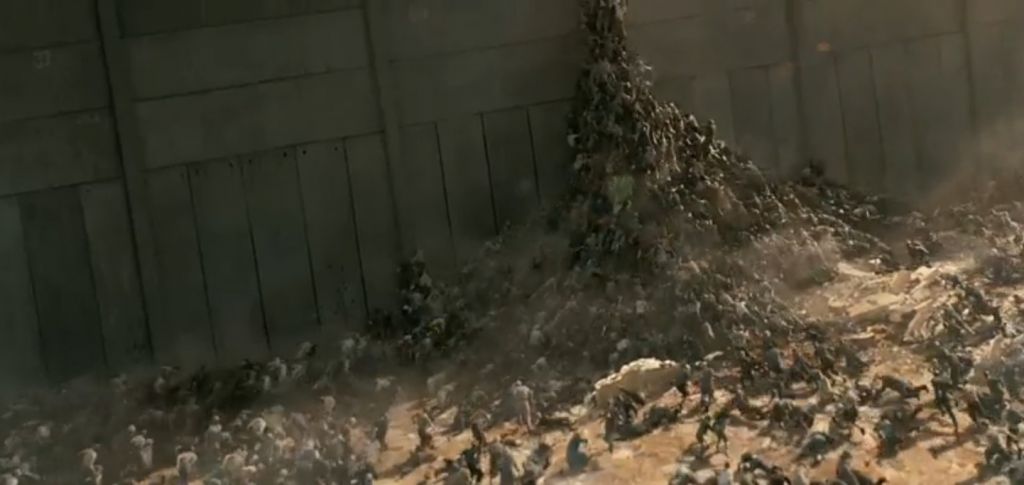
The zombies are drawn by sound. This big kumbaya moment leads the gathered, multicultural crowd to start singing. This joyous cherished vision of unity and peace – an image the whole world has been waiting for – is what winds up leading to the DESTRUCTION OF THE CITY.
The zombies hear the singing (and its amplifier feedback), create a pyramid of snarling, undead bodies, climb the wall and start killing.
Basically, if it weren’t for those damn peaceniks, Israel would have survived. Hey, who the hell wrote this movie, Meir Kahane?
Okay, so Israel falls to the zombie plague, too. But… at least it lasted longer than everybody else. That has to stand for something, right? Plus, when Pitt makes his brave escape to head to the next location in this globe-hopping movie, he takes Daniella Kertesz as the brave, beautiful and badass IDF soldier along with him. (“Get him to the Jaffa Gate!” she shouts to her fellow soldiers.)
The world audience at least gets to see how Israel puts up a good fight, and despite the destruction one could still read it as something of good, fun PR on an international scale.

That is, until we get to the even bigger punchline.
According to the bilingual Istanbul-based film critic Ali Arikan, the Turkish version changes spoken references of the word Israel to read “Middle East” in the subtitles.
They still land in a recognizable Jerusalem (the movie was actually shot in Malta, but inserts make it appear as Jerusalem) but when the English supertitle reads “Jerusalem,” the Turkish one beneath it again repeats the phrase “Middle East.” The shot of the Israeli flag remains, but even when the action is in Jerusalem and someone refers to Israel it is just called “Middle East.”
Arikan reached out the company distributing the film in Turkey (United International Pictures, which is co-owned by Universal Pictures and Paramount), which said that the subtitles and translation came its way from Paramount.
A contact at Paramount said he was “unable to go on the record to discuss local translations.”
“World War Z” opens in the US on June 21 and in Israel on June 27.






The Times of Israel Community.