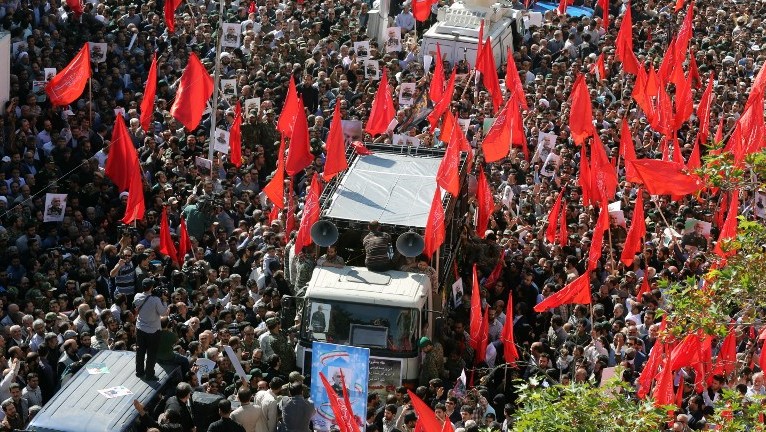
Illustrative: Iranians follow a vehicle carrying the coffin of Iran's Revolutionary Guards Corps Brigadier General Hossein Hamedani during his funeral procession in Tehran on October 11, 2015. (AFP/Atta Kenare)
TEHRAN — A senior Iranian Revolutionary Guards Corps commander has been killed during fighting in Syria, Iran’s state media reported on Tuesday.
“Brigadier General Abdollah Khosravi, a senior war veteran, was martyred on Saturday in Syria,” the Basij news agency said without giving further details.
According to Fars news agency, Khosravi was commander of the Fatehin Battalion, made up of Iranian volunteers fighting in Iraq and Syria.
Its members are drawn from the powerful Basij militia, a volunteer force linked to the IRGC and sometimes used for domestic security inside Iran.
Tehran supports Syrian President Bashar Assad and Iran-backed forces have been on the front lines in battles against insurgents including the Islamic State jihadist group.
Iran denies sending professional troops to fight in Iraq and Syria, saying it has only provided military advisers and organized brigades made up of volunteers from Iran, Afghanistan and Pakistan.
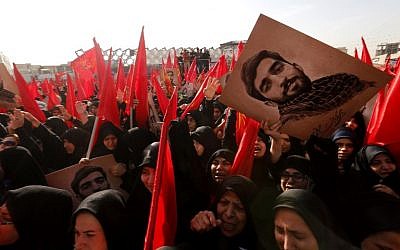
Mourners raise portraits of Mohsen Hojajii, a member of the Iranian Revolutionary Guard Corps beheaded in Syria by the Islamic State, during a funerary procession for him at Imam Hossein Square in the capital Tehran on September 27, 2017. (AFP Photo/Atta Kenare)
Khosravi will be buried in his home town of Arak in central Iran on Thursday, along with Afghan recruit Javid Hosseini, state broadcaster IRIB said.
Advertisement
Iranian media regularly report on the funerals of Iranian, Afghan and Pakistani “martyrs” killed in fighting in Syria.
Authorities rarely issue official casualty figures.
The most recent death toll, from the veterans’ organization in March, was 2,100. It gave no details on how many were foreign recruits.
Help us report truthfully on social media
As a multimedia journalist, my job is to take the quality, fact-based journalism produced by The Times of Israel newsroom and make it accessible across every platform — from Instagram posts to podcasts to short-form videos.
This is how many, especially young people, consume news these days. But misinformation is rampant on social media. Our team at ToI produces accurate, responsible short-form reporting on Israel and the Jewish world.
If you believe in the importance of factual social media journalism, please consider joining our reader support group, The Times of Israel Community. Your financial support is essential to sustain responsible multimedia reporting.
We’re really pleased that you’ve read X Times of Israel articles in the past month.
That’s why we started the Times of Israel - to provide discerning readers like you with must-read coverage of Israel and the Jewish world.
So now we have a request. Unlike other news outlets, we haven’t put up a paywall. But as the journalism we do is costly, we invite readers for whom The Times of Israel has become important to help support our work by joining The Times of Israel Community.
For as little as $6 a month you can help support our quality journalism while enjoying The Times of Israel AD-FREE, as well as accessing exclusive content available only to Times of Israel Community members.
Thank you, David Horovitz, Founding Editor of The Times of Israel


 Add ToI as a Preferred Source on Google