

Iron Dome or iron dim?
As the army announces plans to thwart Gaza’s tunner threat with a technological solution, papers disagree on whether the system can really provide security
 Add ToI as a Preferred Source on Google
Joshua Davidovich is The Times of Israel's Deputy Editor
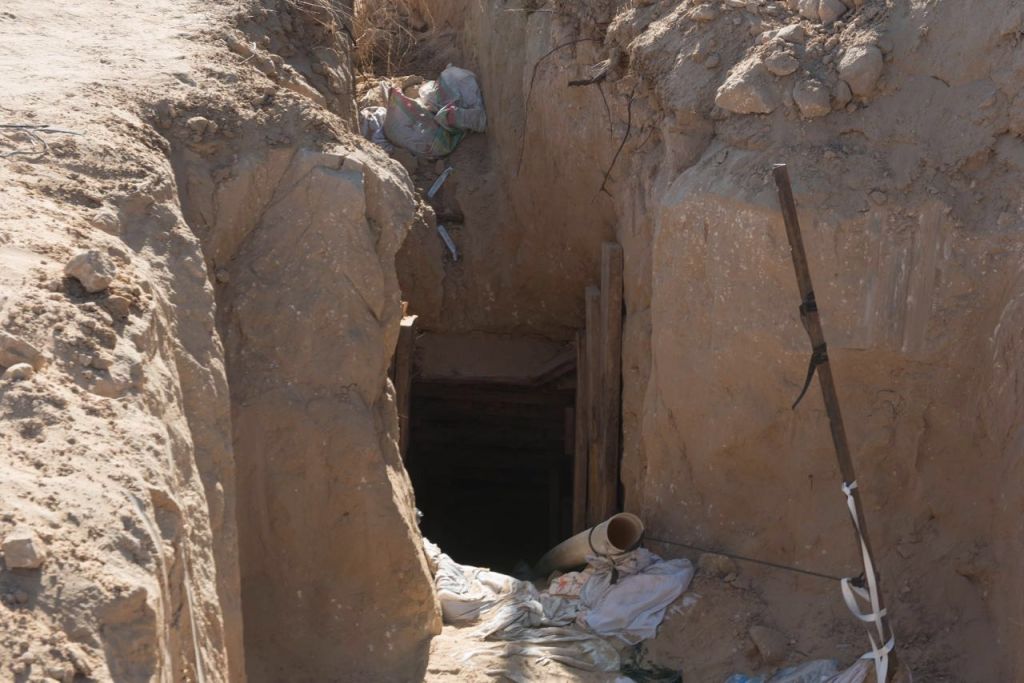
When you are in power, there’s nothing good that ever comes with the word underground. From the Weather Underground and other underground resistance movements to bunkers you only scramble to when the country is in trouble, the down below can be an ominous place.
Perhaps nowhere is this more true than Israel of late, where the underground threat has taken on a very real form in areas bordering the Gaza Strip (and maybe the north, if certain reports can be believed.
Thus it’s little surprise that two days after it was announced a tunnel was uncovered emanating from the Strip into Israel, the issue remains high on the news agenda Wednesday morning, buffeted by the untimely death of silver screen luminary Ronit Elkabetz and a smattering of other news stories, like primaries in New York, a massive diamond embezzlement scam in Ramat Gan and a Tel Aviv rally for a soldier accused of killing a wounded Palestinian that was more underground — i.e., less popular — than organizers may have liked.
But even if the media is united around continuing coverage of the tunnel threat, that is not to say narratives necessarily converge. While Israel Hayom is gung-ho on the army’s abilities to thwart the threat, Haaretz pours a nice heap of cold water on that idea.
“Censors, fences and an underground wall,” reads the laudatory headline in the Israel Hayom tabloid, lifting a bit of haze from Israel’s secretive tunnel thwarting technology and reporting that the army hopes to install the protective shield along the length of the frontier within two years.
“Senior army officials decided to act on the working assumption that despite the discovery of an attack tunnel between Holit and Kerem Shalom, there are more tunnels that have yet to be discovered. The planned barrier is complicated and multi-layered, and is supposed to provide a solution for a wide variety of threats above and below the ground,” the paper reports. “The barrier won’t just be made of a fence and walls, but also engineering elements and technological means unknown elsewhere around the world. Thus, the barrier is supposed to include sensor technology to find hollows underground and dig down to the water table, and an upper fence, called Hourglass, which is supposed to answer threats above ground. Deep below ground will be an ‘underground wall.’ The complicated engineering project will also include systems for collecting [data] and monitoring, a search and destroy system, sensors, [observation] balloons and more.”
Two years can be a lifetime when you live in fear that a Hamas gunman is going to pop up through your toilet, but according to Haaretz’s Amos Harel, that may not even be long enough to secure the border, as these supposed technological innovations are hardly ready to provide a full solution to the problem.
“The discovery of a tunnel near Kibbutz Holit is indeed an achievement helped by the new technology, but it seems the announcement of a coming solution suffers from some degree of exaggeration,” he writes. “This isn’t yet an ‘underground Iron Dome’ as Netanyahu presented it. The coordination between the different ideas and methods of detecting tunnels is still in the first stages of implementation. The ability to scan the whole area and detect tunnels that have already been dug still needs to be proved.”
The outsized focus on the tunnels may also be due to the fact that officials are releasing few details on the search for the attacker behind Monday’s bus bombing in Jerusalem, another major story. Nonetheless, Yedioth Ahronoth reports on what it calls a “dramatic development,” though a gag order keeps it from releasing too many details.
Instead the paper focuses on what it calls a “security failure,” as the attacker was thought to have boarded the bus when there were no security personnel present, blaming the lacuna on a manpower shortage.
“There’s a lot of competition for security guards in Jerusalem and a lot of demand from official institutions and other bodies,” the head of the Transportation Ministry’s Security Division tells the paper. “Even though we’ve raised salaries to about NIS 40 an hour, we’ve still been forced to draft dozens of security guards from outside Jerusalem and then bring them to the city.”
An icon and a star
The loss of Elkabetz, a legend of Israeli cinema, also dominates the media landscape Wednesday morning, with eulogies and memories galore.

In Haaretz, Uri Klein finds no reason to hold back on the superlatives in describing Elkabetz’s affect on Israeli cinema.
“Now, that Ronit Elkabetz is no more, the feeling is like a large and wondrous tree has been cut down from the Israeli cinema scene, and it seems only a hollow is left. She acted in a series of roles, and of course directed with her brother the trilogy of “Take for yourself a wife,” ‘Shiva,’ and ‘Gett.’ There was never in the annals of Israeli cinema another actor or actress who aroused such stormy reactions. There has never been another actress whose raw power, which we sometimes accepted and sometimes recoiled from, has been comparable to Ronit Elkabetz’s.”
Actor Sasson Gabai writes in Yedioth of Elkabetz not just as a acting legend, but also as a crackerjack of a person.
“In my eyes, she was a cultural icon, and an icon as a person,” he writes. “I admired the fact that she built herself up, with her own two hands, into a unique voice as an actress, as a woman, as a member of the Moroccan community and as a person. She was like a star.”









The Times of Israel Community.