

Kerry jets into Geneva for talks as concern over Aleppo mounts
Halting fighting around northern Syrian city hinges on Moscow, US admits, but top Russian diplomat not expected at summit
- See more Times of Israel on Google - add us as a Preferred Source
GENEVA — US Secretary of State John Kerry began a diplomatic push in Geneva on Sunday as world powers desperately sought ways to halt the mounting carnage in the Syrian city of Aleppo.
More than a week of fighting has killed hundreds of civilians and left a UN-backed peace process — jointly sponsored by Washington and Moscow — hanging by a thread.
Kerry jetted in to Geneva for talks with Arab ministers and UN peace envoy Staffan de Mistura, but US officials admitted privately that much depends on Russia’s stance.
“We are talking directly to the Russians, even now,” Kerry said, after a week in which Moscow conspicuously refused to rein it its ally, Syrian strongman Bashar al-Assad.
“The hope is we can make some progress,” he said ahead of a meeting with Jordanian Foreign Minister Nasser Judeh in his Geneva hotel, on the eve of talks with De Mistura.
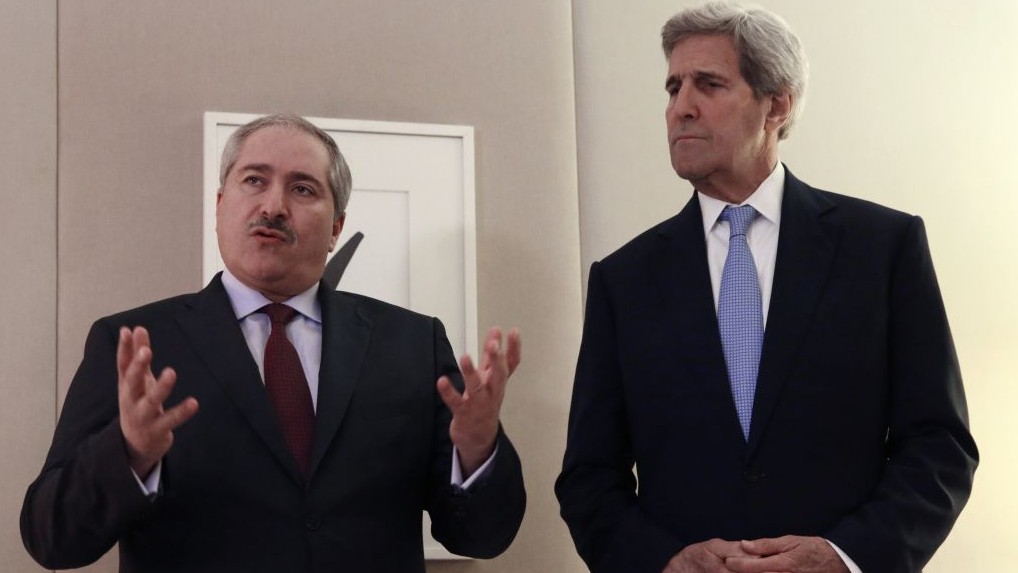
“But the UN Security Council Resolution calls for a full country, countrywide, cessation and also for all of the country to be accessible to humanitarian assistance.”
Kerry and Judeh also discussed the Israeli-Palestinian conflict, according to the Jordanian foreign minister, but it was not disclosed what was discussed.
Excellent & lengthy discussion with @JohnKerry in #Geneva: Dire situation in #Aleppo & rest of #Syria & regional issues esp. #Palestine
— Nasser S. Judeh (@NasserJudeh) May 1, 2016
Concern has been growing that the fighting in Syria will lead to the complete collapse of a landmark ceasefire between Assad’s regime and non-jihadist rebels agreed in late February.
On Saturday, Russia said it would not urge Assad’s forces to halt air raids on the war-ravaged city as they were targeting jihadist groups not covered by the truce.
Washington has rejected this argument.
Lavrov was not expected to be in Geneva, complicating Kerry’s efforts to make the case directly to the Russians for more pressure on their Syrian government allies to stop or at least limit attacks in Aleppo.
The State Department said Kerry, in his meetings, would “review ongoing efforts to reaffirm the cessation of hostilities nationwide in Syria, obtain the full humanitarian access to which the Syrian government committed and support a political transition.”
Specific, viable options to achieve those broad goals are limited, and Friday’s announcement of a new, partial cease-fire that does not include Aleppo underscored the difficulty Kerry faced.
US and other officials described that initiative, brokered mainly by Russia and the United States as co-chairs of the International Syria Support Group, as a “reinforcement” of the February truce, now largely in tatters, that they hope to extend from Damascus and the capital’s suburbs and the coastal province of Latakia to other areas.
“This is an agreement within the task force, but certainly on the part of the US and Russia that there would be a reinforcement of the cessation of hostilities in these specific areas as a start, with the expectation that this … would be then extended elsewhere,” State Department spokesman Mark Toner said.
Syria’s military extended a unilateral cease-fire around the capital for another 24 hours on Sunday, and relative calm set in across much of the country after days of heavy fighting concentrated in Aleppo.
For that city, the US is considering drawing up with the Russians a detailed map that would lay out “safe zones.” Civilians and members of moderate opposition groups covered by the truce could find shelter from persistent attacks by Syrian President Bashar Assad’s military, which claims to be targeting terrorists.
One US official said “hard lines” would delineate specific areas and neighborhoods. The officials spoke on condition of anonymity because they were not authorized to discuss the matter publicly.
It was not immediately clear whether Russia would accept such a plan or if Moscow could persuade the Assad government to respect the prospective zones. Some US officials are skeptical of the chances for success, but also note that it is worth a try to at least reduce the violence that has wracked Aleppo for the past week, with hundreds killed and thousands wounded.
On Sunday the head of Moscow’s coordination center in Syria said talks on a freeze had begun.
“Currently active negotiations are underway to establish a ‘regime of silence’ in Aleppo province,” Lieutenant General Sergei Kuralenko told Russian news agencies.
He said that a freeze in fighting in eastern Ghouta, a suburb of Damascus, had been extended to the end of Sunday and that another freeze was holding in Latakia province.
“We are calling on all sides interested in establishing peace in Syria to support the Russian-American initiative and not to allow a regime of silence to be disrupted,” Kuralenko said from Russia’s Hmeimim air base in Syria.
Before leaving Riyadh for Geneva to join Kerry and De Misura, Saudi Foreign Minister Adel al-Jubeir accused the Assad regime of committing “war crimes” in Aleppo.
Before leaving Washington, Kerry expressed “deep concern” about Aleppo, which has suffered some of the worst fighting in a war that has killed more than 270,000 people.
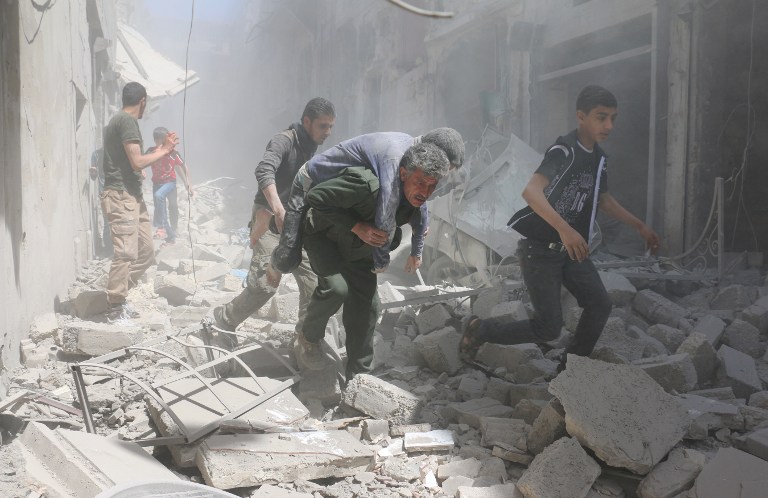
At least 253 civilians — including 49 children — have been killed on both sides of the divided city since April 22, the Syrian Observatory for Human Rights monitor says.
On Sunday the provincial capital’s rebel-held east was eerily quiet, an AFP correspondent said.
There were no reports of fighting in the regime-controlled west of the city, the Observatory said.
But air strikes did hit several rebel areas on Aleppo’s northwestern outskirts, after rebel shelling of the west and regime bombing north of the city in the night.
Rockets were fired Sunday from rebel-held areas into the west without causing casualties, it said.
The regime dropped barrel bombs on Castello road, the only route in and out of rebel-held parts of Aleppo and a civilian escape route, the Observatory said.
The fighting has dampened hopes that the ceasefire could finally lay the groundwork for an end to Syria’s five-year conflict.
Peace talks last month in Geneva failed to make any headway, though De Mistura has said he hopes they can resume “during the course of May.”
Concern for Aleppo, Syria’s former economic hub, has been growing.
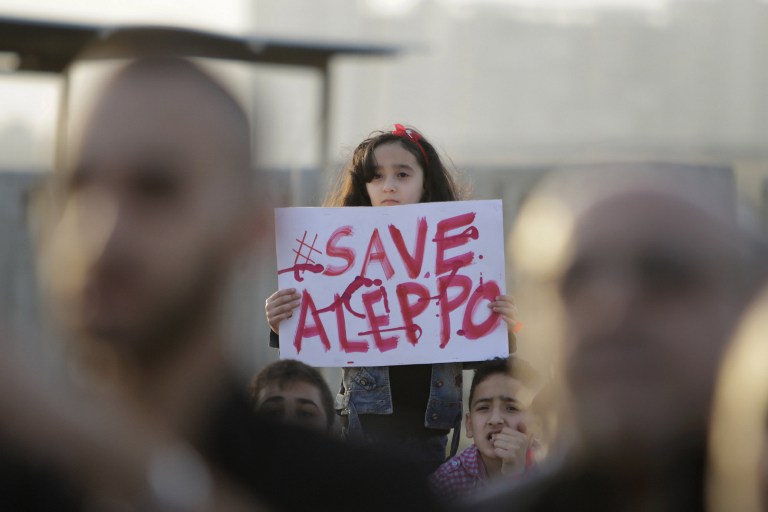
A hashtag demanding an end to the violence — #AleppoIsBurning — has spread on social media, with protests planned this week around the world.
In neighboring Lebanon, dozens of demonstrators protested, some wearing white helmets marked “Civil Defence” in a nod to Aleppo’s rescue workers.
Lebanon currently hosts more than a million Syrian refugees.
The escalating violence in Aleppo has also struck medical centers, with the International Committee of the Red Cross reporting four hit Friday on both sides.
And a raid on Wednesday hit a hospital supported by Doctors Without Borders and the Red Cross, killing 30 people and sparking an international outcry.
On Saturday, many terrified residents fled a new wave of air strikes on the city’s east, saying the violence had become unbearable.
Syria’s conflict erupted in 2011 after the brutal repression of anti-government protests and has since escalated into a complex, multi-faceted war.
Times of Israel staff contributed to this report.



The Times of Israel Community.