

Lapid and ultra-Orthodox trade barbs over budget proposal
Finance minister’s plan calls for NIS 18 billion in government cuts and NIS 5 billion in tax hikes raises hackles in Knesset
 Add ToI as a Preferred Source on Google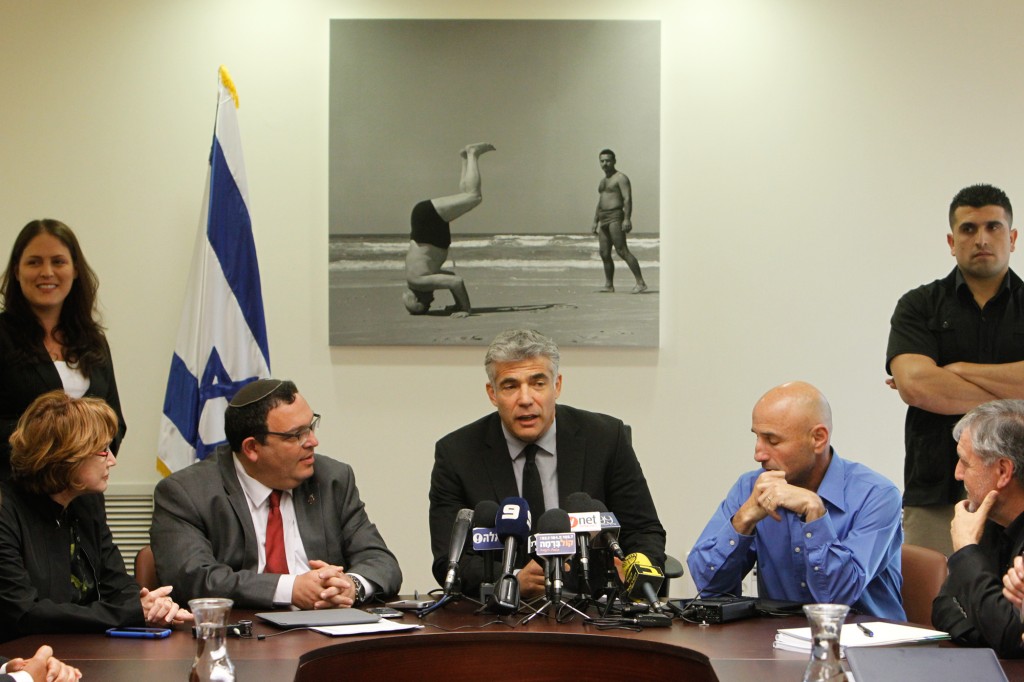
Finance Minister Yair Lapid presented his budget plan to cut government spending by NIS 18 billion ($5 billion) over the next few years and to raise taxes by NIS 5 billion ($1.4 billion). He made the presentation in a lengthy meeting with Prime Minister Benjamin Netanyahu and Bank of Israel Governor Stanley Fischer on Monday.
Lapid hailed his proposal as a “budget of hope” that would move Israel from a “culture of stipends to a culture of work.” However, he admitted that getting the budget through the Knesset would be “contentious.”
He also fired an opening shot at the ultra-Orthodox parties during a Knesset session Monday by placing blame for Israel’s current deficit on them, sparking angry exchanges.
Speaking earlier, at a Yesh Atid meeting, the finance minister said he didn’t view the proposed changes as obstacles, but rather as opportunities for change.
“Those who examine the budget in detail will see that this is a budget of hope. Of course there’ll be the cuts and tax hikes but they are short-lived. There’s been a malfunction, and it will hurt — but that will come and go in favor of much greater things.”
Lapid’s proposed tax hikes could bring in billions of shekels, but his proposal will also involve austerity measures aimed at lowering the deficit by cutting ministry earmarks.
A 1 percent increase in the VAT sales tax, to 18%, would boost the state’s coffers by about NIS 4 billion ($1 billion), and raising income tax by 1% for those making more than NIS 8,881 ($2,500) would rake in NIS 1.5 billion ($413 million) per year, Ynet news reported. Lapid’s proposal also called for setting up a committee to evaluate levying fines on companies that use or exploit the country’s natural resources.
Lapid’s efforts to balance the budget include a much-talked about austerity plan, which includes heavy cuts to the defense budget and other ministries, as well as cuts to allowances for children and a tax increase for consumers and top earners. He said that such a shift was necessary to lower the cost of living and spread the burden among the socioeconomic classes.
The minister also sought to raise the deficit ceiling to 3.25 percent. He had originally wanted to raise the ceiling higher, but Fischer had insisted upon lowering it. The budget deficit is NIS 39 billion, and Lapid had originally proposed raising this year’s target to 4.2% of the gross domestic product (GDP).
In 2012 the deficit ceiling was set at 2%, but economists were shocked to find the debt had grown to 4.2% of Israel’s GDP by year’s end.
In June 2012, the Cabinet approved raising the 2013 ceiling from 1.5% to 3%.
The budget deficit ceiling is set annually by the government as the acceptable limit of national debt, which in turn influences the proposed budget for that year. If the national deficit grows to be greater than the deficit target, the government could resort to austerity measures — budget cuts and increased taxes.
Later, at a Knesset session, Lapid and MKs from ultra-Orthodox parties came to verbal blows over the proposed measures.
After MK Meir Porush (United Torah Judaism) warned that the budget cuts would cause a lot of hardship for average Israelis, Lapid noted bitterly that the last government, in which UTJ controlled the Knesset finance committee, created the deficit in the first place.
“I understand that you’re going through difficult times,” Lapid said. “It’s your government that created that deficit — were you not a partner to it? Were you on Mars? As would any government, we now need to solve the deficit that you have created — and you were not exactly the cheapest friends ever,” he added, referencing so-called government handouts to the ultra-Orthodox community.
After UTJ’s Israel Eichler criticized the government’s intentions to cut child allowance programs, Lapid said that the government should not have to bear the burden of raising children.
“Bringing a child into this world is a great responsibility,” Lapid retorted. “And you need not have children and then assume others will support them; you should assume it is your duty to support your children.”
Opposition Leader Shelly Yachimovich, however, had harsh words for Lapid and his budget plan.
“Lapid returned with Netanyahu’s plan, including a NIS 5 billion tax raise. It’s going to be an impossible burden to carry, certainly for miserable Riki from Hadera, and definitely for the poor,” she said at a Labor party meeting, referring to Lapid’s fictitious character who bore the weight of the middle-class cost-of-living issues.
If passed, Lapid’s budget proposal will be for 18 months, through the end of 2014. Then, beginning in 2015, the government will revert to annual budgets rather than biannual ones, which have been in effect to date.









The Times of Israel Community.