

Let’s call the whole thing off
Now that Syria is handing over its chemical weapons we can all rest easy, right?
 Add ToI as a Preferred Source on Google
Ilan Ben Zion is an AFP reporter and a former news editor at The Times of Israel.
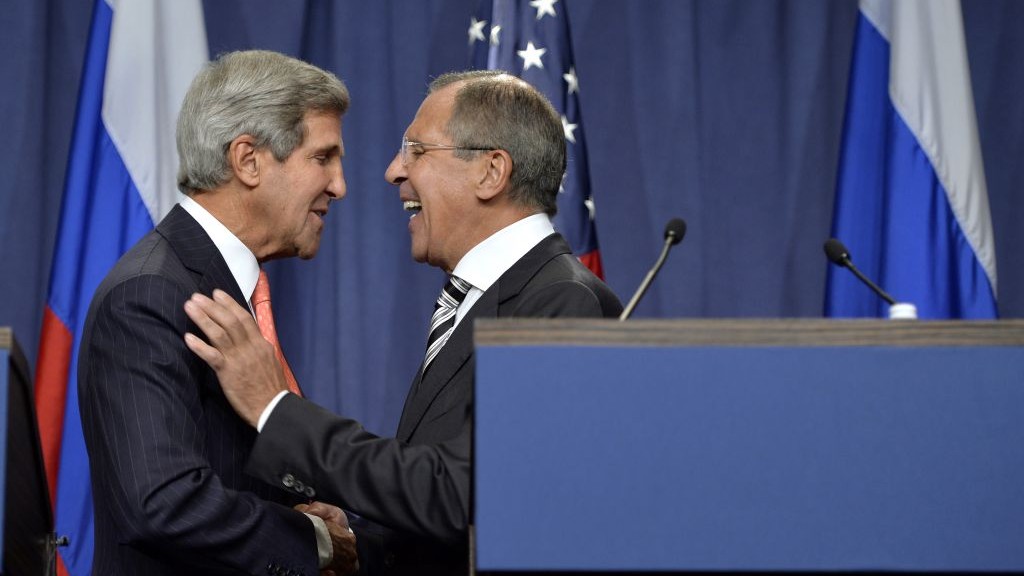
Oh look, the US and Russia have reached an agreement on something, and not just their affinity for Super Bowl rings. As the chummy photos of Secretary of State John Kerry and Foreign Minister Sergey Lavrov on the front pages of Sunday’s papers attest, the two world powers came to a compromise on stripping Syrian President Bashar Assad of his chemical weapons. Syria’s compliance remains to be confirmed, but at least for now the timetable and framework for a mid-2014 secure-and-destroy procedure is in place, and an American strike is out.
The Israeli press, as one can imagine, is elated to hear the news. Haaretz columnist Chemi Shalev says the diplomatic victory “achieves one of Israel’s historic goals on the issue of disarmament, at least theoretically, and eliminates a first-rate strategic threat without [Israel] moving a finger and without being asked to do its part.” Despite Israel’s leg up, Shalev says that the biggest winner in this whole affair was Assad, even though he will lose the chemical weapons against Israel that his father Hafez built.
“The deal in effect secures Assad’s place as an essential partner for its implementation, and certainly aggravates the Americans’ motivation to arm the rebels in case that undermines the regime of he who can provide them with the desired chemical goods,” he writes.
Boaz Bismuth, Israel Hayom’s commentator of the day, remarks that while most sides are content, the only group who got the shaft are the Syrian rebels and the victims’ families. “There are those who’ll see the cup half full,” he says, “Syria is disarmed of its chemical weapons without a war.”
“But for the time being it’s all talk and promises,” he adds with a dose of caution.
He remarks that Iran undoubtedly will teach its ally, Syria, how to stall for time with the international community, as Tehran has done with its nuclear program for the past 10 years. It remains to be seen how the UN will deal with Syria’s chemical weapons, he jabs.
The paper clearly has Syria on the mind, for it devotes its first 11 pages to the issue, and virtually no efforts to anything besides.
In Maariv, Amir Rapaport says the switch from an American strike to Assad staying in power and handing over his chemical weapons is “hard to understand from the Israeli standpoint,” in part because “Obama really intended to attack Syria (all of the preparations and coordinations with Israeli and British officials were already done in advance of the [potential] attack).”
For Israel, he also comments, “Syria’s disarmament from nonconventional weapons is a major accomplishment, if indeed it occurs. On the optimistic side, one can see that a realistic threat brings results, and perhaps it will bring results in the future with Iran.”
Yedioth Ahronoth unequivocally declares the diplomatic breakthrough “excellent tidings for Israel.” Ronen Bergman writes that had Prime Minister Benjamin Netanyahu been asked whether he would have believed that international intervention in Syria would force Damascus, under the threat of arms, to give up its chemical weapons arsenal, “the prime minister would have argued that it is a pipe dream.” And yet, that would appear to be the new reality.
With all the talk of WMDs in the air, Haaretz brings up on its front page the touchy matter of Israel’s undeclared stockpile of nonconventional weaponry. Citing American officials who spoke to the Bulletin of Atomic Scientists, the paper reports that Israel allegedly ceased producing new atomic warheads nine years ago, but still has the capacity to double its nuclear capabilities. According to the figures cited in the paper, Israel had roughly 70 nuclear warheads in 1999, then 80 in 2004 when production ceased. Forty years ago, with its back against the wall during the 1973 Yom Kippur War, Israel was in possession of 15 nuclear warheads.
Par for the post-Yom Kippur course, Yedioth runs a story highlighting how, like every year, several dozen people nationwide fainted and required medical care as a result of the fast during sweltering hot weather. According to the paper, 2,566 individuals required emergency care from Magen David Adom, either because of fasting or because of bicycle accidents — that other plague afflicting Israel on Yom Kippur. But, hey, at least they’re not in Syria.
Turning south, Maariv reports that the Egyptian military’s campaign in the Sinai is working to undermine the Hamas government in the Gaza Strip. The paper goes so far as to accuse Cairo of attempting regime change in the Palestinian territory. It reports that Egypt accused Hamas of dispatching agents to free former president Mohammed Morsi and senior Muslim Brotherhood officials from an Egyptian prison in an attempt to delegitimize the Islamist group. Cairo also accused Hamas of “sending forces in order to aid the Brotherhood in street uprisings in Egypt to hurt soldiers and the new regime,” and “killing security forces through escalating terrorism reigning in the Sinai Peninsula,” the paper writes.









The Times of Israel Community.