Lithuania mints first-ever EU coin with Hebrew letters, honoring Vilnius scholar
Bank of Lithuania unveils coin celebrating 300th anniversary of birth of Elijah ben Solomon Zalman, the ‘Vilna Gaon,’ who spent his life in Lithuanian capital of Vilnius
Cnaan Liphshiz was a Jewish World reporter at The Times of Israel
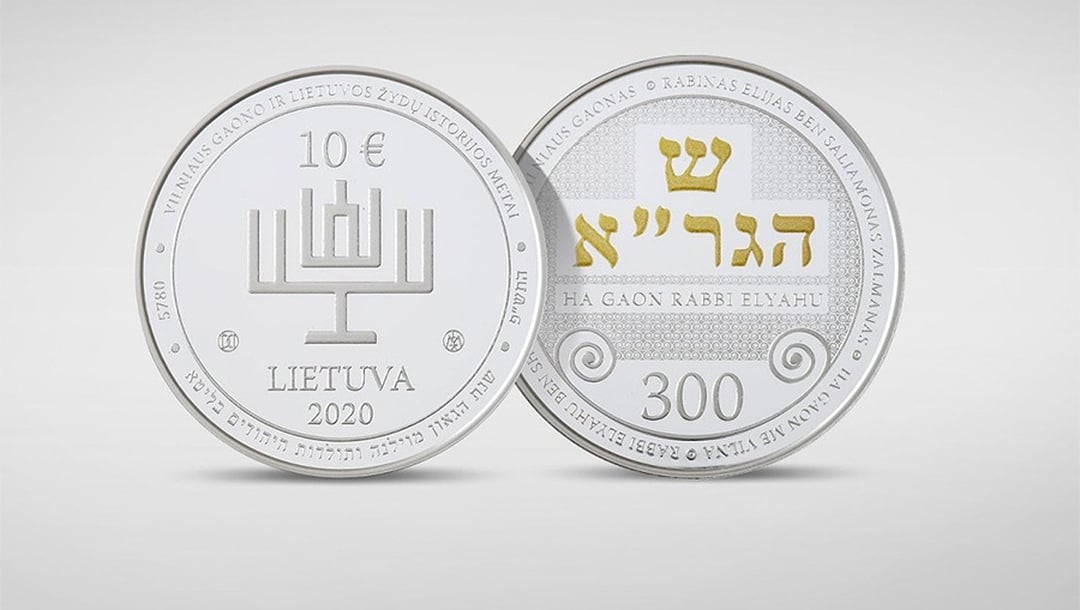
Both sides of a commemorative 10 euro coin celebrating the 300th birthday of the Vilna Gaon in Lithuania. (Courtesy of the Bank of Lithuania/ via JTA)
JTA — The Bank of Lithuania minted the first euro piece of currency containing Hebrew letters.
The 10-euro coin was minted on Tuesday and is a limited-edition commemorative collector’s item celebrating the 300th anniversary of the birth of the Vilna Gaon, the 18th-century rabbinical luminary Elijah ben Solomon Zalman, who lived and died in the Lithuanian capital of Vilnius.
The heads side of the coin features the Hebrew letter shin, whose value according to the gematria alphanumeric code is 300, followed by the acronym in Hebrew of Gaon Rabbi Elijah. The tails’ rim reads in Hebrew: “The year of the Vilna Gaon and the history of the Jews of Lithuania.”
The commemoration of individual people is very rare on bank notes and coins of the European Union, partly because of the political sensitivity in a political union made up of former foes.

An artist’s depiction of the Vilna Gaon (Public Domain)
Earlier this month, a mural of the late Israeli poet Leah Goldberg, who grew up in Kaunas, Lithuania was unveiled there along with other notable individuals connected to the city ahead of its crowning as Cultural Capital of Europe in 2022.
Get The Times of Israel's Daily Editionby email and never miss our top stories
Separately, a monument for Holocaust victims that was smashed and knocked over in Kaunas was restored on October 9, the news site Jewish.ru reported.

We can't do this work alone.
The war with Iran has been draining for all of us in Israel. But when I heard about a high casualty incident – ballistic missile impacts in Arad and Dimona that left nearly 200 people wounded – I drank a cup of coffee, packed a bag, and headed south.
There, I spoke with Shilgit, the head of an after-school program for underprivileged youth. Standing outside her destroyed center, Shilgit said it was a miracle that no children were hurt and spoke about the community coming together in the hours since.
As a Times of Israel reporter, I’m committed to telling stories of resilience like Shilgit’s. But my colleagues and I can't do this alone. If you value work like this,please consider joining our reader support group, The Times of Israel Community. Your financial support is essential to keep real human reporting like this going.
We’re really pleased that you’ve read X Times of Israel articles in the past month.
That’s why we started the Times of Israel - to provide discerning readers like you with must-read coverage of Israel and the Jewish world.
So now we have a request. Unlike other news outlets, we haven’t put up a paywall. But as the journalism we do is costly, we invite readers for whom The Times of Israel has become important to help support our work by joining The Times of Israel Community.
For as little as $6 a month you can help support our quality journalism while enjoying The Times of Israel AD-FREE, as well as accessing exclusive content available only to Times of Israel Community members.
Thank you, David Horovitz, Founding Editor of The Times of Israel