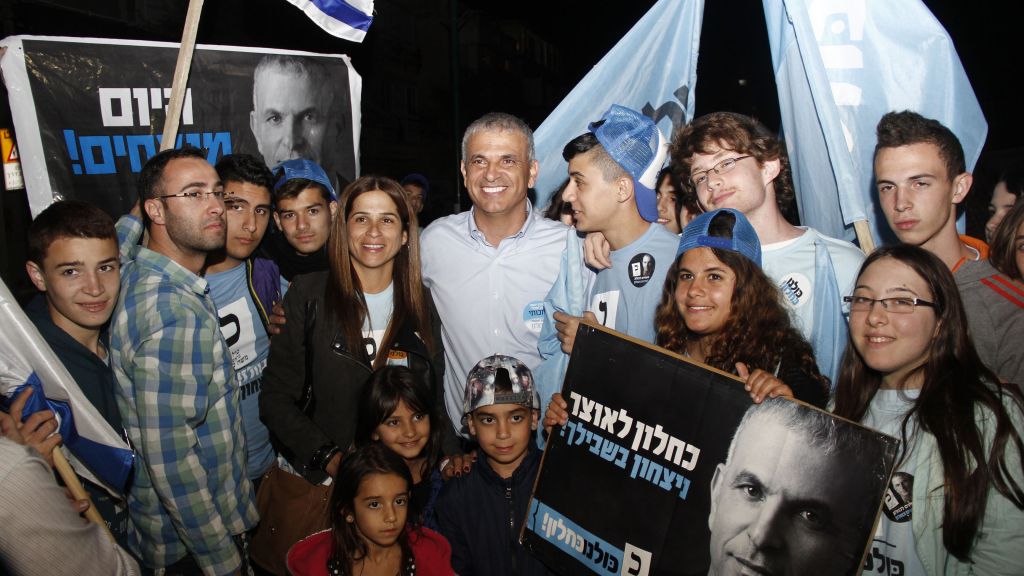
Moshe Kahlon, head of the Kulanu party, makes his last campaign stop before the polls close.
“Our people are gaining energy,” the candidate says at the Rogazin-Bialik Campus in south Tel Aviv. “As time goes by they are getting stronger.”
Moshe Kahlon poses with volunteers of his Kulanu party in South Tel Aviv on Mar. 17, 2015. Kahlon traveled up and down Israel’s coast, rallying support before the polls close. (photo credit: Judah Ari Gross/Times of Israel)
Volunteers and voters swarm around the smiling but tired politician, hoping for the latest in election day fashion: a politician-accompanied selfie.
“I love it,” Kahlon says of the constant picture-taking, “I don’t know about others, but I enjoy it.”
Kahlon obliges his supporters as his handlers try in vain to rush him along. The center-right party head even takes the time to have a jocular conversation with a volunteer from the staunchly left Meretz party.
“That’s why I’m in public life,” he says.
Kahlon, who was a part of the Likud party until two years ago, is expected to draw right-wing support away from Prime Minister Benjamin Netanyahu. For this reason Kahlon’s centrist party is considered pivotal in the elections, and he is seen as something of a kingmaker.
On Saturday and Sunday, Netanyahu said in several interviews that he would make Kahlon finance minister, in a bid to woo the Kulanu head to his side.
Moshe Kahlon, the Kulanu party leader, takes photographs with supporters before the polls close in South Tel Aviv on Mar. 17, 2015. (Photo credit: Judah Ari Gross/Times of Israel)
But Kahlon,a former Likud minister, on Sunday morning rebuffed the advance, saying that Netanyahu’s promise couldn’t be trusted.
Kahlon has thus far refused to recommend either Netanyahu or Zionist Union rival Isaac Herzog for prime minister after the Tuesday vote, a move that would give either candidate an easier chance at forming a coalition.
— Judah Ari Gross
Help us report truthfully on social media
As a multimedia journalist, my job is to take the quality, fact-based journalism produced by The Times of Israel newsroom and make it accessible across every platform — from Instagram posts to podcasts to short-form videos.
This is how many, especially young people, consume news these days. But misinformation is rampant on social media. Our team at ToI produces accurate, responsible short-form reporting on Israel and the Jewish world.
If you believe in the importance of factual social media journalism, please consider joining our reader support group, The Times of Israel Community. Your financial support is essential to sustain responsible multimedia reporting.
We’re really pleased that you’ve read X Times of Israel articles in the past month.
That’s why we started the Times of Israel - to provide discerning readers like you with must-read coverage of Israel and the Jewish world.
So now we have a request. Unlike other news outlets, we haven’t put up a paywall. But as the journalism we do is costly, we invite readers for whom The Times of Israel has become important to help support our work by joining The Times of Israel Community.
For as little as $6 a month you can help support our quality journalism while enjoying The Times of Israel AD-FREE, as well as accessing exclusive content available only to Times of Israel Community members.
Thank you, David Horovitz, Founding Editor of The Times of Israel


 From the Liveblog of
Tuesday, March 17, 2015
From the Liveblog of
Tuesday, March 17, 2015
 Add ToI as a Preferred Source on Google