

Minister contracts virus amid warnings that infection rates may rebound
Ofir Akunis said to feel well as he isolates at home; 522 new cases identified and 322 patients in serious condition day after stores reopen
 Add ToI as a Preferred Source on Google
Regional Cooperation Minister Ofir Akunis has contracted the coronavirus and gone into isolation at his home, his office announced on Monday.
The announcement came as the Health Ministry released numbers showing new daily infections remaining over 500, a key threshold for rolling back more lockdown restrictions.
According to the announcement from his office, Akunis feels well and is continuing to work from home.
It was not immediately clear whether he has been in contact with any other ministers or senior officials who may need to quarantine as a result of potential exposure.

Akunis is the latest of a string of ministers who have contracted the virus, the most recent being Environmental Protection Minister Gila Gamliel, whose infection with COVID-19 in October uncovered violations of government-ordered restrictions.
In April, then-health minister Yaakov Litzman was diagnosed with COVID-19, reportedly after having attended prayer services that at the time were banned under his own ministry’s orders during a previous lockdown.
In August, Immigration and Absorption Minister Pnina Tamano-Shata of Blue and White tested positive for the coronavirus. That came weeks after Jerusalem Affairs Minister Rafi Peretz (Jewish Home) was diagnosed with COVID-19.
Several Knesset members have also caught the virus, the most recent of whom was Ayman Odeh, who leads the majority-Arab Joint List party.
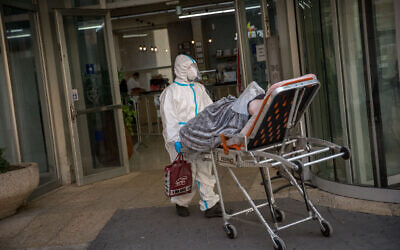
The Health Ministry said Monday that 522 coronavirus cases were identified the previous day, as testing levels started to rise again over the weekend.
There were 21,405 tests carried out on Sunday with a positive rate confirming infection of 2.4 percent, after just 8,070 samples taken on Saturday.
Last week, outgoing coronavirus czar Ronni Gamzu, who is leading the country’s efforts in the pandemic, said that 30,000 tests would need to be carried out on a daily basis to maintain a good overview of the rate of infection in the country.
There are 8,153 confirmed active cases in the country, with the total tally since the start of the pandemic at 319,562, according to the Health Ministry.
Of the active cases, 322 were in serious condition, including 138 on ventilators. Another 89 were in moderate condition and the rest had mild or no symptoms.
No new deaths were announced, leaving the toll since the start of the pandemic at 2,674.
The country sharply brought down its daily coronavirus infection rates from some 8,000 in mid-September to several hundred by late October with the nationwide lockdown, its second since the start of the pandemic.
But officials are warning that infection rates may rise again, which would make further easing of the national lockdown difficult.
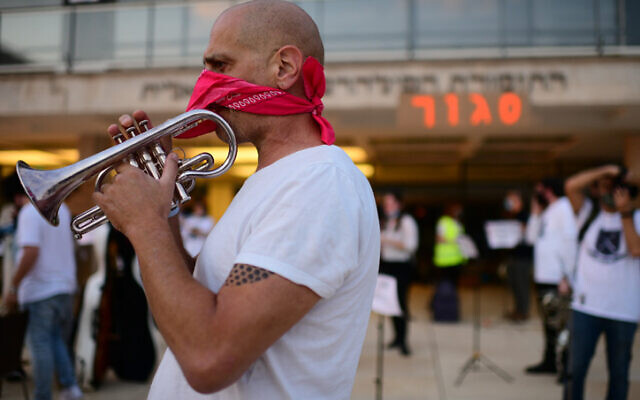
According to a report issued by the country’s military-run coronavirus taskforce on Monday, data from the previous two weeks showed that not only had the number of daily cases stopped dropping, but an increase in transmission rates meant the previous downward trend could be reversed. “If the current trend continues in light of the easing of regulations that have already been implemented, and those that are on the table, a renewed increase in morbidity is expected in the coming days,” the report warned.
On Sunday, the acting head of the Health Ministry’s public health services division Dr. Sharon Alroy-Preis said during a video press briefing that only when the number of new virus cases diagnosed each day dips below 500 will it be possible to move on to the next stage of lifting the lockdown.
The government nonetheless pressed ahead Sunday with permitting stores to open for business with a maximum of four customers allowed inside at a time, and in compliance with virus regulations including social distancing and the wearing of masks.
The stores had been closed since mid-September, when Israel introduced a nationwide lockdown that excluded only essential businesses. Reopening street stores was opposed by the Health Ministry, due to the level of infections.
The third stage in lifting the lockdown is also supposed to include the opening of shopping malls, as well as the wider retail market. In addition, school was to be restarted for grades 11-12 to enable students to prepare for matriculation exams.
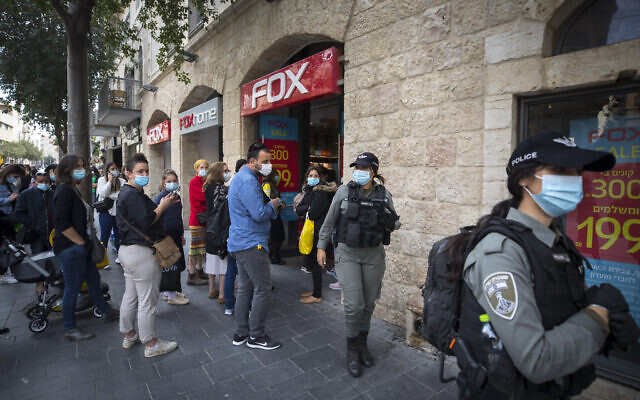
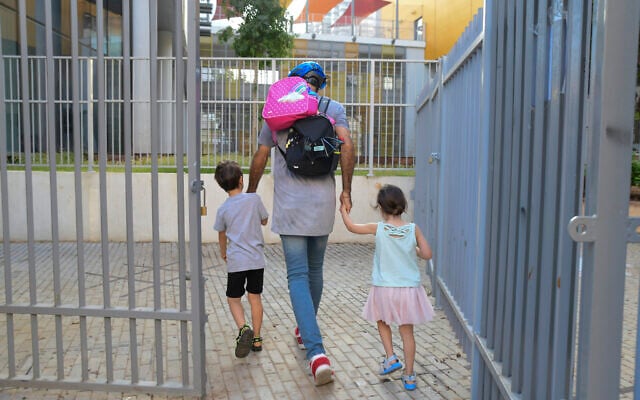
The national lockdown that began on September 18 paralyzed much of public life and the economy and shuttered the entire education system. The government began removing some restrictions in mid-October, opening preschools and kindergartens, then grades 1-4, as well permitting some street businesses to begin operations.
The rest of the education system has continued remote learning.
The chair of the Knesset Education Committee, Blue and White MK Ram Shefa, said on Monday that it was preferable for students to return for in-person learning for at least part of the week than have full-time remote learning.
“I would rather have a child study four hours for three to four days a week, than stay at home. There is no uniform outline for each [local] authority; we need a plan that is broad enough to allow the authorities to adapt themselves,” he told the Kan public broadcaster.
Under the current regulations, children in grades 1-4 are in school for at least four days per week with some municipalities providing a fifth day of studies, leading to concerns of worsening inequality.
Health Minister Yuli Edelstein told the Kan public broadcaster that infections may again run wild. The ministry expects the morbidity to continue to climb with the infection coefficient pulling away from 0.8, the value health officials want before the third stage is begun, the report said.
According to Channel 13 news, the reproduction coefficient was at 0.99 on Sunday. Any value above 1 indicates that the morbidity rate will climb exponentially.
As an additional measure to curb the virus spread, Prime Minister Benjamin Netanyahu is pushing to apply evening curfews as an additional measure to curb the virus spread, with the National Security Council examining the effectiveness of such a move, Kan reported.
Sources told the station that the plan is directed in particular at Arab Israelis, who have recently seen a sharp infection rise in some areas, blamed on mass events, in particular weddings, held in violation of lockdown limitations.
Stuart Winer contributed to this report.








The Times of Israel Community.