

On a demolished Palestinian home, Hanukkah candles of protest
Rabbis for Human Rights petitions Supreme Court to grant Palestinians a say in planning their West Bank villages
 Add ToI as a Preferred Source on Google
Elhanan Miller is the former Arab affairs reporter for The Times of Israel
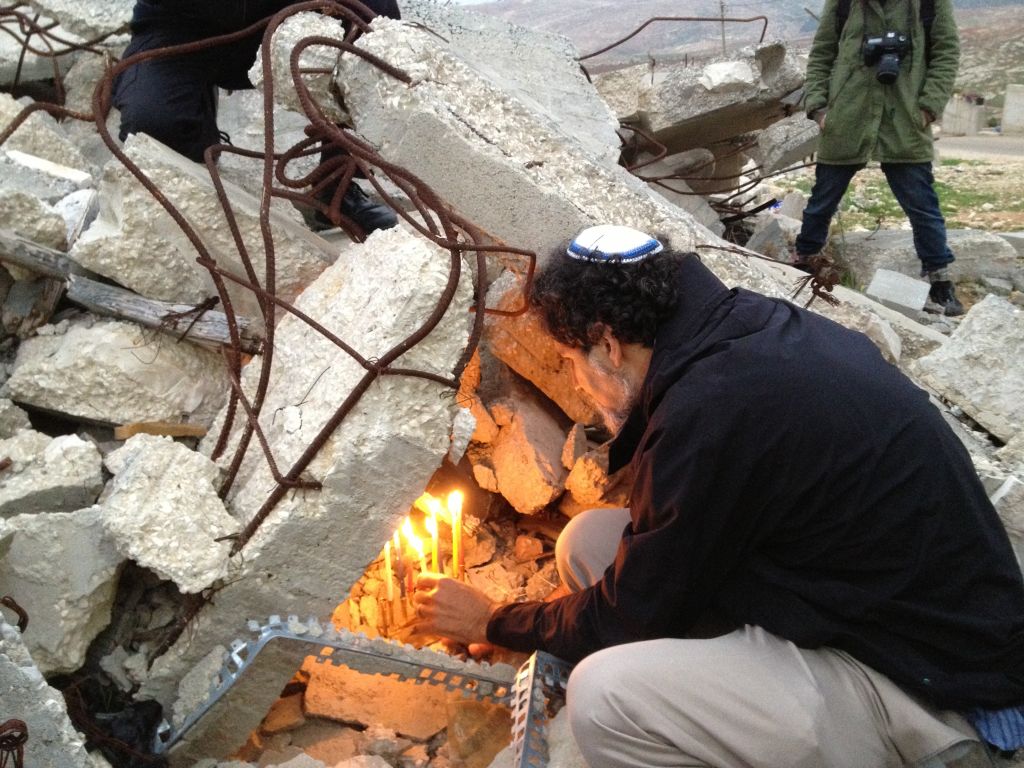
DIRAT, West Bank — Night was beginning to fall on this hamlet in the South Hebron hills on Monday when a small group of rabbis and activists gathered around the concrete debris of a home demolished two years ago by the Israeli Civil Administration to light Hanukkah candles.
It was a symbolic act of protest organized by Jerusalem-based NGO Rabbis for Human Rights against home demolitions and in favor of planning rights for local Palestinian residents. According to statistics gathered by the United Nations Office for the Coordination of Humanitarian Affairs (OCHA), 663 illegally built Palestinian homes and structures were destroyed by Israel in 2013, and 386 between January and August 2014.
“We came here to fulfill an unspoken promise to do everything we can to end this Hilul Hashem, this desecration of God’s name,” said Rabbi Arik Ascherman, president of Rabbis for Human Rights, after lighting the candles. “This is a light of hope in a place of despair; a light of justice where there’s been no justice.”
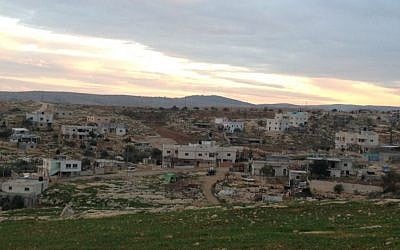
Straddling two rocky hills 15 kilometers (10 miles) southeast of Hebron, Dirat is situated in Area C, an administrative subdivision of the West Bank created by the Oslo Accords under full Israeli civil and security control. According to Ascherman, two “separate and unequal” planning systems exist in Area C: a military system controlled exclusively by the Israeli army for the Palestinians, and a civil system involving local residents for the Israelis.
That wasn’t always the case. Prior to 1971, local village councils were responsible for Palestinian planning; but four years after Israel took control of the territory from Jordan in the Six Day War, an Israeli military decree transferred planning prerogatives to the Civil Administration in Judea and Samaria, an arm of the IDF responsible for civil and security coordination with the Palestinians.
Rabbis for Human Rights and three other organizations appealed to the Israeli Supreme Court in 2011 on behalf of the residents of Dirat, asking that planning rights be returned to the the local councils. In April 2014, the Court instructed the state to put forward a proposal for a more inclusive planning policy, rejecting the army’s claim that residents are being “consulted” under the current planning regime
“It’s a fig leaf plan. Palestinians have no fair chance to build their homes legally,” Ascherman said, referring to the lack of building plans for all but 17 villages out of 150 in Area C. Even the plans that do exist merely define the existing village perimeters but do not allow for future growth. “That’s what makes this a humanitarian tragedy,” he added.
Muhammad Al-Adara, one of the village elders, said his nephew had worked for 15 years to save money for his family home in Dirat, a home demolished in June 2012 just as its construction ended. Today, the nephew rents an apartment in the nearby city of Yatta.

“Poor guy, he has so many debts. God only knows how he’ll pay them off,” Adara told The Times of Israel. His son Yasser’s new home was also razed in a similar manner six years ago. “We’ve provided [the Civil Administration] with proof of ownership, but there’s no licensing.”
Demolitions of illegal structures built in the West Bank are also carried out unequally, Rabbis for Human Rights claimed. From 1987 to 2013, 2,445 Palestinian buildings have been demolished, 20% of the total estimated number of illegally built structures. In Israeli settlements, on the other hand, 524 building were demolished, or 8% of the illegal structures.
Though he can’t prove it, Ascherman argues that the discriminatory planning policies are meant to leave as much open land as possible in Israel’s hands for future expansion of Jewish settlements. His group quotes a 1983 document issued by the Settlement Division of the World Zionist Organization arguing that Palestinian expansion should be limited to built areas, whereas additional land should be allocated to Jewish communities for future growth.
‘If the residents were flouting the law, we could argue whether home demolitions are the appropriate response. But they have no choice’
Residents of Dirat, one of the few Palestinian villages with an Israeli building plan issued in 2005, claim that the land allocated to it, 140 dunams (35 acres), does not even encompass the current homes housing a population of 1,100, let alone allow for future development. Some 100 homes in Dirat, more than half of the entire village, currently have Israeli demolition orders pending against them.
“If the residents were flouting the law, we could argue whether home demolitions are the appropriate response. But they have no choice,” Ascherman said. Dirat was a perfect example of how even villages with building plans, ostensibly drafted in consultation with local residents, did not satisfy their basic needs. One chief planner at the Civil Administration confided in Ascherman that it does not even have the tools to carry out planning for all Palestinian villages in Area C.
In a written response to questions sent by The Times of Israel, the Coordinator of Government Activities in the Territories (COGAT) said that “the Civil Administration strives to include representatives of local Palestinian residents in new building plans which include, among other things, the expansion of existing Palestinian villages. Following the appeal by Rabbis for Human Rights, the matter was established in ‘the procedure to incorporate residents of the region in the planning process’ by the head of the Civil Administration. The Procedure specifies and regulates the inclusion of the Palestinian population in the planning process, including tours, the right to plead, appeals, and the like. There has been no change in the policy of demolishing illegal structures recently,” the response read.
The appeal to Israel’s Supreme Court, Rabbis for Human Rights argues, is meant to shift the public debate from procedural questions of how the Civil Administration conducts its planning policy to the principled question of why the IDF branch carries out planning for Palestinians at all.
“This is a civil matter pertaining to Palestinian villages and Israel has no right to claim authority over planning in Palestinian areas,” the organization wrote on its website. “Security considerations — if such considerations exist and are indeed real — can be solved through specific case-by-case intervention, and do not require a complete takeover of the planning process throughout decades of occupation.”
Adara said that a proper building plan will allow his village to request a water pipe for the first time. Currently, residents of Dirat receive their water in large tanks delivered by trucks. Electricity was only introduced to the hamlet in 2007, through an illegal power line.
“My home is the only one here with no demolition order,” he told The Times of Israel. “I have no idea why. Maybe it’s because I work with the government.”










The Times of Israel Community.