

Residents of burned moshav plead for answers as politics overshadows their loss
Fire destroyed almost every home in Mevo Modi’im on May 23. Now homeless locals are left in limbo and feel deserted by authorities, who they say are more focused on elections
 Add ToI as a Preferred Source on Google
Melanie Lidman is an AP reporter and former Times of Israel reporter
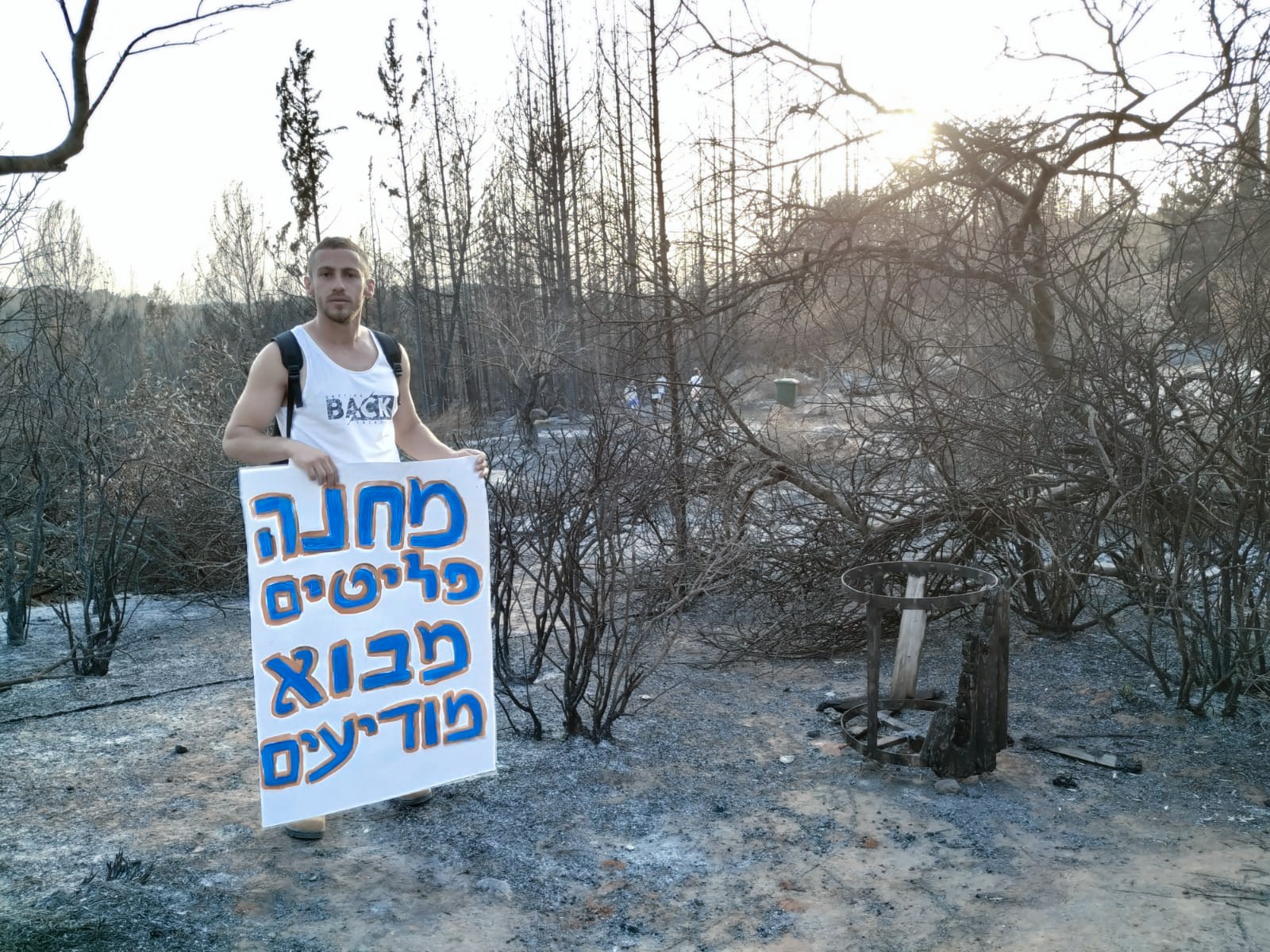
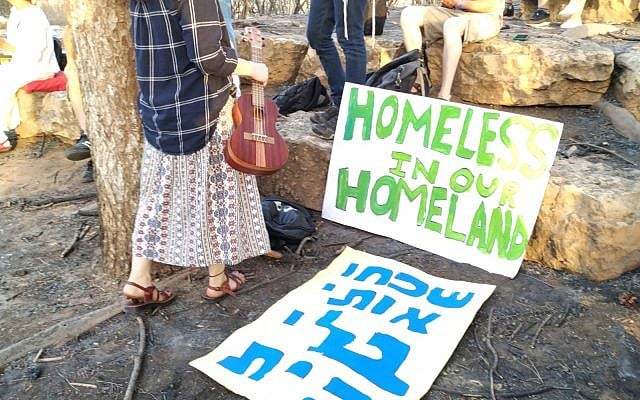
Dozens of shell-shocked and exhausted residents of Mevo Modi’im protested on Thursday at the entrance to the town, furious with the lack of leadership and support they have received from the Israeli government since their homes burned to the ground exactly one week ago.
The residents demonstrated at a “black and white” concert held in support of the community, which asked the hundreds of attendees to come dressed in white to contrast with the blackened background of their former homes.
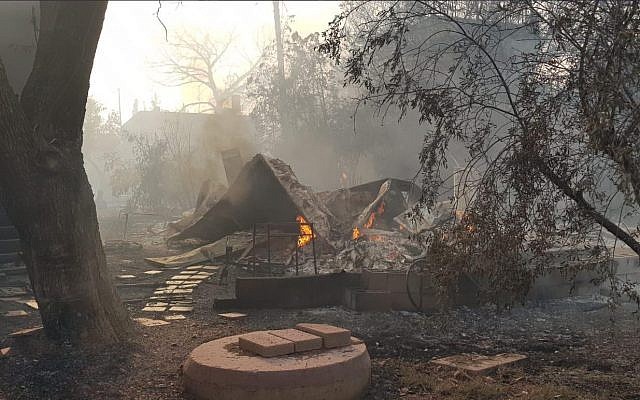
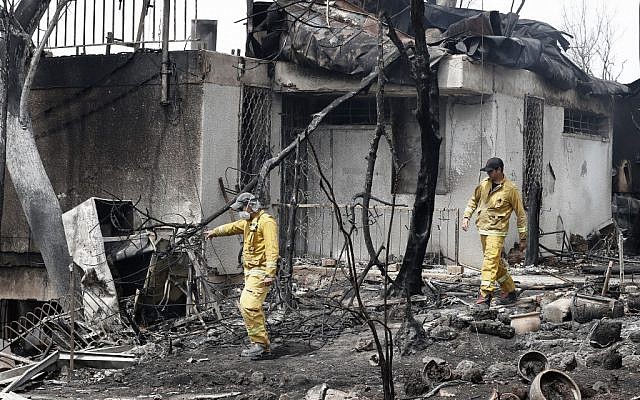
There were no casualties during the fire that engulfed the central Israeli town on May 23, utterly destroying at least 40 of the 50 homes and community buildings.
On the day of the fire, community leaders started calling for an evacuation at around 2 p.m.
“Within 40 minutes, we evacuated the entire town, and at 3:10 the fire hit the moshav,” said Elnatan Golomb, 31, a father of three who grew up on the Carlebach Moshav, as Mevo Modi’im is commonly called, since it was founded by followers of “singing rabbi” Shlomo Carlebach in the 1970s. “By 5 p.m., we knew it had burned down most of the moshav and we heard we would not be going back.”
Golomb was hosting his oldest daughter’s 6th birthday party when they evacuated. For two days, she was hysterical that she had lost all of her toys, he said.
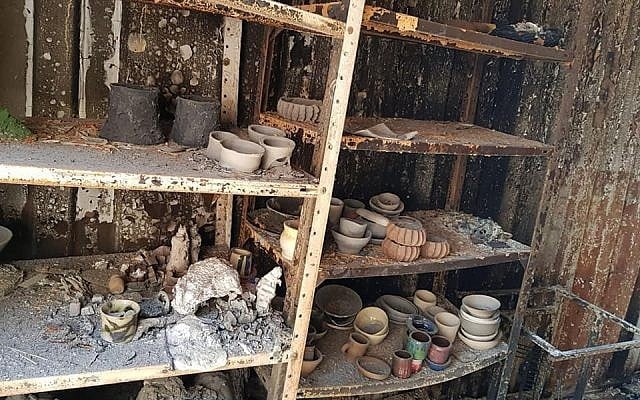
“It’s not just my own private tragedy, it’s the entire community,” said Adamhon Galor, a ceramic artist who lost her home and her ceramic studio with all of her equipment. “The kids lost not only their own house, but also their grandparents’ house, their friends’ houses. If it had been just a few houses, the community would have taken us in and helped us get back on our feet. But because it’s the entire community, there’s nowhere for us to go.”
Even worse than the tragedy, said Golomb, is the complete lack of information about what will happen next. An investigation said that the fire started in four places almost simultaneously, pointing to arson as the likely cause. Government reimbursement is determined by the cause of the fire, with different amounts paid out to victims of arson, terror, or natural disaster.
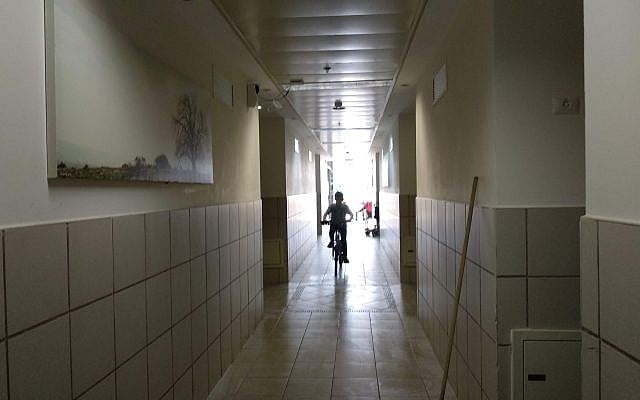
While awaiting information on compensation and where the community will go, most of the families are living in high school dormitories in the towns of Yad Binyamin and Hefets Haim, with each family crammed into a single room.
“We just want to know there’s a future, because there’s a difference between looking into a tunnel or looking into a cave,” said Golomb, visibly exhausted. “With a cave, you can’t see the end. A tunnel can be dark, but at the end, there’s a point of light.”
He said families, already stressed by living with all of their children in a single room, are desperate to know what will happen next — if they will receive compensation, where they will live, if they can stay together as a community and rebuild.
“There is a total and utter lack of information,” said Galor. “No one is saying, ‘we’re giving you compensation,’ or ‘this is how we can help.’ I feel like a refugee here from my own home.”
“There are individual people here helping us, but the country isn’t helping,” she said.
The community is in “survival state,” trying to get through each day, she said.
Golomb said the goal is to build a “temporary moshav” of caravans on the outskirts of Mevo Modi’im while families rebuild their individual homes. Even in this best-case scenario, he acknowledged that families would be in the caravans for at least four years.
Golomb said there are a number of bureaucratic problems that could take a long time to solve, however. The founders of Mevo Modi’im never signed a long-term lease with the Israel Lands Authority, so there could be legal challenges. Almost no one had insurance on their homes.
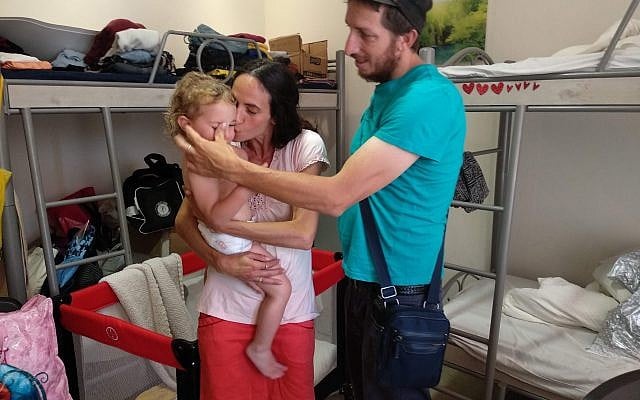
“We are worried that we could get stuck in caravans for 15 years,” said Golomb, referring to Gush Katif evacuees who languished for over a decade in temporary homes. “And then some real estate shark will come and build huge homes in Mevo Modi’im and we’ll be homeless refugees.”
“Instead of investing so much money in campaigns and elections, cough up a small percentage for Mevo Modi’im,” Golomb added.
Golomb said most people were still in shock and hadn’t yet absorbed the loss of their homes. “Because we’re still in transit, I don’t think anyone has really yet understood it,” he said. The community is still accepting donations of electronics, from toasters to refrigerators to computers, as well as furniture and monetary donations. They have plenty of clothes, said Galor, but they could use quality reusable water bottles. They’re grateful for all the food donations but worried about all of the disposable plates and bottles, she said.
“It’s very depressing and said to see a whole community torn up from their roots and moved,” said Golomb, pointing out that even in the country’s wars and tragedies, never has a whole community been completely incinerated. “Even Hezbollah hasn’t managed to erase a whole village yet,” he said. “I opened up the newspaper today and I saw that no one even cares anymore. Instead, they’re talking about putting out NIS 5 billion for another election.”
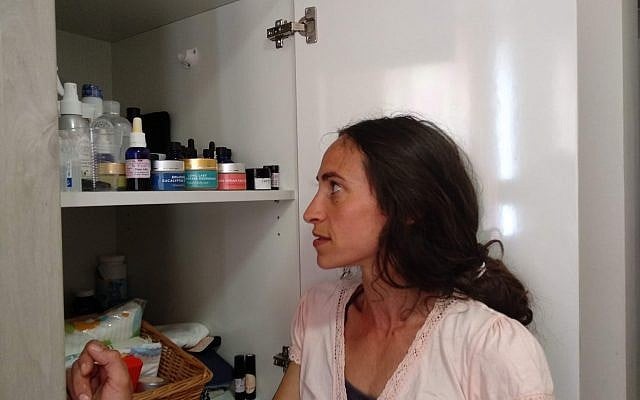
Both Golomb, and his wife Chanita, lost not just their homes but also their livelihoods. Golomb works part-time at the Carlebach Foundation and Educational Center, which also burned to the ground. Chanita runs Chanita’s Naturals, where she makes all-natural herbal cosmetics at home, and she lost everything. “There is a store in Tel Aviv that sells my products, and I’m thinking of going there and buying everything just so I have some left for myself,” she said.
“We left without anything, not even our tefillin or our wallets,” said Moshe Kohen, who grew up on the Moshav and ran a falafel stand. He said he was trying to keep the children in their routines and among their friends to help them cope, but it was difficult living in such close quarters.
“This is a hard time, but it’s also a time for new possibilities,” said Kohen. “Someone who has nothing, has nothing to hold them back.”
“It’s a tragedy for a whole community, but it’s also an opportunity for the community to start anew,” he added. “There are two types of victims: a good victim, that will get up and try to rebuild, the way Jews rebuilt the Temple after it was destroyed, or a bad victim, that is unable to rebuild. This can be a time of new growth.”
Kohen said the fire had definitely put things into perspective, highlighting what is really important, showing the goodness of individuals who came to help “day and night,” even those who had no connection to the moshav before the fire. “But you don’t need to wait for a fire to start anew,” he said. “We shouldn’t need to wait for a fire to see this.”
After the black and white concert at the entrance to Mevo Modi’im, residents returned to their dormitory at a yeshiva high school at Yad Binyamin. Piles of bags of diapers sat in the corner of a courtyard, as children and parents milled about, talking, smoking cigarettes, trying to find themselves.
One of the families on the moshav planned to celebrate a Bar Mitzvah at the dormitory on Thursday night, keeping their original date for the celebration despite losing their homes. It was a chance to celebrate, but also a reminder of what was lost, and the uncertainty that hovers over them while the authorities drag their feet.
“For years, we’ve opened our homes to all sorts of people,” who came to visit the Carlebach moshav, said Golomb. “Now, we need the government to do the same.”









The Times of Israel Community.