

Sporadic rocket fire from Gaza shows IDF’s deterrence eroding
In the five months since Pillar of Defense, 19 missiles have been fired at Israel. And while the IDF fires back at Hamas targets, those aren’t actually the right address

 Add ToI as a Preferred Source on Google
Avi Issacharoff, The Times of Israel's Middle East analyst, fills the same role for Walla, the leading portal in Israel. He is also a guest commentator on many different radio shows and current affairs programs on television. Until 2012, he was a reporter and commentator on Arab affairs for the Haaretz newspaper. He also lectures on modern Palestinian history at Tel Aviv University, and is currently writing a script for an action-drama series for the Israeli satellite Television "YES." Born in Jerusalem, he graduated cum laude from Ben Gurion University with a B.A. in Middle Eastern studies and then earned his M.A. from Tel Aviv University on the same subject, also cum laude. A fluent Arabic speaker, Avi was the Middle East Affairs correspondent for Israeli Public Radio covering the Israeli-Palestinian conflict, the war in Iraq and the Arab countries between the years 2003-2006. Avi directed and edited short documentary films on Israeli television programs dealing with the Middle East. In 2002 he won the "best reporter" award for the "Israel Radio” for his coverage of the second intifada. In 2004, together with Amos Harel, he wrote "The Seventh War - How we won and why we lost the war with the Palestinians." A year later the book won an award from the Institute for Strategic Studies for containing the best research on security affairs in Israel. In 2008, Issacharoff and Harel published their second book, entitled "34 Days - The Story of the Second Lebanon War," which won the same prize.

Saturday’s rocket fire on the Sdot Negev Regional Council while residents were celebrating around their Lag B’Omer bonfires — a Kassam that landed in open ground — offered renewed evidence of a fact Israel is loath to admit: the IDF’s Gaza deterrence is eroding.
Slowly and unsafely, Israeli residents of the south are returning to a grinding and familiar daily reality: Every once in a while, a rocket falls in or next to one of the towns and villages in the area; Israeli political and military leaders promise that there will be no return to the grim routine of intermittent rocket fire that prevailed before November’s Operation Pillar of Defense; the IDF strikes unmanned targets in Gaza; and the cycle continues. As of Sunday night, when yet another rocket was fired, a total of 19 rockets had fallen on Israeli territory in the five months since the end of Pillar of Defense.
But there’s a complication. Israel always formally blames Gaza’s Hamas rulers for any rocket fire out of the Strip. They’re the government; they are responsible. Yet the IDF and Israel’s decision makers know Hamas is actually making considerable efforts to prevent the firing of rockets into Israel. Just recently, Hamas reestablished a military body charged with thwarting rocket attacks, which was last active several years ago. Gaza sources say the unit has been given new equipment and has extra personnel patrolling border areas in uniform and plainclothes.
Hamas has also arrested various rival Jihad operatives who tried to launch rockets in the past few weeks. Embarrassingly, some of the detained terrorists being held in Hamas prisons have launched hunger strikes to protest their arrests.
One consequence of this reality is that Israel’s routine retaliatory strikes at Hamas targets — instead of at those directly responsible for the rocket fire — will do nothing to renew deterrence in the short-term. Quite the reverse. Injuries to Hamas members from Israeli attacks will probably lead to “measured responses” by Hamas, namely fire at Israeli villages close to the Gaza border, creating further tensions that could rapidly escalate.
There are no magic solutions. It may be possible for Israel to increase the pressure on Egypt to, in turn, tighten the screws on Hamas. But as long as Israel is interested in avoiding a wide-scale operation in Gaza, its arsenal of carrots and sticks is limited.
Another Pillar of Defense-style operation could produce at least a temporary period of calm, but this too would presumably be followed by a resumption of fire. A far more dramatic ground operation, eschewed by Israel in 2008-9’s Operation Cast Lead and again in Pillar of Defense, aimed at bringing down the Hamas regime and/or retaking the Gaza Strip, does not seem like a realistic solution for several reasons: firstly the large number of likely Israeli and Palestinian casualties, and secondly the lack of a viable alternative to Hamas. The Islamist group continues to vow it will never to recognize Israel, but at the same time it is trying to maintain its ceasefire agreement and keep indirect financial and humanitarian cooperation routes open.
Ten days ago, two rockets were fired on the Negev. A day later, Jihad operatives fired two Grad rockets, this time towards the southern resort city of Eilat, one of which landed in the backyard of a house, causing some damage. The IDF avoided retaliating militarily, perhaps out of a desire to allow Egyptian intelligence to pressure Hamas, and settled for closing the Kerem Shalom border crossing. On Saturday night, the army didn’t settle for just stopping the transfer of goods and bombed two targets in Rafah and Khan Younis.
Palestinian sources say they were an Islamic Jihad warehouse and a Democratic Front for the Liberation of Palestine structure. The IDF says both targets belonged to Hamas.
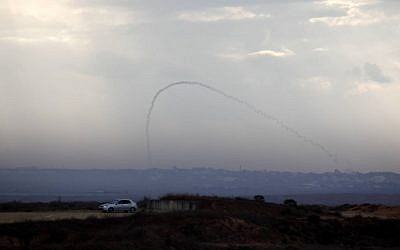
Israel plainly hopes the escalated response will produce a longer lapse in rocket fire. Perhaps. But a complete end to the sporadic fire — the traumatic drip-drip of rocket attacks to which the south has become so bitterly accustomed over recent years — seems unrealistic.









The Times of Israel Community.