

The French correction
Papers celebrate the defeat of Le Pen at the polls, but given the support she did get, apathy toward Macron and remaining ills in Europe, they muster little more that cautious optimism
- See more Times of Israel on Google - add us as a Preferred Source
Joshua Davidovich is The Times of Israel's Deputy Editor
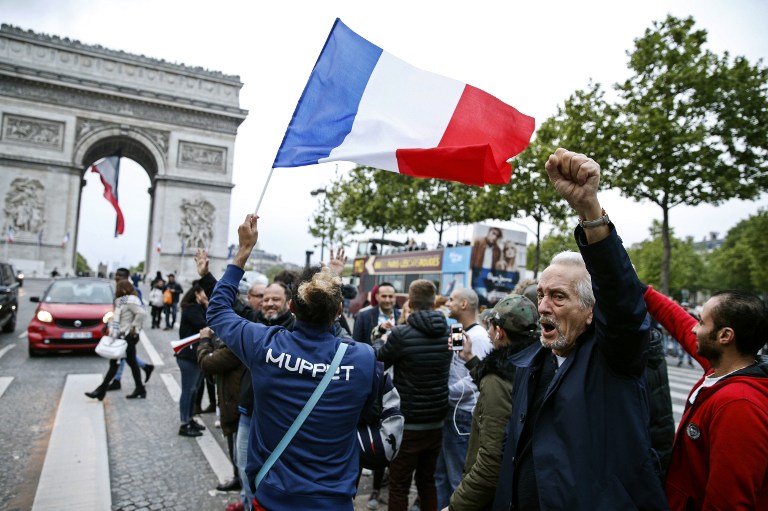
For the first time in a long time, things went how they were “supposed” to. The preferred option of enlightened Western centrists walloped the far-right nationalist demagogue choice as the world power went to the polls. Normally ho-hum, but with Trump, Brexit and Russian hacking becoming shorthand for the formation of a new world order, the victory in France by Emmanuel Macron was anything but a given and Israeli pundits, despite being thousands of kilometers away, pay very close attention, as they have throughout the race.
The papers and their pundits don’t exactly hide their excitement over Macron’s win, though Israel Hayom has the most muted coverage. Luckily for the right-wing tabloid, it was able to hide whatever disappointment it might feel in the results (and it’s not clear it has any) behind an exclusive message by patron saint US President Donald Trump who previews his upcoming trip to the region with an anodyne message about plans to discuss Iran, Islamic State and peace talks.
On the other end of the spectrum is Yedioth Ahronoth, which runs a front page headline “le President Macron” in French, festooned with with the French flag and taking up the first eight pages of the paper.
“Not yet 40 and leading a power,” reads the headline on a gushing story about his victory, which includes a rundown of all the things the 39-year-old wunderkind will now have his hands on, including a UN Security Council veto, the sixth-largest army in the world, nuclear arms, 67 million people and the 10th biggest economy in the world.
Yet most of the coverage of the victory, in Yedioth and elsewhere, focuses not on Macron, but rather on the wider implications of the French electorate’s choice.
“France broke the global trend. It restored dimensions of certainty to the international system, a certainty that had slipped away from our fingers,” writes columnist Nadav Eyal in the paper. “No, the EU will not fall apart so quickly. No, Trump and Putin do not choose the princes to serve their ideology. Fact: They both wanted [Marine] Le Pen and received a French version of Obama. A nightmare for both, especially for the Kremlin.”
Haaretz’s front page features no fewer than five analyses/op-eds on the French results, combining to paint a picture of cautious optimism.
“From this morning French society and French politics will have to roll up their sleeves and get their hands dirty. Not just because the elections for the national assembly can expose the weakness of the president-elect, who lacks any real political base, but also because Marine Le Pen managed to define the presidential election as a choice between two options: patriots and globalists. The patriots are for the republic, the globalists against.”
While several of the columns take note of the fact that Macron won not because he is popular but because most hated Le Pen, writing of the high number of protest votes and low turnout, Paris correspondent Dov Alfon still says other world leaders can learn a thing or two from the new president.
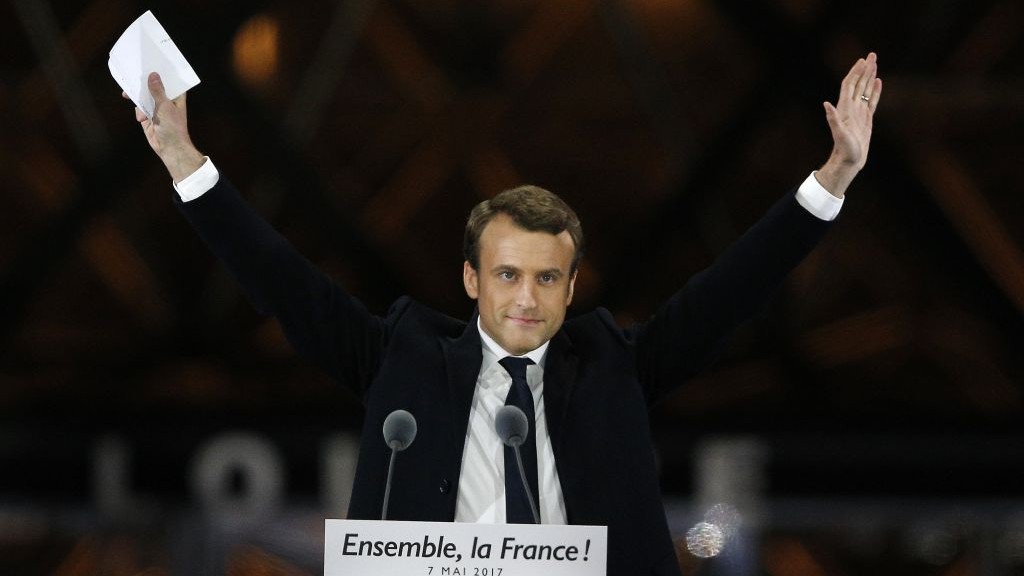
“The most important quality in politics is determination,” he writes. “Macron captured the Elysee Palace from out of nowhere, with no party, no allies, and confronted by experienced rivals who pounded him incessantly. But he kept his eye on the prize, and even when he found himself on the boards due to plenty of mistakes, he always found the strength to pick himself up and continue. That’s how – with some help from Lady Luck – he bumped other candidates out of the race, including incumbent President Francois Hollande and former President Nicolas Sarkozy, whose approval ratings were initially far higher than Macron’s. In the end, he also prevailed over the head of the National Front, who had the only partially concealed support of two of the world’s most powerful leaders – Russian President Vladimir Putin and US President Donald Trump.”
In Israel Hayom, though, Pierre Gandus joins others in expressing worries over what the low turnout and lack of excitement even for victor Le Pen could mean for the Republic, comparing her loss Sunday to her father’s loss in the second round in 2002.
“You should have seen everyone is Paris enlisting. Everyone marched together to the voting booth to stop the extreme right. We didn’t see that this time. Instead you saw apathetic people glued to their phones and tablets, apathetic toward the tangible threat of the National Front. A sad sight,” he writes.
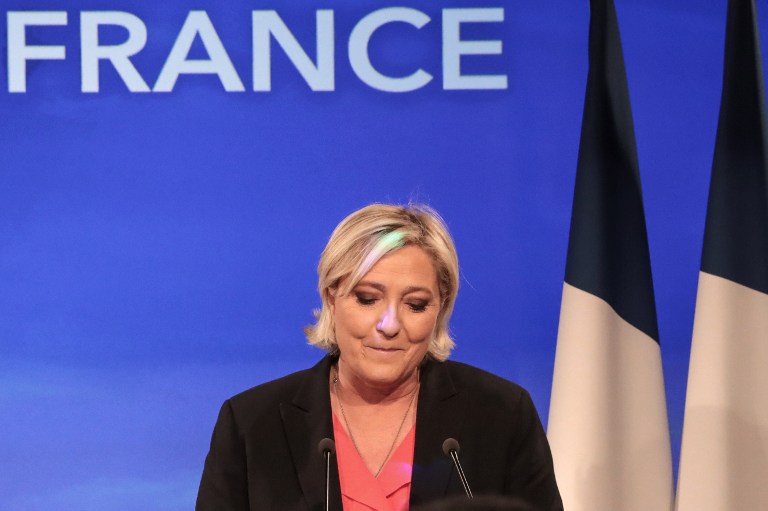
In the paper’s op-ed page, Dror Eydar, without lamenting the loss of Le Pen, raises worries over the future of a Europe unwilling to fight radical Islam and calls on French Jews to move to Israel.
“Fearing the trends that preceded the catastrophe of World War II, the continent has gone to the other extreme. Now everyone is fighting against the ideas that Le Pen represents. And what happens now? Are the Islamists just going to disappear? European Jews are currently facing a real threat, and it isn’t from the traditional Christian anti-Semites. It is from Islam,” he writes.
But what Israel will they come to? A diverse society that is Jewish but respects its Arab minority or one where the state’s Jewish character is enshrined as more equal all others, as per a bill advanced by the Ministerial Committee for Legislation on Sunday, which gives papers much to wring their hands over.
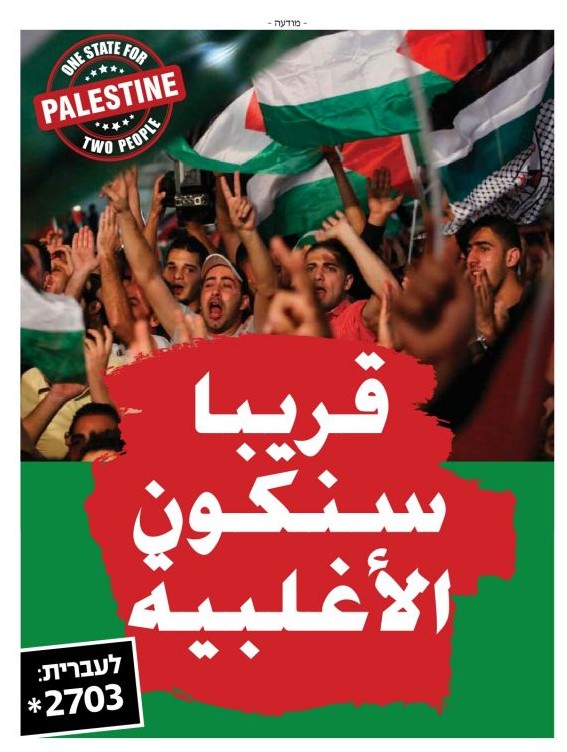
Yedioth Ahronoth uses a picture of a street sign in Hebrew, English and Arabic to illustrate the fact that Arabic may soon be downgraded and features a column by novelist Ayman Sikseck with a headline in Arabic reading “We are here.” Sikseck laments the disappearance of Arabic from the public sphere and points to a recent ad calling for separation from the West Bank which used Israelis’ lack of knowledge of Arabic as a scare tactic.
“The more Arabic is not around, the more it will be seen as a threat,” he writes. “This is how Arabic will turn from a minority language seen in everyday life to a language practically unseen in the public sphere, and at the end of the day into a weapon for copywriters who want to create a public panic.”
Haaretz’s lead editorial calls the bill a “cornerstone of apartheid” and writes that its real purpose is to do the opposite of what those who made that ad wanted: annex the West Bank.
“The nation-state law is fundamentally antithetical to democracy, as it seeks to enshrine the rule of a Jewish minority over an imagined Arab majority,” the editorial reads. “This is a fearful and aggressive move by a people that sees itself as a minority and is preparing to maintain control over an apartheid state that contains a Palestinian majority living under its rule. Yet even before that point is reached, the law discriminates against members of Israel’s Arab minority and legally labels them as second-class citizens.”
Meanwhile, the press also has a field day with a video purt out by the Prison Service showing hunger strike leader Marwan Barghouti munching on a Tortit candy bar.
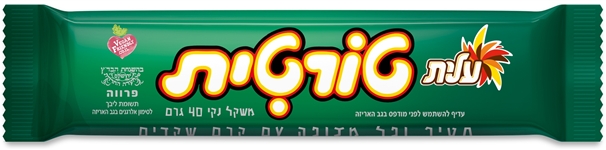
It’s the candy bar that’s the star of Israel Hayom’s coverage, which headlines its story “The Tortit that broke Barghouti.”
“One little Tortit. That’s all it took to break the ‘leader of the Palestinian prisoners,’” writes the paper snottily.
Yedioth’s coverage is just as silly, garnishing the short story with a picture of its headline the last time Barghouti was caught breaking a hunger strike, in 2004, and reproducing a number of ribald tweets making fun of the inmate and the lowly snack.
“I understand breaking a hunger strike for a Mekupelet or a Pesek Zman — but can’t figure out for a Tortit,” MK Oren Hazan is quoted tweeting. Hilarious.







The Times of Israel Community.