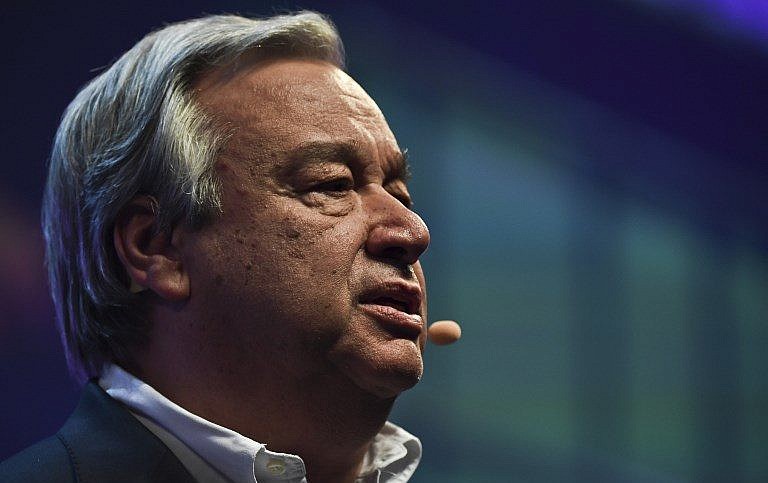
United Nations secretary general Antonio Guterres delivers a speech during the opening ceremony of the 2017 Web Summit in Lisbon on November 6, 2017. (AFP/Patricia de Melo Moreira)
UNITED NATIONS — UN Secretary-General Antonio Guterres warned Friday that a new conflict in Lebanon would have “devastating consequences” and said he was engaged in intense contacts with all players to urge de-escalation.
Lebanon’s prime minister Saad Hariri resigned in a shock announcement broadcast from Riyadh on Saturday as a power struggle intensified between Saudi Arabia and Iran, which backs Lebanon’s Hezbollah movement.
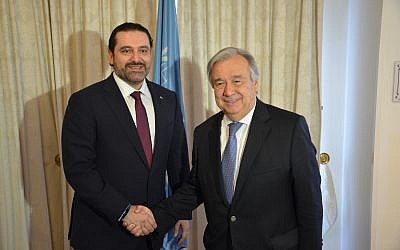
Antonio Guterres meeting with Saad Hariri in Brussels on April 4, 2017. (UN/Christophe Verhellen)
“It is essential that no new conflict erupt in the region,” Guterres told reporters. “It would have devastating consequences.”
“This is a matter of great concern to us. What we want is for peace to be preserved in Lebanon.”
Guterres said he had been holding “very intense contacts” with Saudi Arabia, Lebanon, other countries in the region as well as governments with influence in the Middle East.
Get The Times of Israel's Daily Editionby email and never miss our top stories
“We are indeed very worried and we hope that we won’t see an escalation in the region that would have tragic consequences,” said Guterres.
The UN chief spoke to Saudi Foreign Minister Adel al-Jubeir on Wednesday.
The head of Lebanon’s Hezbollah terror group said in Beirut that Hariri was “detained” by Saudi Arabia and prevented from returning to Lebanon.
Advertisement
Saudi Arabia and Kuwait have urged their citizens to leave Lebanon.
Help us report truthfully on social media
As a multimedia journalist, my job is to take the quality, fact-based journalism produced by The Times of Israel newsroom and make it accessible across every platform — from Instagram posts to podcasts to short-form videos.
This is how many, especially young people, consume news these days. But misinformation is rampant on social media. Our team at ToI produces accurate, responsible short-form reporting on Israel and the Jewish world.
If you believe in the importance of factual social media journalism, please consider joining our reader support group, The Times of Israel Community. Your financial support is essential to sustain responsible multimedia reporting.
We’re really pleased that you’ve read X Times of Israel articles in the past month.
That’s why we started the Times of Israel - to provide discerning readers like you with must-read coverage of Israel and the Jewish world.
So now we have a request. Unlike other news outlets, we haven’t put up a paywall. But as the journalism we do is costly, we invite readers for whom The Times of Israel has become important to help support our work by joining The Times of Israel Community.
For as little as $6 a month you can help support our quality journalism while enjoying The Times of Israel AD-FREE, as well as accessing exclusive content available only to Times of Israel Community members.
Thank you, David Horovitz, Founding Editor of The Times of Israel


 Add ToI as a Preferred Source on Google