

You don’t believe we’re on the eve of destruction
Hebrew pundits are out in force proclaiming (or not) the Third Intifada after 2 Israelis slain by a Palestinian terrorist in Old City
 Add ToI as a Preferred Source on Google
Ilan Ben Zion is an AFP reporter and a former news editor at The Times of Israel.
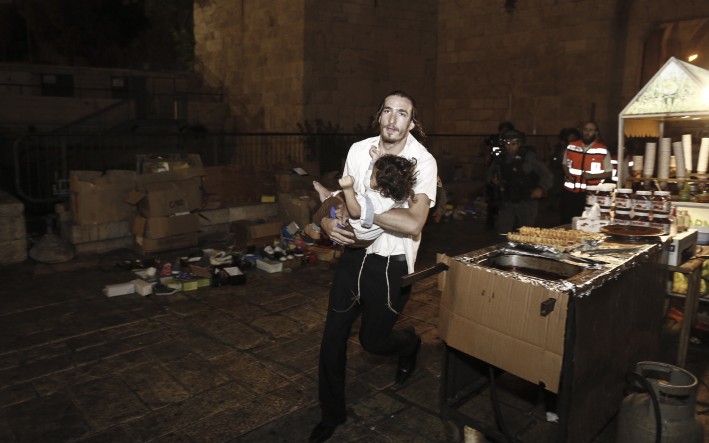
If it were up to the Hebrew press, the third intifada would already be a reality following three Palestinian terrorist attacks in as many days that left four Israelis dead and several injured. The murder of two Israelis in the Old City of Jerusalem Saturday night dominates the news coverage Sunday — and the papers went to print before they could report on a second attack in the early morning hours.
The tabloids play up the heroism of Nehemia Lavi, 41, who was stabbed to death after rushing to aid of Aharon Banito, 21, and his wife and child. “Two baby carriages orphaned — that’s what remains at the site of a terrorist attack in the Old City of Jerusalem,” Yedioth Ahronoth writes. “Slaughter on the way to the Kotel,” reads the headline in Israel Hayom. Haaretz, with more sober reporting, points out that the Banito family was headed away from the Western Wall, but that’s not as scintillating a headline.
But news of the attack plays second fiddle in the morning papers to the hosts of pundits who are out in force, opining on the implications of the spike in violence. Haaretz puts four op-eds by its authors across the front page, with cheery, snappy headlines such as “On the brink of the abyss,” “No law and no order,” “Steps without influence” and “Abbas’s paradox.” Yedioth Ahronoth runs three whole pages of op-eds, starting with Nahum Barnea’s front page proclamation that this is the outbreak of the much-anticipated “third intifada” and compares it to the outbreak of the first intifada in 1987.
“It’s important that we call it by its name because not calling it by its name allows the political and military establishment to shirk, avoid, and run from responsibility,” he says. If history is a lesson to Barnea, it’s only a matter of time until Palestinian suicide bombers start blowing themselves up across the country.
He offers an optimistic outlook, saying that there’s no military solution to “spontaneous waves of terrorism” such as the ones crashing against Israel at the moment. “The Shin Bet can quickly catch one cell, a soldier or police officer can shoot a terrorist, but this wave won’t be broken,” he writes. He says the current uprising is not a consequence of “lack of political hope, but because of a lack of all hope” — from the Palestinian Authority and its president to the economy to the Arab world.
“Even from Allah there is no hope,” he writes. “The youths who shout ‘Allahu akbar’ when they throw rocks at Israeli civilians’ cars, or when they stab worshipers on HaGai Street in the Old City [of Jerusalem] know that they’re shouting in vain. Allah hasn’t done a thing for the Palestinians since the defeat of 1948. Allah isn’t the cry of their hope: it’s the cry of their despair.”
In Israel Hayom, whose reportage on the attack takes a more dramatic tone than the cut and dried reporting by Haaretz, Nadav Shragai says the stabbing in the Old City was “reminiscent of the riots and murders that took place at the very same spot during the 1929 Arab riots.”
“The Palestinian terrorist who perpetrated Saturday’s attack acted in plain view of the multitude of security cameras stationed in the area,” which is a major thoroughfare for Jews, Arabs and tourists alike, he says. “This fact alone indicated that deterrence has been completely eroded; that something has gone terribly wrong, and that something has to be done immediately.”
His solution? “To increase Jewish presence in the Old City” by having the state encourage Jews to move to the Muslim Quarter where the attack took place and along all streets leading to the Western Wall. “That is the proper Zionist response, the real response to the terrorism that strikes at us relentlessly, as if it no longer has anything to fear.”
While Yedioth Ahronoth’s pundit-in-chief argues that the flare-up of violence stems from a lack of hope, Israel Hayom’s argues that “the Palestinian Authority’s wild, incessant, systematic incitement against Jews” is to blame. Whereas Barnea says the third intifada is here, Shragai more cautiously says “We may be in the brink of the foretold third intifada.” Haaretz‘s editorial says “a third intifada is on the way” and that while it’s not here yet, “in the absence of any hope for the future, an uprising is likely.”
Contrary to Shragai’s proposal in Israel Hayom, Haaretz says that settlement construction and a military crackdown would only exacerbate the situation. “Genuine, courageous and far-reaching diplomatic action is the only thing that can head off the violent uprising and put a halt to the risk of bloodletting that is hovering over the residents of the region.”






The Times of Israel Community.