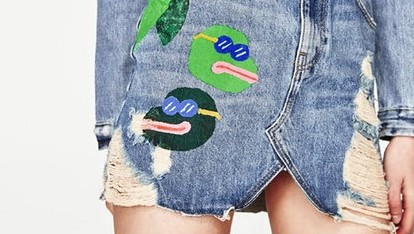
A skirt pulled by Zara following outrage over what appears to resemble Pepe the Frog images, April 2017.
The international clothing chain Zara removed from its website and stores a distressed denim miniskirt printed with an image that resembles the “alt-right” hate symbol Pepe the Frog.
The skirts were withdrawn on Tuesday following a social media backlash, The New York Times reported.
“The skirt is part of the limited Oil-on-Denim collection, which was created through collaborations with artists and is only available in selected markets,” a Zara spokesman told the Times. “The designer of the skirt is Mario de Santiago, known online as Yimeisgreat. There is absolutely no link to the suggested theme.”
Santiago is a Spanish artist who told Zara that the frog face “came from a wall painting I drew with friends four years ago.”
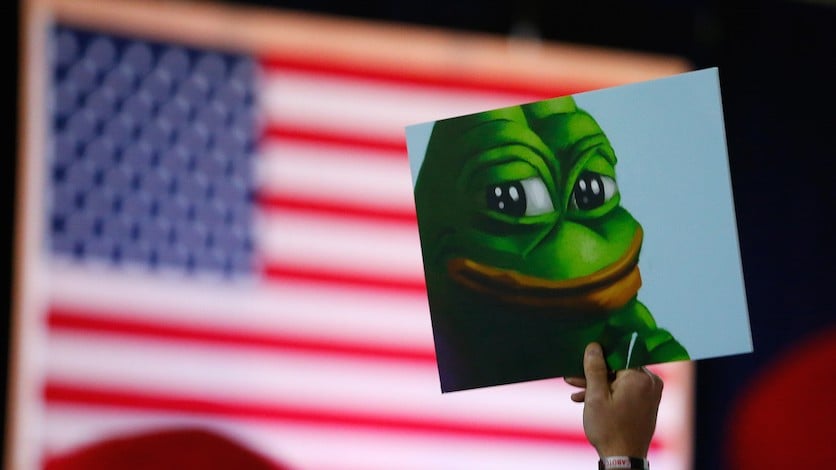
A Donald Trump supporter holding a poster of Pepe the Frog, which is a symbol of the alt-right movement, at a campaign event in Bedford, New Hampshire, on September 29, 2016. (Jessica Rinaldi/The Boston Globe via Getty Images)
In September, the Anti-Defamation League added the internet meme Pepe the Frog, a cartoon character that has become a popular symbol for white supremacists, to its online hate database. Images of the frog, variously portrayed with a Hitler-like mustache, wearing a yarmulke or a Ku Klux Klan hood, proliferated in hateful messages aimed at Jewish and other users on Twitter in the weeks leading up to its inclusion in the online hate database.
Get The Times of Israel's Daily Editionby email and never miss our top stories
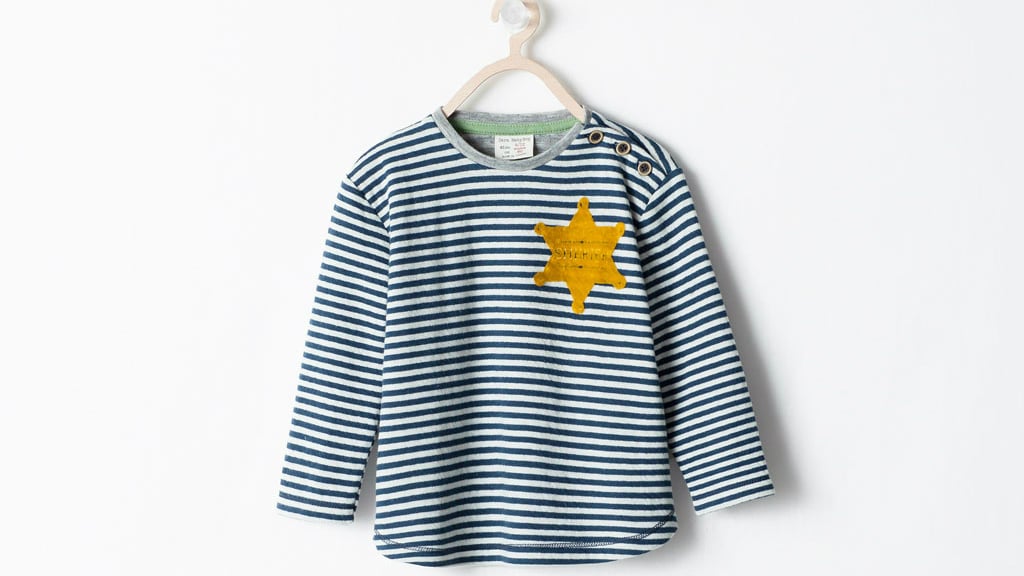
In 2014, Zara apologized for selling a blue-and-white-striped shirt with a six-pointed yellow star on the chest for toddler boys that resembled a Holocaust concentration camp inmate’s uniform.
International fashion chain Zara’s 2014 ‘sheriff’ shirt provoked an outcry that quickly saw the clothing outlet removing it from its shelves. (screenshot)
In September 2007, Zara removed a handbag with embroidered swastikas that was manufactured in India and inspired by commonly used Hindu symbols, which include the swastika.
Advertisement
Help us report truthfully on social media
As a multimedia journalist, my job is to take the quality, fact-based journalism produced by The Times of Israel newsroom and make it accessible across every platform — from Instagram posts to podcasts to short-form videos.
This is how many, especially young people, consume news these days. But misinformation is rampant on social media. Our team at ToI produces accurate, responsible short-form reporting on Israel and the Jewish world.
If you believe in the importance of factual social media journalism, please consider joining our reader support group, The Times of Israel Community. Your financial support is essential to sustain responsible multimedia reporting.
We’re really pleased that you’ve read X Times of Israel articles in the past month.
That’s why we started the Times of Israel - to provide discerning readers like you with must-read coverage of Israel and the Jewish world.
So now we have a request. Unlike other news outlets, we haven’t put up a paywall. But as the journalism we do is costly, we invite readers for whom The Times of Israel has become important to help support our work by joining The Times of Israel Community.
For as little as $6 a month you can help support our quality journalism while enjoying The Times of Israel AD-FREE, as well as accessing exclusive content available only to Times of Israel Community members.
Thank you, David Horovitz, Founding Editor of The Times of Israel


 Add ToI as a Preferred Source on Google