

Charlie Hebdo cartoonist will no longer draw Mohammed
Luz, who illustrated French satirical magazine’s cover following deadly Paris attacks, denies that terrorists have won
 Add ToI as a Preferred Source on Google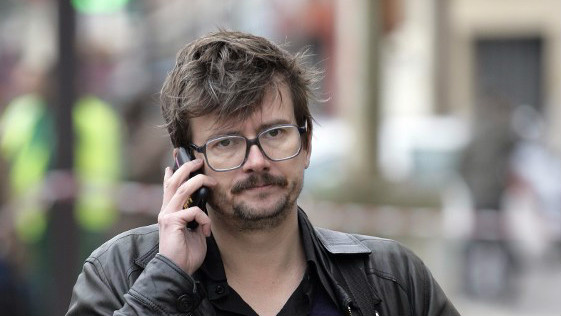
French Cartoonist Luz, who drew Charlie Hebdo’s front cover picture of Mohammed following the massacre of the satirical weekly’s editorial team by jihadists in January, told a French magazine he will no longer draw the prophet.
“I will no longer draw the figure of Mohammed. It no longer interests me,” he told Les Inrockuptibles magazine in an interview published on Wednesday.
“I’m not going to spend my life drawing (cartoons of Mohammed).”
Luz’s cover image in January portrayed Mohammed with a sign saying “Je Suis Charlie” under the words “all is forgiven.”
The issue came out a week after the attack by jihadists on the magazine’s office left 12 dead. It had a print run of eight million — a record for the French press.
“The terrorists did not win,” Luz told Les Inrockuptibles.
“They will have won if the whole of France continues to be scared,” he added, accusing the far-right National Front of trying to stir up fear in the wake of the attacks.
President Francois Hollande announced Wednesday that France would increase its defense budget by close to 4 billion euros ($4.4 billion) over four years, in response to extremist threats after the Paris jihadist attacks.
He also said that emergency military patrols set up at sensitive sites nationwide after the January attacks would be made permanent, with a 7,000-strong force dedicated to internal security.
France has been on high alert since jihadists went on a three-day killing spree in Paris in January that left 17 people dead.
Hundreds of its citizens — more than any other European country — have left to join militant groups such as the Islamic State group (IS) in Iraq and Syria.
Speaking after a meeting with his defense council, Hollande said the decisions were taken to ensure internal security but also the safety of its 9,000 military forces involved in operations abroad.
France is engaged against jihadist groups in Africa’s troubled Sahel region, is central to peacekeeping efforts in the Central African Republic, and is part of the US-led bombing campaign against IS in Iraq.
“Security, protection, independence, these are principles that are non-negotiable,” he told reporters.
“We have the duty to support people who may come under threat, but we also defend our own security.”
The French leader did not say how much of a percentage rise the budget increase represents, nor did he say where cash-strapped France would find the money.
But according to a law setting out defense targets for 2014 to 2019, pouring in an extra 3.8 billion euros ($4.2 billion) in funds over four years would represent a roughly three percent increase, taking overall spending to 131 billion euros.
“It’s a significant effort, it’s even a very big effort,” Hollande said, acknowledging France’s ballooning budget deficit.
“I made this choice for France, for its protection, its security, and I know that if they want to have confidence in the future, the French must feel safe everywhere.”
France had originally planned steep cuts in defense spending, with some 34,000 jobs due to be slashed in the 2014-2019 period.
But Hollande backtracked after the January attacks on Charlie Hebdo magazine, a policewoman and a Jewish supermarket, and said Wednesday that 18,500 of those posts would now be preserved.
The military has complained of being overstretched and having to cut leave and training sessions for some soldiers.
France does not currently meet NATO’s defense spending target — set at 2 percent of economic output — according to analysis by the Stockholm International Peace Research Institute (SIPRI) published earlier this month.
It spent only around 1.5% of its GDP on defense last year, SIPRI said, and that is unlikely to change dramatically with the additional funds.
Only the United States, Britain, Greece and Estonia actually met the NATO spending target, and cuts by the British government are expected to see it slip below the threshold over the next five years, SIPRI said.
A number of countries — notably Germany and Poland — have announced they are boosting defense spending in recent months, primarily in response to perceived renewed aggression from Russia.




The Times of Israel Community.