

Lady and the Trump
Hillary Clinton faced off against her Republican rival at a pro-Israel conference in Washington, but the press shows US interest in Israel is somewhat one-sided
 Add ToI as a Preferred Source on Google
Joshua Davidovich is The Times of Israel's Deputy Editor

The annual AIPAC policy conference is a yearly highlight for Americans eager to show their support for Israel. But even as Americans go gaga for the Jewish state, filling a Washington arena with their clamor to show how pro-Israel they are, it’s not clear that the people in Israel they care so much about actually care much about them.
That apparent disconnect is evidenced by the fact that only one out of three front pages features AIPAC, even with a much-ballyhooed appearance by Donald Trump, and that one paper is Israel Hayom, backed by newly Trump-supporting billionaire Sheldon Adelson.
Despite the extra cost of sending the paper to print late, the tabloid, with Adelson’s pockets and its new-found love for the tycoon-cum-possible-politician, was clearly willing to spend the shekels to feature the speech on its front page.
And despite its headline, which crows about AIPAC’s unexpectedly warm welcome for Trump, the paper features only scant reporting on his speech and a few telling formatting errors that testify to a likely rush to get the paper out the door.
“The tycoon, who was welcomed with cheers at the conference despite assessments to the contrary, said if he is elected he will use the US’s veto to stop the UN from imposing on Israel a peace deal with the Palestinians,” reads one of four sentences on the speech.
It’s true that most predicted a chillier reception for Trump at the conference. Writing without the benefit of hindsight, Haaretz’s Chemi Shalev noted that Democratic front-runner Hillary Clinton received the warmest embrace for AIPAC, helped by her attacks on the mogul.
“Hillary Clinton is a veteran supporter of Israel, but the especially warm reception she received yesterday at AIPAC is thanks to two men: Barack Obama and Donald Trump,” he writes. “Clinton gave a super pro-Israel speech, but the applause rose by several decibels anytime she distanced herself from the tone of Obama or the behavior of Trump.”
Yedioth Ahronoth also includes Trump’s speech in its coverage, though it downgrades his speech to below Clinton’s, in a story buried well inside the paper.
The paper paints the twin appearances as a battle over the Jewish vote, and sees Trump’s pro-Israel promises as him trying to make amends for a comments made hours earlier in which he said Israel would have to repay its defense aid, which it reports “angered Israel supporters.”
“The Jewish vote stood yesterday at the center of attention for the US election cycle – as Democrat Hillary Clinton made a full-force blitz, at the same time as Donald Trump made controversial statements for pro-Israel voters, and then quickly tried to make up for it with a pro-Israel speech,” the paper reports.
The paper’s humble placement of the story, and the front page treatment it gives to a heart-rending package on families of terror victims trying to celebrate the Jewish holiday of Purim, probably give a good idea of what the average Israeli cares more about.
The story features several pictures of families smiling through the pain and vignettes on how they are coping. In terms of pure meta-ness, the story on the family of Dafna Meir, killed outside her home in the West Bank settlement of Otniel, wins out, with her kids and widower dressed as various kinds of double-sided emojis, including happy, angry and devilish.
“We looked for a costume with a double meaning that would express our swirling emotions,” widower Natan Meir tells the paper. “On the one hand, we wanted something that will express the sadness that accompanies us, but on the other hand, we wanted something to show the joy of the holiday and the laughing that continues to be part of our home. We are laughing and crying, crying and laughing.”
Haaretz’s top story is also Trump-free, instead reporting on the government coming out against army veterans group Breaking the Silence over reports it tried to gather operational information on the IDF. The paper highlights anti BtS quotes from Prime Minister Benjamin Netanyahu, Defense Minister Moshe Ya’alon, Justice Minister Ayelet Shaked and Tourism Minister Yariv Levin, but in case anyone accidentally thought it agreed with them, it accompanies its coverage with an editorial and analysis lambasting Ya’alon’s warning that the group could be guilty of treason.
“It’s doubtful that the defense minister … is aware of the serious implications of his remarks. Ya’alon gave in, in cowardly fashion, to the extreme right-wing spirit that has taken over the government. He has added his support to the threats against Breaking the Silence that have intensified in recent months, led by the prime minister and some of his cabinet ministers,” the editorial reads.
Legal analyst Aeyal Gross picks up where the editorial leaves off, reporting that the accusations against the group serve only to bury its work in exposing the ills of the IDF’s activities in the territories.
“The fact that, instead of dealing with the illegitimacy of this regime, we are dealing with the question of whether a specific question asked by Breaking the Silence is relevant to the group’s work or not; and the fact that, instead of accounting for the crimes that occur in the territories as the minister responsible for them, the Israeli Defense Minister dares accuse the organization of treason – all this proves how much the tactic of shooting the messenger has succeeded.”
All the talk of Trump, terror and treason of course distracts from the real history-making story in the press, the end of a decades-long program to bring Yemenite Jews to Israel, which officially ended Monday with the arrival of 17 of the last Jews from the country’s once-thriving Jewish community.
The pride runs thick as molasses in Yedioth and Israel Hayom, which runs the story under the headline “This is what we have a country for.”
The paper’s Boaz Bismuth, as he is wont to do, somehow makes the story of the immigration of the gaggle of Yemenites about himself and a trip he took to Yemen in 1991, the first of many visits abroad he has made on his reporting adventures.
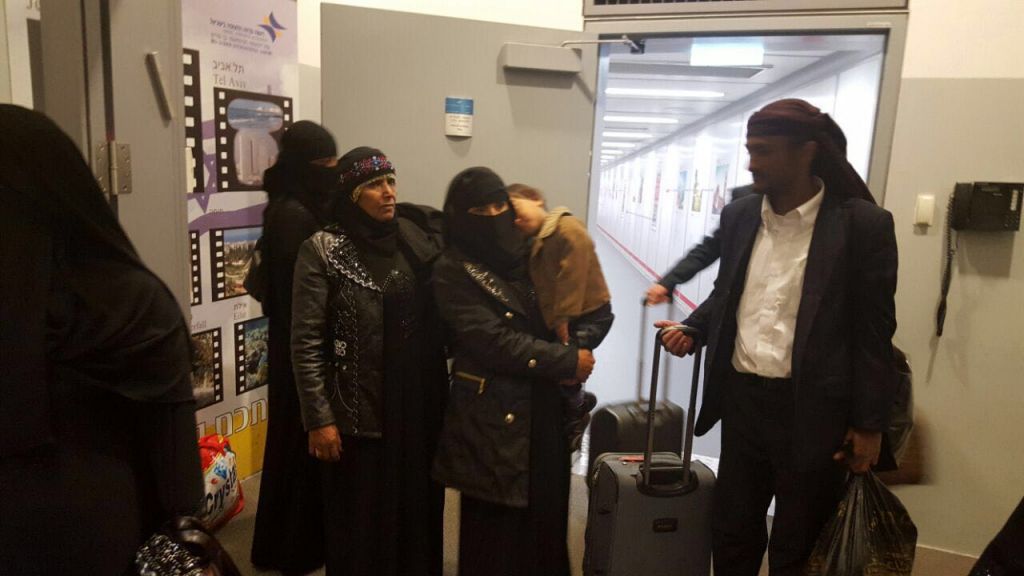
“The reports on the 17 last Jews to emigrate from Yemen brought me back to my various visits to the terror-ridden and war-ravaged country. They took me back to a conversation I had with a Yemenite Jew 25 years ago, who was fighting even back then to come to Israel. He wanted to show me how the community kept a Jewish lifestyle there,” he writes. “I thought yesterday that I had merited to be able to see the Jewish Yemenite community in its natural setting. Today we all merit to see them in an even more natural setting.”
Writing In Yedioth, Ahuva Zaguri notes she actually comes from the Yemenite community, but her commentary unfortunately reads more like the musings of a 19th-century Orientalist bringing a band of savages to the civilized world.
“It’s very exciting to see them. They come from another world. They were from a place that was extremely naïve, a world of simplicity, of goodheartedness,” she writes. “It will be important to keep their culture, not to change them. The Jews of Yemen suffered from extremist Islam, and in Israel there is a big community that can bring them in, help them, give them a hand.”






The Times of Israel Community.