Elie Leshem is deputy editor of The Times of Israel.
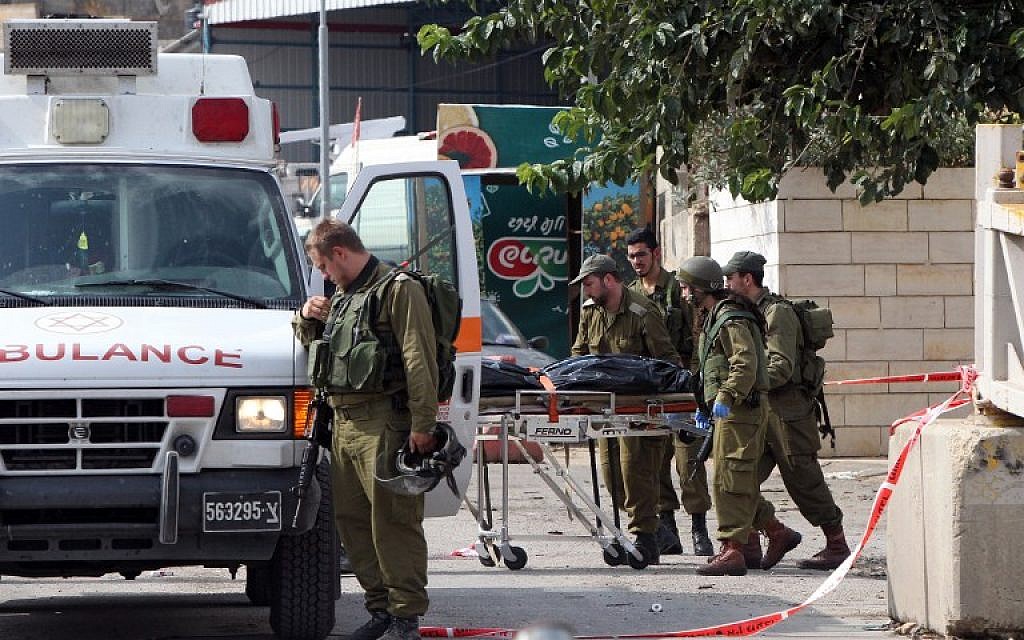
Israeli soldiers evacuate, on a stretcher, the body of Palestinian Raed Jarradat, who had stabbed and seriously wounded a soldier before he was shot dead, on Monday, October 26, 2015, near the West Bank city of Hebron (AFP PHOTO/HAZEM BADER)
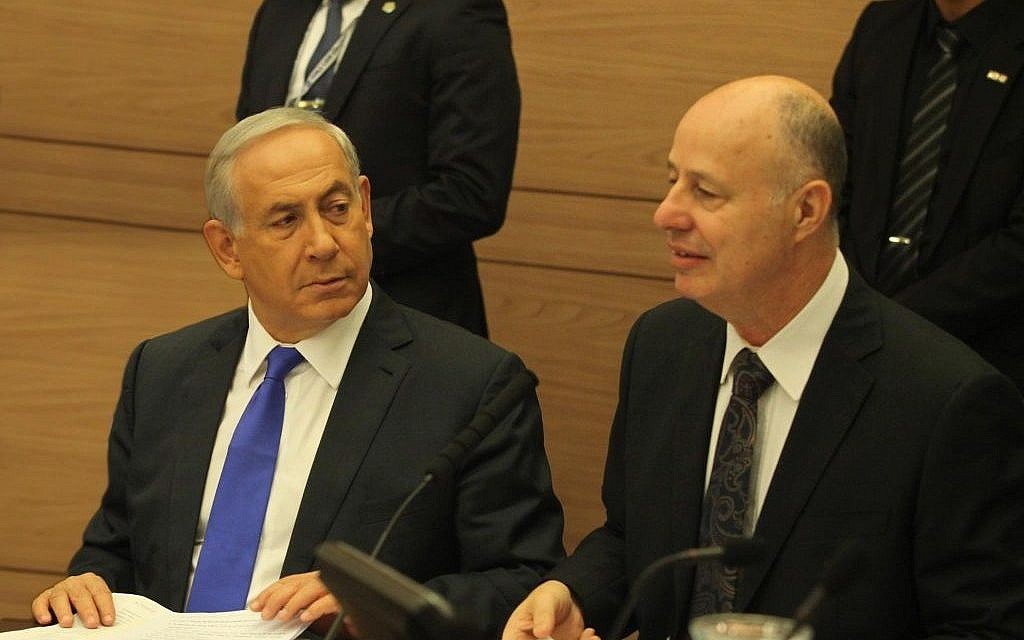
Prime Minister Benjamin Netanyahu attends a meeting of the Knesset Foreign Affairs and Defense Committee alongside the committee's then chairman, MK Tzach Hanegbi, on Monday, October 26, 2015 (Knesset spokesman)
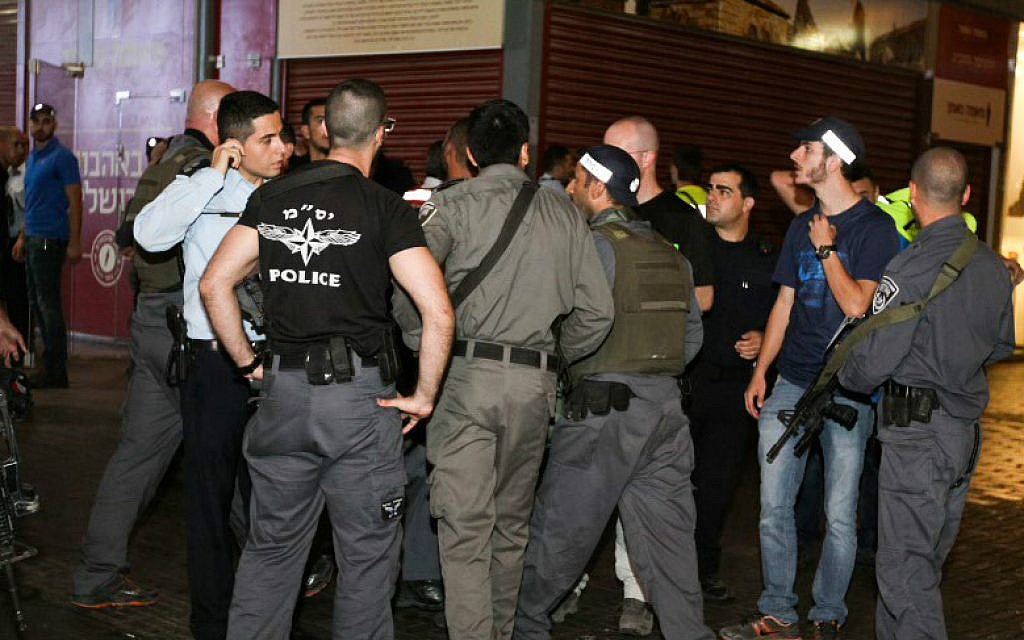
File: Israeli security forces at the scene of a terror attack at the Beersheba central bus station in the southern city, October 18, 2015. (Meir Even Haim/Flash90)
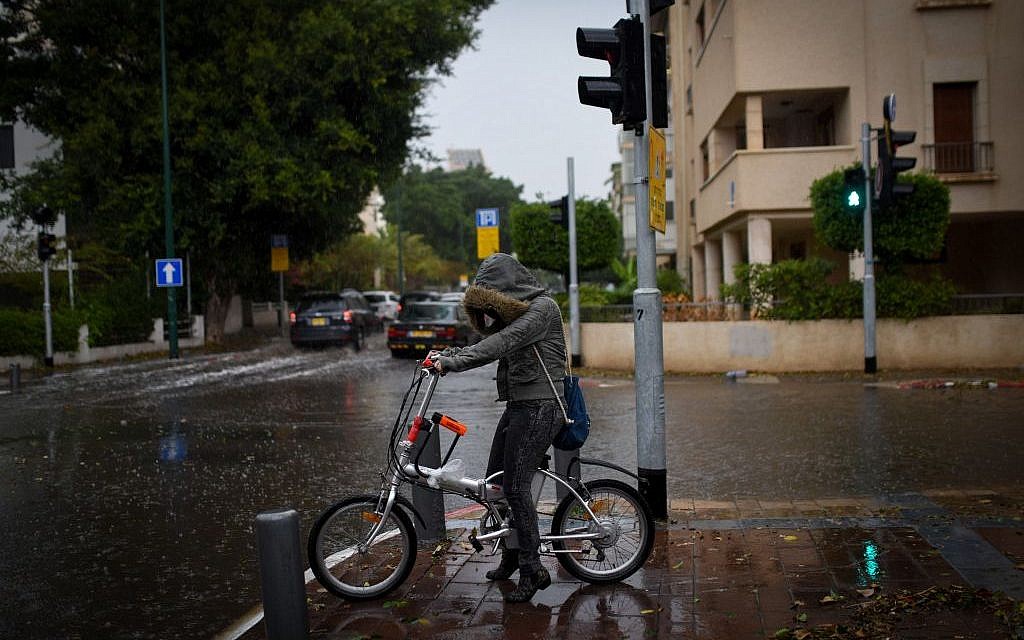
Heavy rain and strong winds as a thunderstorm hits Tel Aviv, on October 25, 2015 (Ben Kelmer/FLASH90)
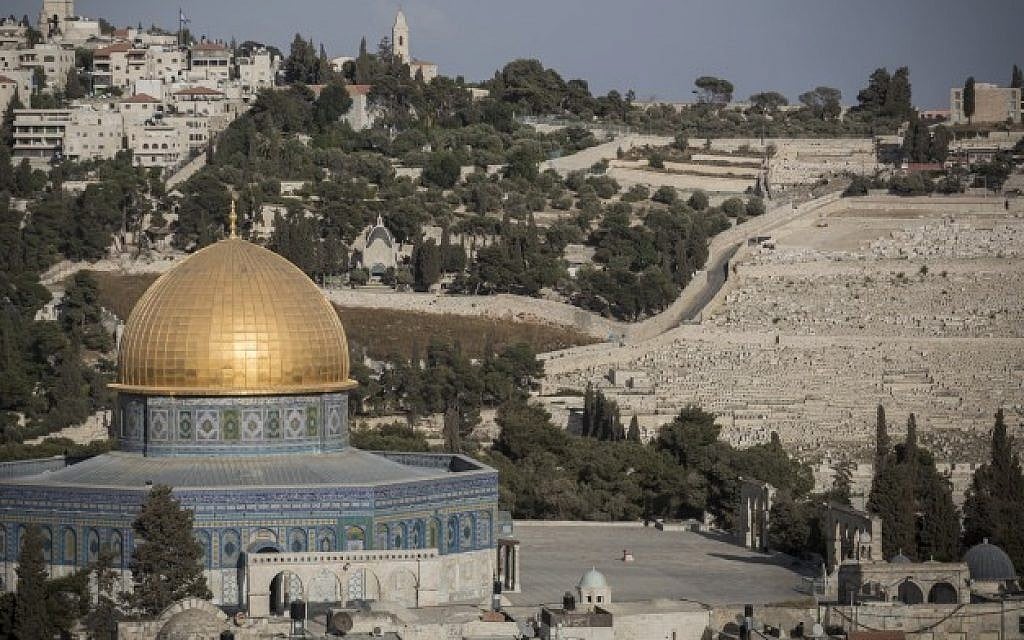
View of the Dome of the Rock on the Temple Mount in the Old City of Jerusalem, September 29, 2015 (Hadas Parush/Flash90)
The Times of Israel liveblogged Monday’s developments as they unfolded.
The public prosecution indicts Omar Alukabi, whose brother Muhanad Alukabi was killed carrying out a deadly terror attack last week in the Beersheba central bus station.
Omar Alukabi, 20, is accused at the Beersheba Magistrate’s Court of failing to prevent the attack by his brother, 21, who according to the prosecution had declared his intention to “liberate” the Al-Aqsa Mosque in Jerusalem and made anti-Semitic remarks.
The prosecution says the younger Alkubi also knew his brother was in possession of a gun.
The prosecution is asking the court to send Alkubi to jail for the remainder of the proceedings against him.
The attack on the bus station killed an IDF soldier, Sgt. Omri Levy, and wounded 11.
An Eritrean man, Haftom Zarhum, 29, died in the hospital after he was shot by a security guard who mistakenly identified him as a terrorist, and also beaten by an enraged mob.
Israel’s population and immigration authority approves a force of 150 Jordanian hotel workers in the southern resort city of Eilat, to replace asylum-seeker workers who have been taken to the Holot detention facility.
The plan, first approved by the cabinet in June, will enable the Jordanians to work only in hotels — not as service providers in other industries.
At the end of every day, they will return to Jordan through the nearby Wadi Araba Border Crossing.
Eventually, up to 1,500 Jordanians could receive permits to work in Eilat.
Prime Minister Benjamin Netanyahu says that while he doesn’t want to bring about a single-state solution to the conflict with the Palestinians, Israel would have to maintain control of the West Bank in “the foreseeable future” in order to ensure security, according to Haaretz.
“These days, there is talk about what would happen if this or that person would have remained. It’s irrelevant; there are movements here of religion and Islam that have nothing to do with us,” Netanyahu says at a meeting of the Knesset’s powerful Foreign Affairs and Defense Committee, according to the report.
Netanyahu tells opposition Knesset members that there is no “magic wand” to resolve the conflict and that Israel will “forever live by the sword,” the report says.
The Israel Electric Corporation announces that some 45,000 households are still cut off from power following Sunday morning’s storm, most of them in the coastal cities of Netanya and Ra’anana.
The IEC calls on Israelis unable to power up their life-saving medical equipment to either use batteries or go to a hospital.
A soldier seriously wounded in a stabbing attack near Hebron in the West Bank earlier Monday undergoes surgery at Jerusalem’s Shaare Zedek Medical Center.
The surgery is described by the hospital as a success, and the soldier’s condition is said to be stable, if still serious.
He is in an induced coma and hooked up to a respirator.
Some reports are now saying that a Palestinian man shot while attempting to stab a soldier in Hebron may not have been killed but is rather in critical condition.
Responding to an apparent misunderstanding as to who will install surveillance cameras on Jerusalem’s Temple Mount, the Prime Minister’s Office issues a statement, saying, “The full arrangements regarding the manner and location of the cameras throughout the Temple Mount, agreed on between Israel, Jordan and the United States, are meant to be coordinated by the professional bodies.”
The statement comes hours after the Muslim authority administering the Temple Mount in Jerusalem’s Old City said it tried to install its own cameras on the Temple Mount, but was blocked by Israeli police.
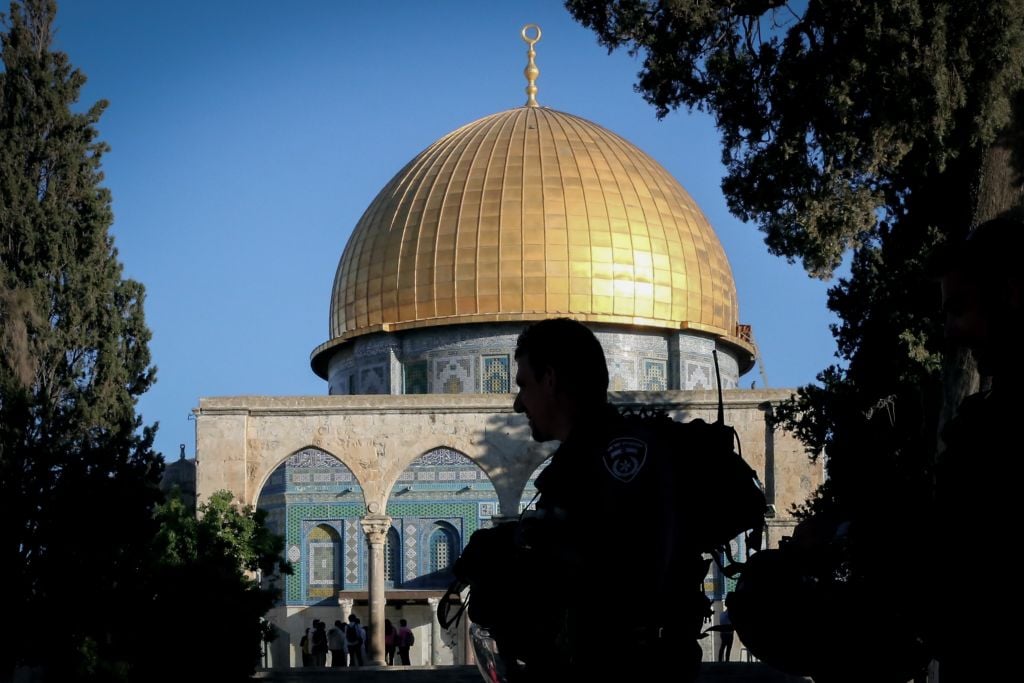
An Israeli policeman patrols Temple Mount in Jerusalem, October 21, 2015. (Yossi Zamir/Flash90)
It quotes US Secretary of State John Kerry, who said on Saturday, “I expect Jordanian and Israeli technical teams will meet soon to discuss the implementation of this idea alongside other measures to maintain and enhance public order and calm.”
According to the PMO statement, “the cameras will be installed based on the results of the arrangements that will be reached by the two sides. Israel has already given its consent for starting the process as soon as possible.”
Prime Minister Benjamin Netanyahu, addressing a memorial ceremony commemorating the assassination of Yitzhak Rabin 20 years ago, says that Israel is a “sanctuary of freedom and human rights” in a Middle East “dominated by the sword.”
But, he continues, “even a thriving democracy sometimes faces moments of crisis.”
He says “extremist Islamist” hatred is the root of the conflict, and asserts that Rabin, too, acknowledged that.
Netanyahu also notes that Rabin, in a speech before his death, pointed a finger at Iran as a promoter of terrorism against Israel.
President Reuven Rivlin, who addressed the crowd before Netanyahu, said that peace cannot include the division of Jerusalem.
The director of the Communications Ministry scrambles to explain statements he made in an interview with Bloomberg published Monday.
In a statement, Shlomo Filber clarifies that while he believes prices in the mobile phone market are too low, he does not think it is a regulatory issue but rather something to be sorted out by the forces of the market.
“The prices in the country are lower than what’s needed,” he says in his clarification. “For the sake of comparison, in Europe they’re 20 euros [a month per phone line].”
But, he adds, “the prices in the market are determined through free competition, and I don’t decide what they will be.”
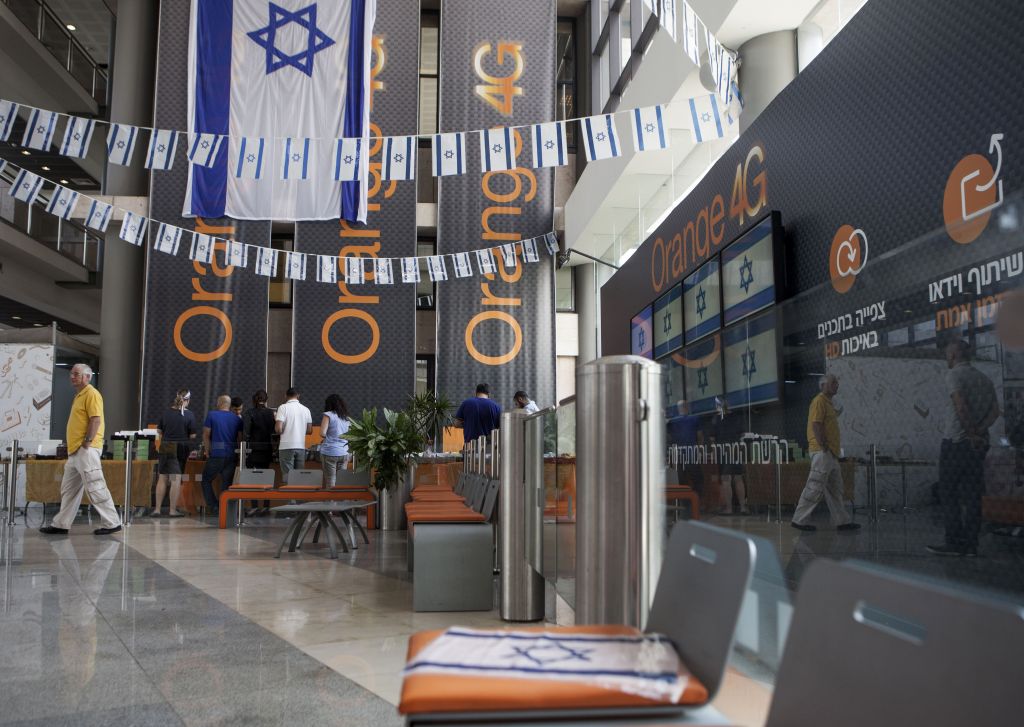
Israeli flags are seen inside the ‘Partner Orange’ Communications Company offices in the city of Rosh Ha’ayin, Israel, Thursday, June 4, 2015. (AP Photo/Dan Balilty)
The Bloomberg piece had indicated that Filber’s stance was a departure from that of some of his predecessors in the ministry — who led reforms that introduced new players to the market, thus bringing on a radical reduction in prices — and implied that regulatory moves to correct the prices could be in the offing.
“OECD prices are around 20 euros (86 shekels), and we should aim for that level,” he was quoted by Bloomberg as saying.
Prime Minister Benjamin Netanyahu is Israel’s communications minister, among several other cabinet roles.
During his speech at the memorial ceremony for Rabin, President Rivlin recalled that the late prime minister, so often associated with Israel’s peace movement, was also at the vanguard of two military campaigns for Jerusalem, during the 1948 War of Independence and the Six Day War 19 years later.
“Rabin was the one who opened the road to Jerusalem, he was the one who united the city, and he was one who instructed us, both the supporters of the Oslo [accords] and those who opposed [them] to defend Jerusalem,” he said.
“Today” — amid numerous attacks on Israelis by East Jerusalem Palestinians — “it is clear to all of us that we can no longer ignore the existence of East Jerusalem. We can no longer repress its existence.”
MK Yair Lapid, who leads the centrist Yesh Atid party, says he has asked the attorney general and to weigh prosecuting MK Moti Yogev for “criminal incitement” against a Supreme Court justice.
Yogev last week criticized a decision by Supreme Court Justice Uzi Vogelman that froze an order to demolish terrorists’ homes, pending hearings on appeals against the demolitions.
In a statement, Yogev had said Vogelman “placed himself on the side of [Israel’s] enemies.”
In a statement, Lapid says that he “waited three days” before reacting to Yogev’s “criminal incitement against Justice Vogelman, the Supreme Court and the rule of law in Israel” because he expected Prime Minister Benjamin Netanyahu to step in and reprimand Yogev.
However, he says, he decided to approach Attorney General Yehuda Weinstein once he realized that Netanyahu would not be responding.
An Israeli teenager who stabbed four Arab men in the southern city of Dimona in an apparent terror attack is indicted in the Beersheba District Court on four counts of attempted murder.
The youth, 17, is also accused of aggravated assault and causing aggravated bodily harm with racist intent.
The attack, which took place on October 9, saw the accused stab one man at a shopping center and then advance to another location next to a local school, where he stabbed three others. A security guard then tackled and restrained him until police arrived.
At the time, police termed the attack “nationalistic,” indicating that it was likely a retaliation for a spate of Palestinian attacks against Israelis, which have exacerbated Arab-Jewish tensions.
Questioned immediately after the attack, the suspect said he had stabbed the four because they were Arabs, and claimed he thinks “all Arabs are terrorists.”
The stabber’s attorney, far-right activist Itamar Ben Gvir, claims his client suffers from mental health issues and was under the influence of drugs during the attack.
However, a court-ordered psychiatric exam found that he was fit to stand trial.
Israeli authorities at a crossing to the Gaza Strip confiscate a large delivery of fabric that, according to suspicions, was to be used by the Strip’s Hamas rulers to make military fatigues.
According to the IDF, while some of the fatigues would be used by Hamas for its own armed forces in Gaza, others were to be delivered to affiliates of the radical Islamic State group in Egypt’s Sinai peninsula.
An investigation has been opened into the suspected smugglers.
Members of the Palestinian National Security service, loyal to Hamas, patrol the southern Gaza strip border on February 10, 2015. (Abed Rahim Khatib/Flash90)
Attorney General Yehuda Weinstein clarifies that it is illegal to shoot suspected terrorists after they have been neutralized and no longer pose a threat.
“The upholding of the regulations and principles that inform our actions is tested most during tense and trying times such as the current one,” he says in a written response to a query from the Arab-Israeli advocacy group Adalah.
The query was sent in light of the many recent cases in which suspected Palestinian attackers were killed by security forces during or after attacks. In one instance, during a terror attack at the Beersheba central bus station, an Eritrean man was mistaken for a terrorist, shot by a security guard, and then severely beaten by an enraged mob. He died shortly after.
The query also follows ambiguous statements from several right-wing politicians that could be read to imply that terrorists should be killed whether or not they still posed a threat.
“The use of a firearm to prevent an immediate life-threatening situation is permitted as long as there is concrete fear of such harm,” Weinstein says, adding, “To use a firearm after the threat to bodily integrity or human life has elapsed would constitute a deviation from the law.”
Berlin’s Jewish Museum was closed for a day after the discovery of an unexploded bomb from World War II.
Some 11,000 people also were evacuated from their homes near the museum as specialists worked Sunday to defuse the 550-pound American bomb, the German daily Tagesspiegel reported. The efforts were completed at 9 p.m.
The bomb was discovered Friday at a nearby construction site.
During a speech at a Knesset ceremony marking 20 years since the assassination of prime minister Rabin, opposition chief Isaac Herzog lashes out at Netanyahu.
“Twenty years have elapsed and the State of Israel misses his responsible, decision-making leadership, it misses Yitzhak Rabin, Mr. Responsibility, and is disgusted by a leadership that only says, ‘Who will I blame today?'”
Adds Herzog, “Were Rabin to have been in the prime minister’s chair today, he would have proven anew, as he did throughout his military and political service, that his sole goal is to safeguard a Jewish and democratic state.”
Herzog says Rabin was assassinated because he tried to avert a binational state.
Deputy Foreign Minister Tzipi Hotovely tells Israel’s Knesset Channel that she “absolutely” would like to see the Israeli flag flying high over the Temple Mount compound in Jerusalem.
“It is the center of Israeli sovereignty, the capital of Israel, and the holiest place in Jerusalem,” says Hotovely, a member of Prime Minister (and acting foreign minister) Benjamin Netanyahu’s Likud party.
Netanyahu has repeatedly asserted that Israel would not initiate any change in the status quo on the Temple Mount, rebuffing Palestinian accusations that have been fueling an ongoing wave of unrest in Israel and the West Bank.
A Palestinian hospital official says a Palestinian was shot and killed during clashes with Israeli forces in the West Bank.
Raed Said, a doctor at a hospital in Hebron, says the Palestinian was pronounced dead on arrival Monday evening. The doctor says he was killed in nearby clashes with Israeli soldiers.
The Israeli military says it is checking the claim.
Knesset Member Yoel Hasson of the opposition Zionist Union party urges Netanyahu to fire his deputy foreign minister, Tzipi Hotovely, for saying she wants the Israeli flag to fly over Jerusalem’s Temple Mount.
“Hotovely is an example of egregious irresponsibility,” Hasson says. “She should be fired immediately and removed from the cabinet for the sake of Israel’s security.”
More than a day after an early autumn storm knocked out electricity along much of Israel’s coastal region, Energy Minister Yuval Steinitz faults the Israel Electric Corporation for failing to quickly resume the power supply.
He speaks with Channel 2 as members of some 30,000 Israeli households are preparing for a second straight night without electricity.
Steinitz calls the ongoing outage, and the IEC’s reaction to it, “a very grave incident that must not repeat itself.”
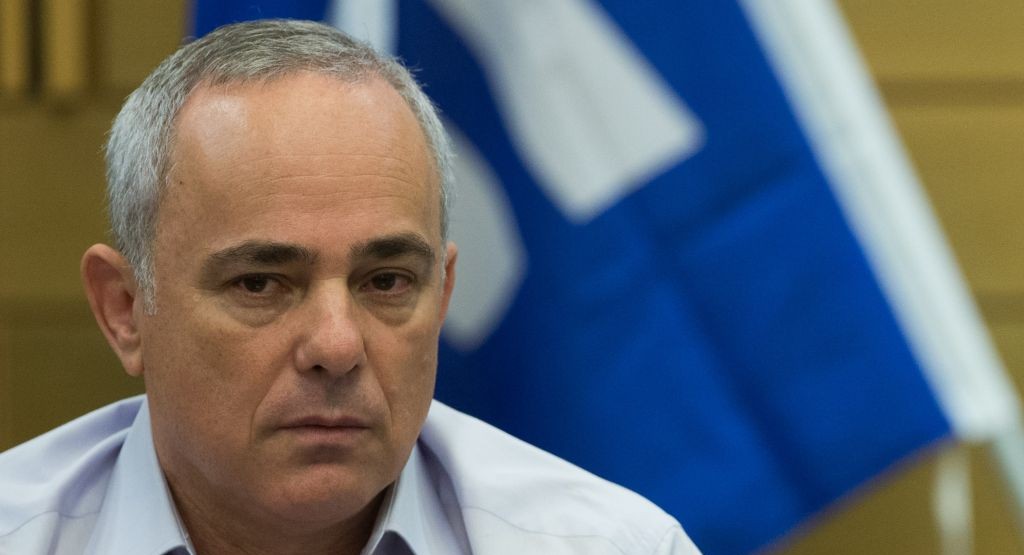
Energy Minister Yuval Steinitz attends a Likud faction meeting at the Knesset on July 27, 2015. (Yonatan Sindel/Flash90)
According to multiple reports, disgruntled IEC employees may have been taking their time repairing broken power lines to signal their displeasure with management’s moves to streamline the state-owned company.
“This saddens me greatly, and I think the union made a huge mistake,” adds Steinitz. “This is a grave fault, from an ethical standpoint as well.”
He says that once the power grid is patched up, there should be an investigation into what went wrong.
Are you relying on The Times of Israel for accurate and timely coverage of the 2026 Israeli election? If so, please join The Times of Israel Community. For as little as $6/month, you will:
Support our independent journalists who are working around the clock to report political developments as they unfold;
Read ToI with a clear, ads-free experience on our site, apps and podcasts; and
Gain access to exclusive content shared only with the ToI Community, including our DocuNationstreaming film series and weekly letters from founding editor David Horovitz.
We’re really pleased that you’ve read X Times of Israel articles in the past month.
That’s why we started the Times of Israel - to provide discerning readers like you with must-read coverage of Israel and the Jewish world.
So now we have a request. Unlike other news outlets, we haven’t put up a paywall. But as the journalism we do is costly, we invite readers for whom The Times of Israel has become important to help support our work by joining The Times of Israel Community.
For as little as $6 a month you can help support our quality journalism while enjoying The Times of Israel AD-FREE, as well as accessing exclusive content available only to Times of Israel Community members.
Thank you, David Horovitz, Founding Editor of The Times of Israel


 Add ToI as a Preferred Source on Google