

Molenbeek: Out of the north, an evil
As the Belgium immigrant neighborhood becomes the focus of Europe’s fight against terror, papers see parallels between Israel and France
 Add ToI as a Preferred Source on Google
Joshua Davidovich is The Times of Israel's Deputy Editor
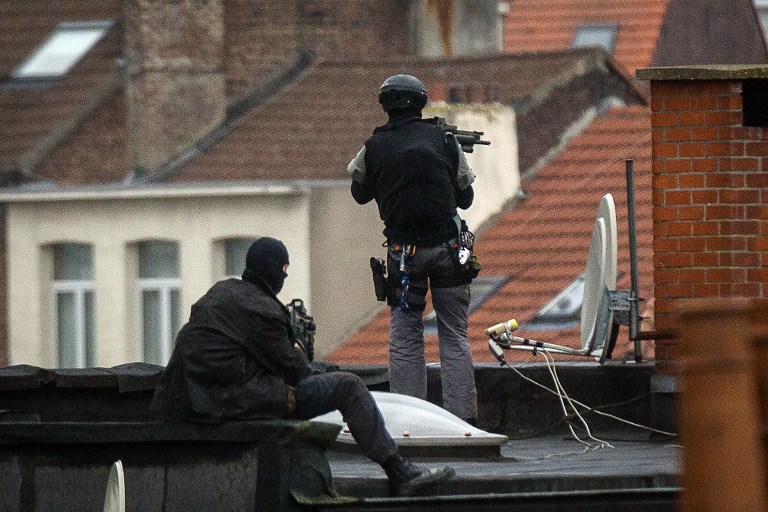
A full four days after the terror rampage in Paris, Israeli media still has its sights focused on the aftermath of the carnage, as Europe transitions from remembering and mourning to rooting out the jihadi sleeper cells that gave birth to the tragedy.
For that, coverage looks north, to the Brussels neighborhood of Molenbeek, which Israel Hayom dubs “the jihadi capital,” a pejorative usually reserved for Raqqa, Syria. The paper’s foreign editor Boaz Bismuth, dispatched to the supposed capital (you know this because the paper runs a picture of him there, as it always does for some strange reason whenever he hops on a plane, as if the tabloid is his personal travelogue), sets the scene in the neighborhood that became the focus of police raids a day earlier.
“Molenbeek is one of 19 boroughs that make up Brussels. Once they called it ‘little Manchester.’ Rich people are not here. The residents are second and third generation immigrants, very working class. The Muslims in Belgium enjoy all rights, including learning Islam in schools, but women are still prohibited from covering their faces,” he writes. “In 2012 a woman was stopped while driving for breaking the ban. Wanna guess where she was from? You’re right – Molenbeek. ‘Here we feel free,’ Sufjan, a driver from Algeria who immigrated to France and then Belgium, tells me. ‘Nobody tries to mess with our heads. Nobody asks questions. Life here is also calmer, and jihadis we don’t know about and don’t see.’”
Despite Sufjan’s claims, Yedioth’s Nahum Barnea, who is in Belgium, but somehow forgot to have the paper run a picture of him there, adds another sister city to Molenbeek: Hebron. Barnea notes that he asked a cab to take him straight to the police, and on the way he notices people walking around in “long dresses, gray or brown, with their heads covered, just like Hebron.”
Barnea reports that the police raid almost certainly intended to arrest Saleh Abdeslam, suspected as the eighth Paris terrorist, who is described by a local kid who knows him and his brothers as “half Moroccan, half French.”
“For five hours and more we stood there, in the wind and rain, but the picture we hoped to see, Saleh Abdeslam being led into a police cruiser, down and defeated, or being taken out on a stretcher, with the blanket pulled over his head, to an ambulance, we did not see,” he writes. “In the end he’ll be caught, dead or alive, but the terrorist nest in Molenbeek will continue to teem with life without him.”
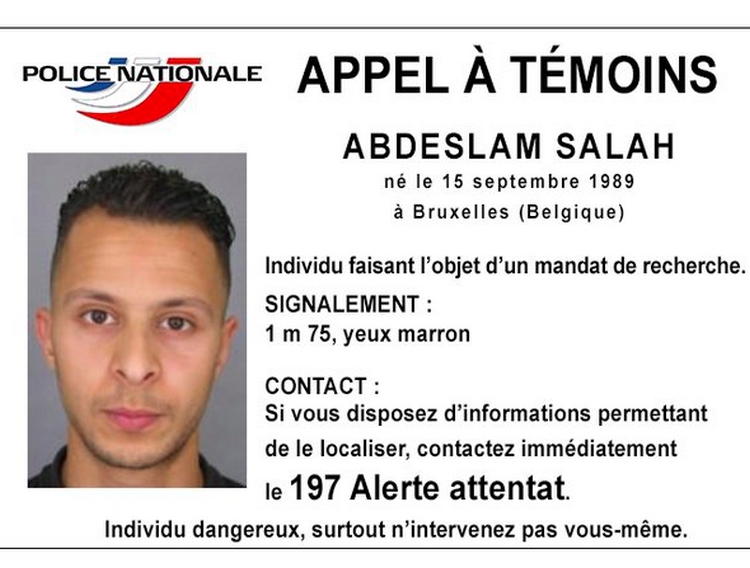
While police were searching for Abdeslam in Brussels, raids were also taking place to crack down on Islamist suspects in France. In Haaretz, Sefy Hendler writes that some of the steps French president Francois Hollande announced in a major address Monday night will sound familiar to Israelis.
“He doesn’t plan to take it slowly. Liberte is out; securite is in. Some of the ideas (some would say most of them) seem to come from the platforms of European right-wing parties, even the extreme right-wing: Stripping even native-born dual citizens of their French citizenship if they are involved in terror; the expulsion of foreign nationals suspected of terror; changing the rules of engagement for the security forces; and adding thousands of policemen, detectives, prosecutors and border guards, all of which means a substantial increase in the defense budget,” he writes.
“Practically speaking, he opened the door to taking the dramatic step of keeping thousands of people under administrative house arrest, which no Western nation has attempted in such dimensions since World War II. If after the attacks one might ask if and how France will be able to preserve its fundamental principles, first and foremost liberty, Hollande made it clear, in a fashion Prime Minister Benjamin Netanyahu wouldn’t hesitate to adopt, that life in many ways itself takes priority over sacred freedoms.”
In Israel Hayom, Dan Margalit writes that Hollande’s speech shows that France finally understands what Israel is going through, and predicts what Paris can now expect, like an old hand giving a youngblood some advice. And old hand with a penchant for run-on sentences and schadenfreude, that is.
“There is no other way to stop terror than to flood the city of lights with cops and to step up security checks based on racial profiling at Orly and Charles De Gaulle airports, like they do at Ben-Gurion; and there will be innocent victims and undercover forces who break into the casbahs of Paris, Toulouse and Lyon, and who knows, it’s possible that with an operation like this a day will come that French forces will act in secret in Malmo, Sweden, as well to catch a senior terrorist hiding like a needle in a haystack, and the foreign minister Margot Wallstrom – known as hostile to Israel – will scream to the heavens about why their sovereignty was breached.”
Yedioth Ahronoth’s Eldad Beck describes Hollande’s speech as “gloves off” (and his paper’s front page accuses the self-same Wallstrom of chutzpah for saying the attacks are linked to the Palestinian plight), but in Haaretz, columnist Annette Levy-Willard finds a very un-Israeli response to the terror attacks: understanding.
Levy-Willard describes her journey from memorial site to memorial site, where she finds people who are mourning, but not necessarily gearing up for a fight.
“At the bottom of the statue at the Place de la République, I do something that’s unethical for a journalist, a first in my career as a reporter. I had brought a candle with me. I lit it thanks to a borrowed lighter and put it under the big banner: ‘We are not afraid!’ In the crowd two men stand, dignified, carrying a poster: “I’m a French Muslim, not a terrorist.” They address the crowd: ‘Don’t be afraid of us – we are in the same boat. We love France.’ Applause around them,” she writes.
“We are so emotional today, we are for freedom, for liberty, for democracy. We love everybody. And the whole world supports us, declaring, ‘We are Paris.’ The planet has been painted blue-white-red. ‘La Marseillaise’ has become the new anthem of freedom, sung from New York to Sydney. On the eve of the January attacks and the mass march, I had written a piece for The Washington Post entitled ‘A New France is born.’ This France is still alive. And Parisians are ready to forget, at least during this time of mourning, their feelings of xenophobia and bitterness.”



The Times of Israel Community.