

The PA gets serious about celebrating prisoner releases
All the attention in Ramallah Tuesday night was focused on the Muqata, where Mahmoud Abbas oversaw a fete more impressive than times past
 Add ToI as a Preferred Source on Google
Avi Issacharoff, The Times of Israel's Middle East analyst, fills the same role for Walla, the leading portal in Israel. He is also a guest commentator on many different radio shows and current affairs programs on television. Until 2012, he was a reporter and commentator on Arab affairs for the Haaretz newspaper. He also lectures on modern Palestinian history at Tel Aviv University, and is currently writing a script for an action-drama series for the Israeli satellite Television "YES." Born in Jerusalem, he graduated cum laude from Ben Gurion University with a B.A. in Middle Eastern studies and then earned his M.A. from Tel Aviv University on the same subject, also cum laude. A fluent Arabic speaker, Avi was the Middle East Affairs correspondent for Israeli Public Radio covering the Israeli-Palestinian conflict, the war in Iraq and the Arab countries between the years 2003-2006. Avi directed and edited short documentary films on Israeli television programs dealing with the Middle East. In 2002 he won the "best reporter" award for the "Israel Radio” for his coverage of the second intifada. In 2004, together with Amos Harel, he wrote "The Seventh War - How we won and why we lost the war with the Palestinians." A year later the book won an award from the Institute for Strategic Studies for containing the best research on security affairs in Israel. In 2008, Issacharoff and Harel published their second book, entitled "34 Days - The Story of the Second Lebanon War," which won the same prize.
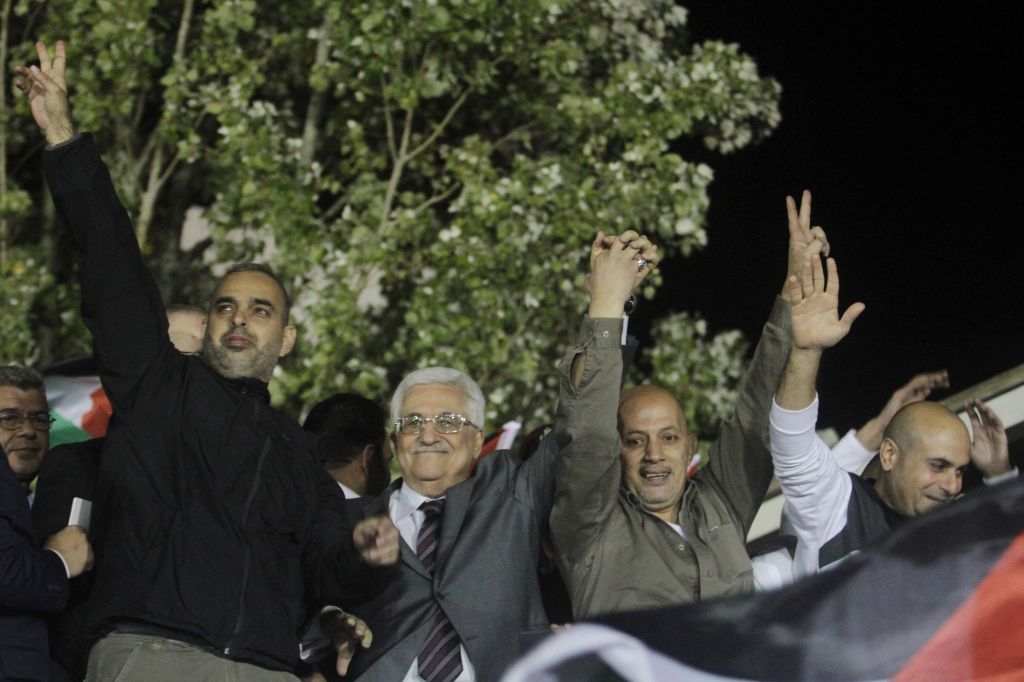
RAMALLAH — The streets of this West Bank city at midnight were not particularly festive. The roads were empty and there were no special decorations to celebrate the release of the 26 long-term Palestinian prisoners — 21 of them coming home to the West Bank, and the other five to Gaza. There were celebrations, but they were confined to the Palestinian Authority’s Muqata HQ.
For hundreds of yards around the compound, there were no parking spots to be found. Dozens of youths carrying mostly Palestinian flags (and a few of Fatah) moved to join the thousands in the Muqata. The families of the prisoners were there, along with curious onlookers and youngsters from all over the West Bank who came to welcome the “heroes.”
Gershon Baskin, who was a mediator in the deal with Hamas that secured the freedom of kidnapped IDF soldier Gilad Shalit in 2011 — in “exchange” for over 1,000 Palestinian security prisoners — was there and noted the contrast between the somber atmosphere in Israel and the Muqata celebrations. They were bigger and more impressive than when the first group of prisoners were freed in August, as though the Palestinian Authority at long last felt proud of its achievement. The dozens of journalists present added to the magnitude of the occasion.
The loudspeakers blasted all the familiar songs such as “Aley Kufiyeh” and the Palestinian anthem. Yusef Daoud, 80, from Qalqiliya, came to welcome his son, Oved A-Rahaman, who was in prison since 1992 for murdering an Israeli woman. With him came dozens of family members who arranged themselves in a tight circle and didn’t stop dancing.
“It is hard for me to explain to you just how happy I am,” he said. “My son is 41 now, I just want him to marry and have children. The last time that I saw him was a year ago.”
“I hope that one day there will be peace with the Jews,” he said when asked about the Israeli side. “They need to understand something: My son and his friends will not go back to carrying out attacks. Enough. Enough. My son regrets what he did. He murdered someone and to this very day he regrets it. He was young, stupid, and ignorant. I would have prevented him from doing it. He was a kid.”
PA President Mahmoud Abbas himself arrived at 1:30 a.m. to welcome the 21 prisoners.
He escorted them to the grave of Yasser Arafat to lay memorial flowers and from there to the balcony in view of the crowd. The families who had not seen their sons for so many years were forced to wait a bit more.
As for the prisoners themselves, some of them seemed to be in a state of shock, others euphoric. One of them, in a pink shirt, almost refused to come down from the stage after the ceremony finished and continued to wave two Palestinian flags. From the moment that they descended into the multitude the usual mayhem began: The journalists and the families charged at them, some with kisses, others with questions.
“I am delighted with this welcoming, I thank President Mahmoud Abbas and the Prisoners Ministry,” said Asrar Samarin, one of the freshly released. “They made a promise and they kept to it.”
His comrades said similar things to each of the dozens of journalists who crowded them. The lucky ones managed to get away quickly in cars and head home. Other remained in the Muqata as crowds crushed against the stage.
At about 2:15 a.m. the Muqata’s courtyard emptied. Then the sound of celebratory shooting could be heard in the streets of Ramallah, at first just single shots, then bursts of automatic fire.
The PA may have imposed a ban on shooting at celebrations, but when it comes to prisoner releases, it’s a whole different ballgame.




The Times of Israel Community.