

Board of Peace unveils $2.4B Gaza recovery plan, but hurdles remain before implementation
Representatives from US-controlled panel brief foreign diplomats on 66 projects they want to advance, asking for donations to fund them, even as start date remains up in the air
 Add ToI as a Preferred Source on Google
Jacob Magid is The Times of Israel's US bureau chief
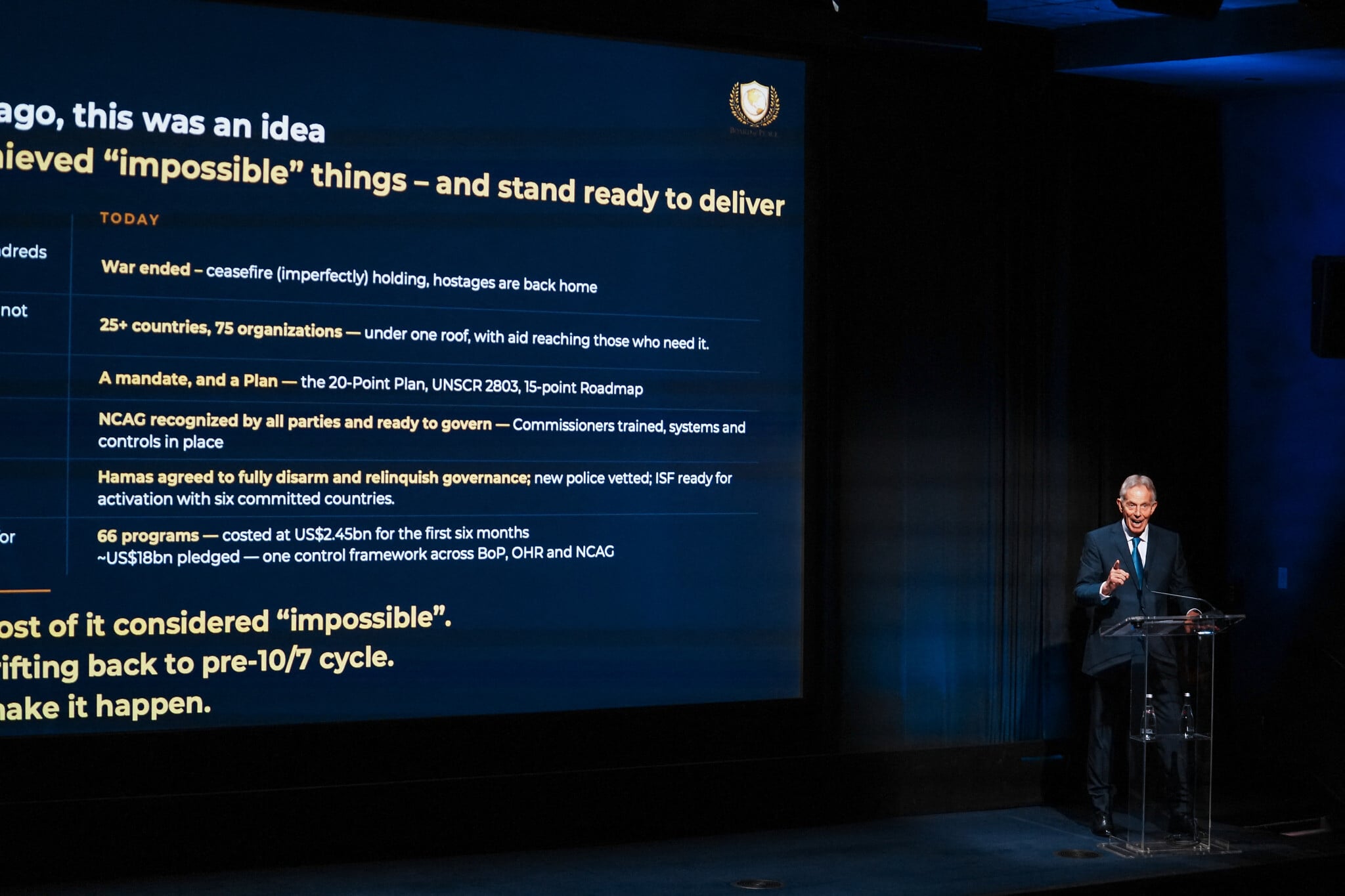
NEW YORK — The US-controlled Board of Peace on Wednesday unveiled its six-month plan for the commencement of reconstruction in the war-decimated Gaza Strip, with its envoys telling representatives from dozens of countries present that they will need $2.45 billion to implement their first 66 projects.
“For the next year, we move from preparation to implementation,” said Board of Peace senior envoy and former UK prime minister Tony Blair, as he introduced the 6-Month Gaza Recovery Program to several hundred foreign diplomats and journalists on the sidelines of the UN General Assembly in New York.
No start date was given for the program, though, as it almost entirely hinges on Hamas handing over its weapons and control over Gaza to a new government of Palestinian technocrats overseen by the Board of Peace.
After months of negotiations, Hamas agreed to the Board of Peace’s disarmament plan on July 30, but its implementation has stalled amid Israel’s rejection of the proposal. Prime Minister Benjamin Netanyahu has insisted that the IDF will only withdraw once Hamas has been completely disarmed, rejecting the gradual and reciprocal framework envisioned in the proposal.
Board of Peace officials believe Netanyahu is refusing to cooperate ahead of the upcoming Israeli election and believe that their leverage over Jerusalem will return after the vote, no matter who wins. However, Israel faces a real possibility of a stalemate in the October 27 vote, which would significantly complicate efforts to advance the recovery program.
Nickolay Mladenov, another Board of Peace senior envoy, acknowledged that “discussions with Israel right now are not easy because of the elections there. Everything is a little bit more emotional, a little bit more politically sensitive.”
But he insisted that Israel and the Board of Peace are in agreement regarding the end goal, which is a demilitarized Hamas and the transfer of all armed factions’ weapons to the Palestinian technocratic panel known as the National Committee for the Administration of Gaza (NCAG).
A new Gaza police force is among the other bodies tasked with replacing Hamas and assisting in the disarmament process, but its deployment has been stalled by Israel, which is refusing to allow recruits that it itself vetted to exit the Strip for training in Egypt.
Board of Peace representatives briefing foreign diplomats on the recovery program did not focus on these hurdles.
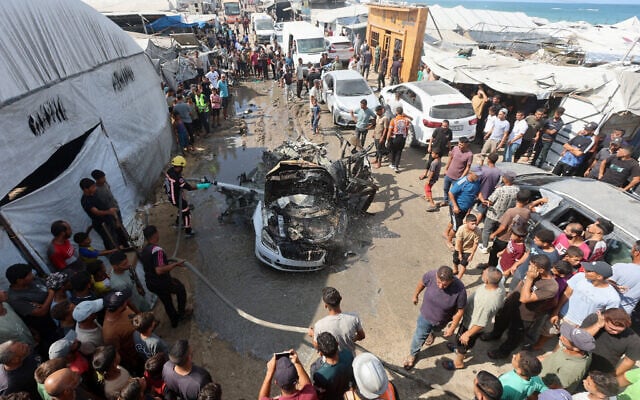
“We didn’t talk about who was to blame. People were just focused on solutions — not slogans, not political speeches. That was really what the purpose of today was to do,” US special envoy Jared Kushner said in concluding remarks.
Last week, The Times of Israel first revealed the projects as well as the plan for Wednesday’s briefing.

Their realization would provide massive relief for Gazans by repairing roads, homes, schools, mosques, hospitals, ports and crossings; expanding fuel and food deliveries; upgrading internet and cellular connectivity; reviving the judicial system and a Palestinian airline; establishing warehouse and logistics hubs, a Gaza tech park, a new digital payment system, a center for alternative disputes and a community radio channel.
There are also projects aimed at disarming Hamas, including the clearance of tunnels, a weapons buy-back program, mobilizing the International Stabilization Force and training a new Gaza police force.
NCAG chief commissioner Ali Shaath said the top priority would be projects to prepare Gaza for the winter as Board of Peace officials received warnings from Israeli meteorological experts who forecast an earlier winter this year, with more extreme conditions than normal, two sources familiar with the matter said.
Shaath insisted that his committee would be “color blind” when it comes to rebuilding projects, planning ones for both the “red zone” half of Gaza currently controlled by Hamas as well as the “green zone” half of the Strip currently controlled by Israel.
Skeptics fear that reconstruction will only take place in places outside of the red zone, where the overwhelming majority of Palestinians are located. There are questions as to whether Gazans will be willing to move to the green zone if Israel doesn’t withdraw its troops.
Last month, Mladenov called out Israel’s “unacceptable” restrictions on the entry of temporary shelters, which have hampered abilities to assist the over 1 million Palestinians who are still living in tents in the “red zone” coastal half of the Strip, after three years of conflict.
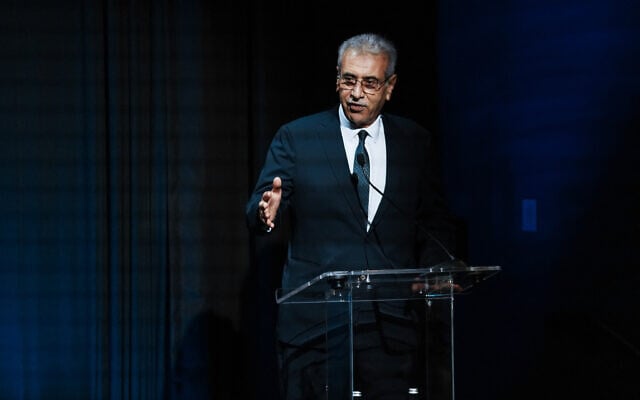
One of the 66 projects is to provide caravans to roughly 400,000 Palestinians currently living in tents. This would suggest that the vast majority of those not included will remain in tents for the foreseeable future.
The Recovery Program obtained by The Times of Israel notes that Turkey has pledged to donate 70,000 mobile homes and that 5,000 mobile homes donated by Egypt and Qatar are currently sitting on the Egyptian side of the Gaza border due to Israel’s refusal to allow them into the Strip.
With $2.45 billion just to implement the first six months of recovery programs, Board of Peace representatives are going to be asking foreign governments to follow through on pledges that were made at a donor conference in February.
Seventeen billion was promised by roughly a dozen countries, but only $280 million has been transferred. Mladenov clarified that the board is only asking for funds when it is ready to use them, indicating that moment is approaching.
Also during the briefing, ISF commander and US Army Gen. Jasper Jeffers outlined a five-step approach to dealing with the thorny issue of demilitarizing Hamas. It begins with the first wave of the multinational unit being deployed with 500 troops from Morocco and Kosovo, to be followed by additional personnel from Albania and Kazakhstan.
Their task will be to demilitarize the territory and assist in the decommissioning of Hamas’s military infrastructure.





The Times of Israel Community.