

Blood glucose levels are lower when you eat with a loved one — Israeli study
Hebrew University of Jerusalem and Sheba Medical Center researchers show that human bonding helps basic body functions; findings can help treat diabetes and other metabolic conditions
 Add ToI as a Preferred Source on Google
Reporter at The Times of Israel
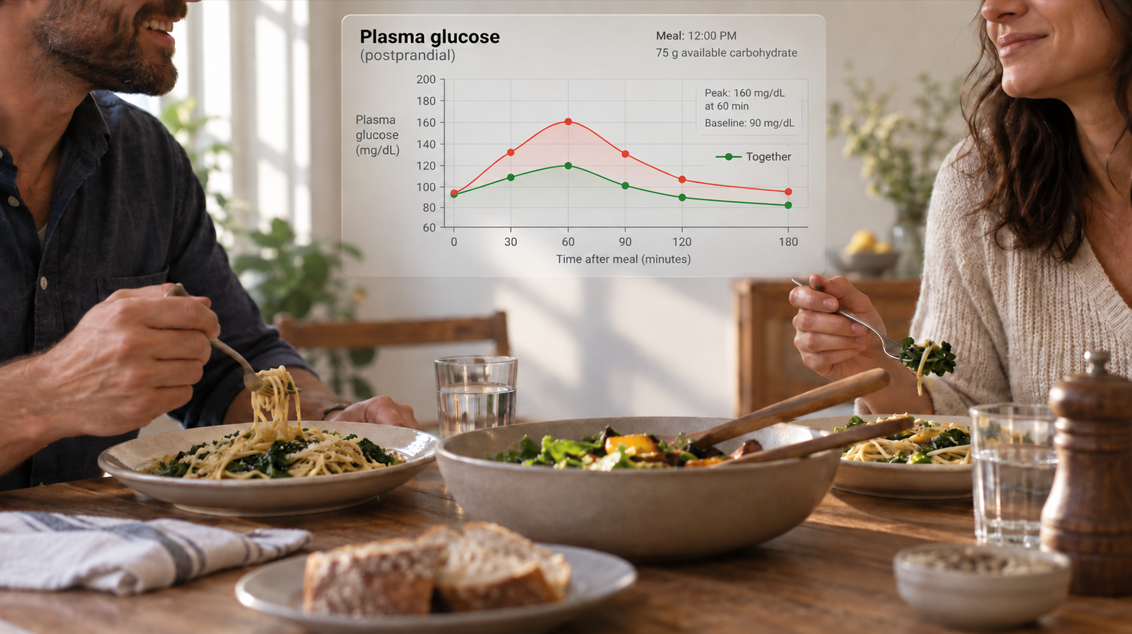
Could eating with someone you love actually change how your body processes food? The answer is yes, according to a landmark study led by researchers from the Hebrew University of Jerusalem and Sheba Medical Center.
The team examined how social interactions impact blood glucose levels, temperature regulation, and stress among 339 adults.
The peer-reviewed research shows that people’s blood glucose levels dropped significantly lower when they ate with a loved one than when they ate alone.
The study demonstrates a scientific principle that lead researcher Prof. Shir Atzil of Hebrew University’s Department of Psychology has dubbed “social physiology.” She said that basic human metabolic and regulatory systems operate more effectively when social partners are present.
“The role other people play in our lives is not just about comforting or reassuring us when we hurt,” Atzil told The Times of Israel in a Zoom conference call. “We actually support each other for basic physiological processes that are not commonly considered to be socially modulated.”
The study, published Tuesday in Science Advances, was led by first author Monia Masalha, collaborator Dr. Shai Fuchs of Sheba Medical Center, and other Israeli researchers.
The scientists found that after eating, participants had smaller blood sugar spikes and returned to baseline faster when they were with their partner than when they were alone.
They found a similar pattern when they exposed couples to the cold, with a smaller drop in temperature and a quicker recovery in both temperature control and physiological stress.
Atzil said the findings may help explain why humans are so strongly motivated to form close bonds.
High blood glucose is now a major global health problem, Atzil said.
“Identifying a previously unrecognized factor that helps regulate it could open a new direction for health research, and advance practical applications for treating diabetes, obesity and other metabolic conditions,” she added.

Humans rely on one another for basic metabolic functions
Atzil said she has been studying the biological and neural basis of social bonding for many years.
“I gradually realized that sociality is not just a behavioral strategy for survival,” she said. “It is also a very low-level biological mechanism.”
“As humans, we are deeply reliant on our caregivers,” Atzil explained. “They become crucial because they mean survival, well-being, energy, comfort, and regulation.”
Ten years ago, she began hypothesizing that humans rely on each other not only for comfort or safety, but for “homeostasis itself, for the regulation of our most basic physiological processes.”
However, she said people met her glucose hypothesis with skepticism.
When people eat carbohydrates, their digestive system breaks them down into glucose, a type of sugar that enters the bloodstream to serve as the body’s primary fuel source. When this system functions efficiently, blood sugar rises gently after meals and returns quickly to a stable baseline.
Yet people wondered how one individual could affect another person’s glucose levels, she said.
The hypothesis was “kind of bold but solid,” Atzil said. “When we received a European Research Council Starting Grant, it allowed us to test the hypothesis.”
She and Masalha, along with the other scientists, then built a research infrastructure to test their social physiology theory, focusing on three specific physiological challenges: post-meal glucose levels, temperature regulation, and physiological stress.

Conducting the experiments
The scientists recruited monogamous heterosexual couples who had been in relationships for at least nine months through social media and the Hebrew University online experiment system. They screened out anyone with underlying health conditions or abnormal blood sugar levels.
All testing took place in a comfortable laboratory designed to look like a living room, complete with natural light, a sofa, and a carpet. Participants completed the challenges twice on the same day. One time they were alone, and the other time, they were with their partner.
In the glucose experiment, participants consumed a standardized serving of 50 grams (1.76 ounces) of carbohydrates, equivalent to one potato or a cup of rice.
In the temperature test, participants entered a cold room set to 12 degrees Celsius (54 degrees Fahrenheit), while wearing standard lightweight clothing.
Then, in the stress experiment, participants faced mild electrical stimulation to measure their nervous system responses.

Across all three challenges, researchers carefully tracked how a loved one’s presence helped the body adapt and return to normal.
“The stress challenge was the most straightforward because people are known to soothe each other,” she said. “But we actually support each other’s homeostatic processes across the other two physiological systems.”
She said the researchers were “surprised” by how consistent the effects were.
“We were fascinated by the fact that no matter where we tried it, in which system or in which age group or in which experiment, the social physiology effect was always very consistent,” Atzil said. “The physiological response was always more efficient when people are together compared to when we are alone.”
Atzil said the experiments raised new questions about why some people seek closeness more than others.
“One possibility we are now testing is that individuals differ in how much physiological benefit they derive from social proximity,” she said.
Is social proximity a factor in glucose control?
Atzil said the research could change how clinicians carry out diagnostic testing.
“If you perform a glucose test in a clinic, whether someone arrives alone or with a close partner may influence the physiological response,” Atzil said. “Social context is not currently part of standard testing protocols, but our findings suggest it may be a meaningful source of variation.”
“There is something that impacts our basic homeostatic processes, down to our glucose metabolism working more efficiently when we’re with close partners,” she said. “This idea invites new research avenues into whether social context can be used to support metabolic health.”
The research suggests that “our need for other people is built into the basic biological mechanisms that keep our bodies functioning,” Salomon Israel, an associate professor at Hebrew University’s Psychology Department, told The Times of Israel.
Israel was not involved in the research.
“An important next step will be to understand individual differences,” he said. “Why do some people benefit much more from this closeness than others? And why is it that for some, it may not help at all.”
‘Science gives us a sense of hope’
Atzil said the first meeting to discuss the research was held on October 6, 2023, the day before October 7, 2023, when thousands of Hamas-led terrorists invaded southern Israel and slaughtered some 1,200 people, most of them civilians, and kidnapped 251 to the Gaza Strip.
“The way for us to manage and to cope was through science,” Atzil said. “This research was conducted in Israel during some very difficult years.”
“We live here together, we work together, and we have very close relationships with one another,” she added. “Continuing to do science gives us a sense of comfort, and also a sense of hope.”
Atzil said Masalha, the first author, who grew up in Kafr Qara, near Haifa, identifies as a Palestinian, while she describes herself as an Israeli Jew.
“Conducting ambitious research while navigating the scientific challenges alongside a complex geopolitical reality has not been easy,” Masalha told The Times of Israel in a statement. “I hope this paper can help open new questions about how profoundly our social relationships are intertwined with our biology. Reaching this point therefore represents much more than the final results; it reflects resilience, collaboration, and a shared belief in the value of science.”









The Times of Israel Community.