

‘We did not bend the knee’: Pezeshkian tells UN Iran and Gaza committed to ‘resistance’
Iran’s president says Tehran open to talks but will not cave to US force, says nation will never give up on ‘peaceful’ nuclear program
 Add ToI as a Preferred Source on Google
Lazar Berman is The Times of Israel's diplomatic reporter
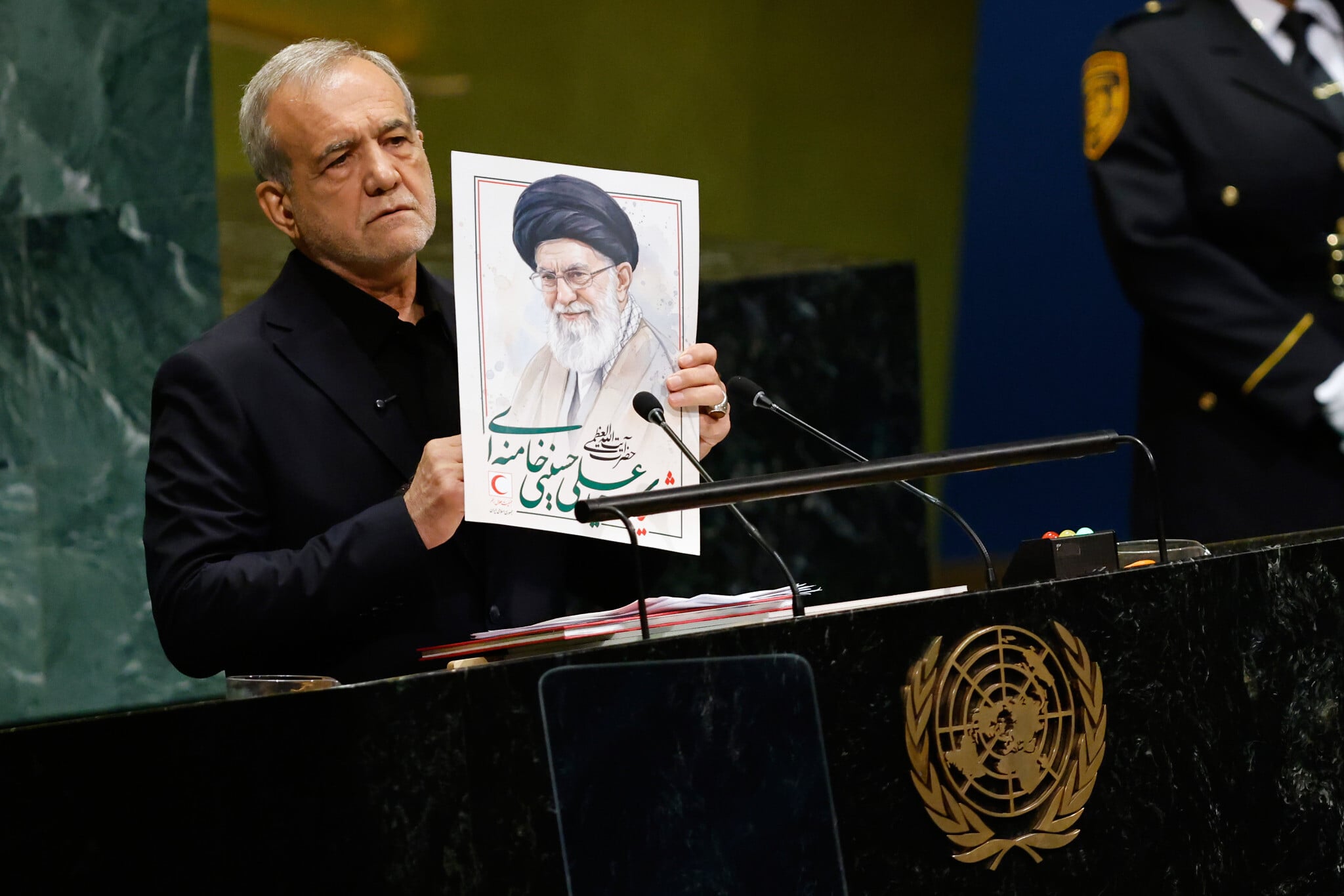
Iranian President Masoud Pezeshkian on Wednesday vowed Tehran would continue its “resistance” against pressure and threats by the United States, while also saying Gaza would remain firm against what he called “occupation and aggression and injustice,” in a defiant address to the UN General Assembly.
“The resistance of the Iranian people will only increase in the face of sanctions, pressure, and increased bullying,” he said at the United Nations, his first appearance at the body since the outbreak of his country’s ongoing war with the United States, which began in late February with US-Israeli strikes.
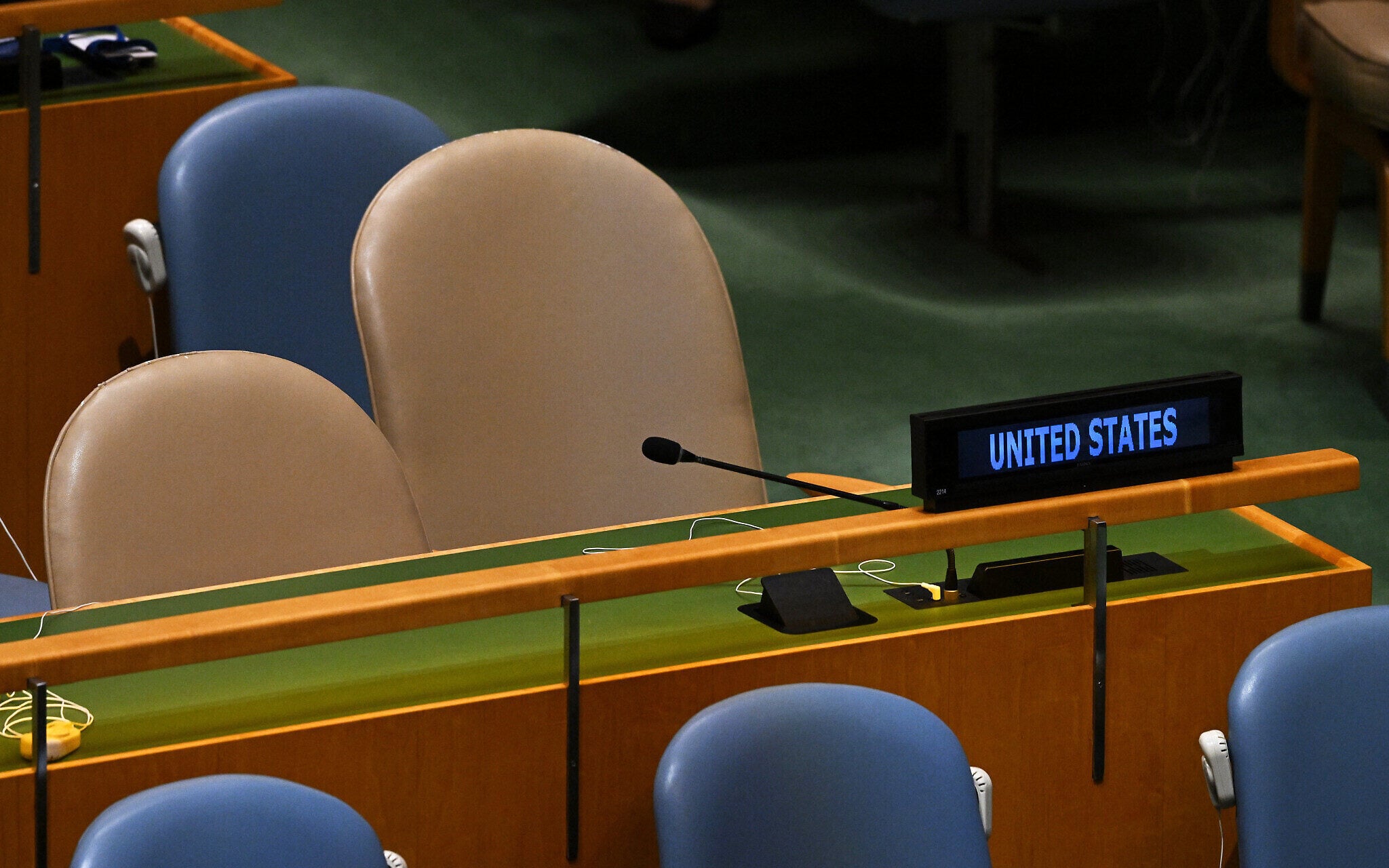
During Pezeshkian’s speech, the lone US diplomat in the hall walked out. The US mission to the United Nations did not immediately respond to a request for comment
“Iran must be understood by Mr. Trump,” Pezeshkian said in reference to the US president. “We are ready for dialogue and diplomacy and negotiations without accepting the language of force.”
“The remarks made by the US president yesterday … are a sign of a bullying mentality. … The Iranian people will not bow to pressure. … Those who are terrorists and train terrorists call us terrorists,” he said, referring to Trump’s description of Iran as the world’s leading sponsor of terrorism in his UN speech a day earlier, and his comment that he might “annihilate” it.
Turning to the Strait of Hormuz, he said, “We cannot let some have free access and gain their interests from the waterway, while at the same time using that waterway to impose their aggressions upon us… to forbid us access to our own waterways.”
Tehran has conveyed its conditions to reopen the strategic waterway to the United States through mediators, Iranian sources told Reuters on Tuesday.
Pezeshkian accused the US of blocking Iranian shipping while bringing missiles through the strait to its allies. Iran has sought to obstruct the strait, a vital pathway for the global energy supply, since the beginning of the war. In response, the US imposed a blockade on Iranian ports.
Turning to Gaza, Pezeshkian said “resistance will continue” against “occupation and aggression and injustice.”
“If it is weakened in one form, it will reemerge in others, perhaps stronger still,” he said. “What other choice do they have? Succumb to bullying?”
Iran is a longtime backer of Hamas, whose onslaught from Gaza into Israel on October 7, 2023, launched the war in the Strip.
Pezeshkian accused Israel of “committing genocide by using the so-called technologies they have at their disposal, then they label others as terrorists.”
Israel denies accusations of genocide in Gaza. It says it seeks to minimize civilian fatalities and stresses that Hamas uses Gaza’s civilians as human shields, fighting from civilian areas including homes, hospitals, schools, and mosques.
“Yes, they did hit us, but we did not bend the knee,” Pezeshkian declared, in reference to Israeli-US strikes on Iran.
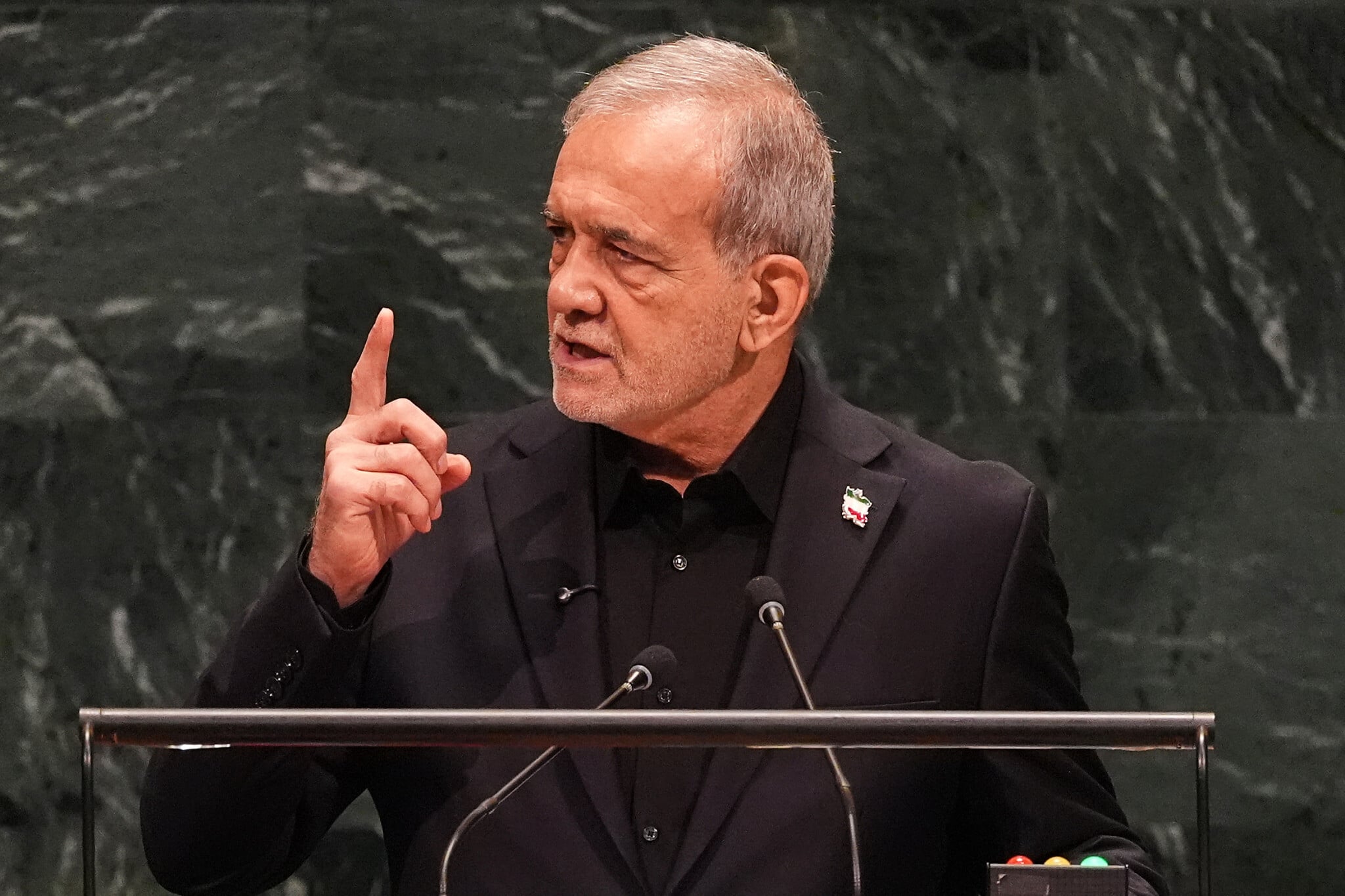
“Our defensive systems have been built so that no one can think that the bombing of Iranian cities can go unanswered,” Pezeshkian said.
Israel and Iran largely stopped exchanging fire in April, but US-Iranian tensions over the Strait of Hormuz and Iran’s nuclear program continue. The Iran-backed Houthis in Yemen are also currently fighting a Saudi-led coalition.
Pezeshkian also vowed in his speech that Iran will never compromise on its right to have a civilian nuclear enrichment program.
“We will not bow our heads and give up the right that is inherently ours,” he said. “No nuclear weapons, and no limitations to new peaceful nuclear technology.”
“We seek energy for progress, not to threaten societies with weapons,” he insisted, calling peaceful nuclear technology “part of our inherent progress.”
Pezeshkian accused the UN’s nuclear agency, the IAEA, of double standards regarding nuclear inspections, referring to Israel’s alleged nuclear weapons program.
“Atomic and nuclear bombs are in the hands of the Israeli regime, but the inspectors are requested to come to Iran,” he said.
Iran has consistently denied seeking to acquire nuclear weapons. However, it enriched uranium to levels that have no peaceful application, obstructed international inspectors from checking its nuclear facilities, and expanded its ballistic missile capabilities.
Holding up an image of late supreme leader Ali Khamenei, who was killed in the opening strikes of the US-Israeli war with Iran, Pezeshkian said that “we have been the victims of terrorism.”
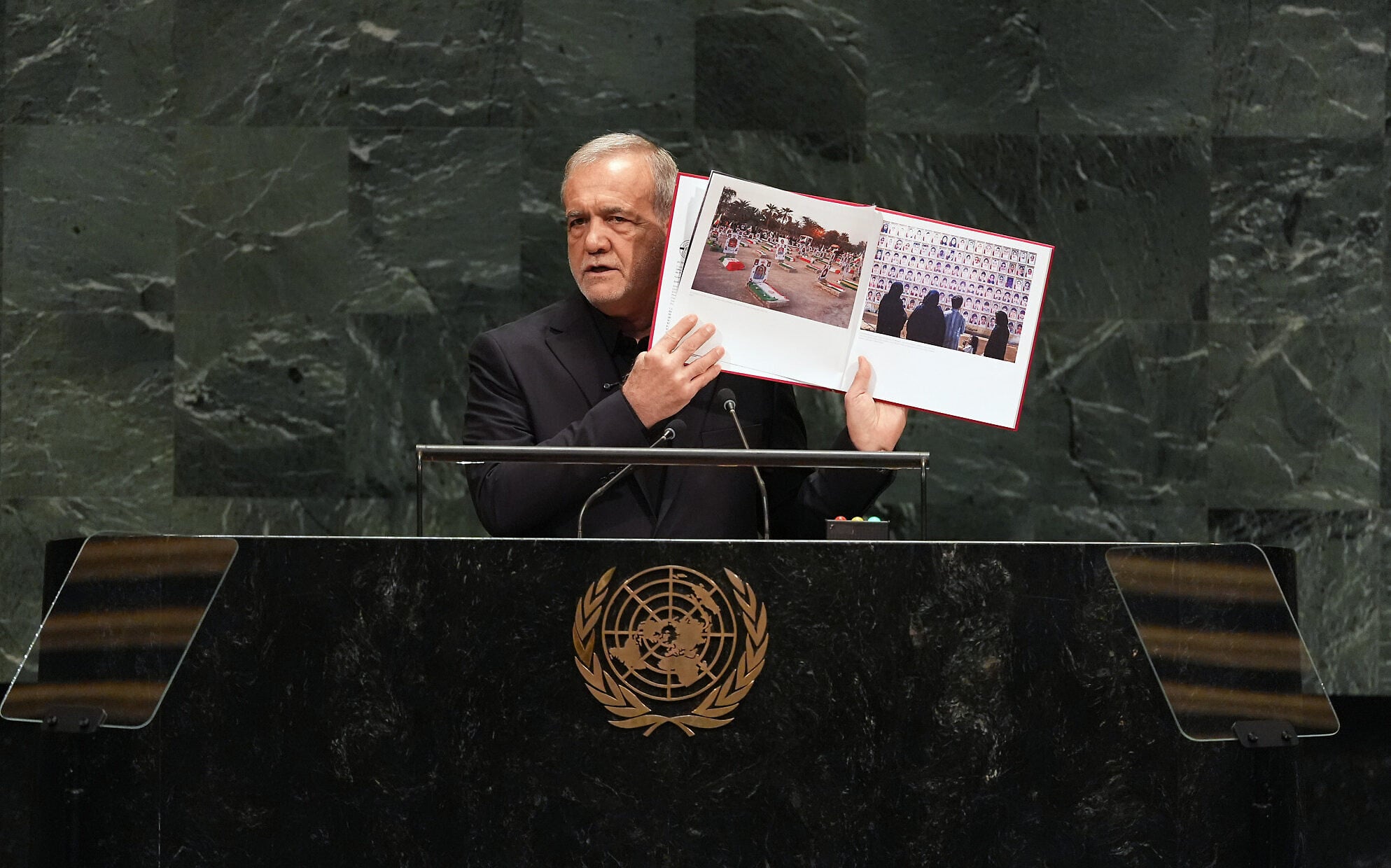
Pezeshkian displayed images of Iranian civilians killed in US and Israeli attacks, including schoolgirls in Minab killed on the first day of the war in a US strike.
Pezeshkian said that Iran only “defended itself with utmost strength” against aggression.
“We responded, but we did not hit civilian populations,” he falsely claimed. During this year’s war, 21 Israeli civilians and foreign nationals were killed in Israel in Iranian ballistic missile attacks, along with four Palestinians in the West Bank.
Iranian strikes have also targeted civilian areas across the region, including in Iraq, the UAE, Kuwait, Bahrain, Saudi Arabia, and beyond.
Pezeshkian also claimed that “for the past two centuries Iran has not attacked any country or any territory, but we’ve always defended ourselves.”
This year, Iran and its proxies launched repeated missile and drone attacks at almost every Arab country in the Middle East, as well as Israel, Cyprus, and Turkey. A network of Iranian-backed terror proxies has attacked civilian areas in Israel and fought regional conflicts for decades.
Meanwhile, Iran’s Foreign Ministry spokesman Esmail Baghaei said on Wednesday that Iran had conveyed its conditions for renewing talks “in a manner that leaves no doubt or ambiguity and provides no excuses or pretexts for any party” during a meeting with top US officials a day earlier.
Writing on X, he said that the war must end “on all fronts,” an apparent reference to the end of Israeli operations against Hezbollah in Lebanon.
Baghaei repeated Iranian demands that the US blockade of Iranian ports, as well as economic sanctions, must end, and frozen Iranian assets must be released in order for talks to resume.
He also said that the US must agree to a “safe shipping route” through Hormuz that is determined by Iran and Oman.
Trump said Tuesday that his envoys Steve Witkoff and Jared Kushner met with members of an Iranian delegation, including Foreign Minister Abbas Araghchi, for three hours on the sidelines of the UN General Assembly and that another meeting was set for the “very near future.”
However, according to Iran’s semi-official Tasnim news agency, the meeting between Araghchi and US envoys was not authorized by decision-makers, including the powerful Supreme Council for National Security.
Reuters contributed to this report.




The Times of Israel Community.