

PA’s Abbas at UN: Israel trying to force Palestinians out with ‘genocidal war,’ ‘settler terrorism’
In virtual address, leader rejects US justifications for visa ban extension, insisting that Ramallah rejects terrorism and has ‘completed’ pledged reforms, targeting Israel in ICC is ‘peaceful’
 Add ToI as a Preferred Source on Google
Jacob Magid is The Times of Israel's US bureau chief
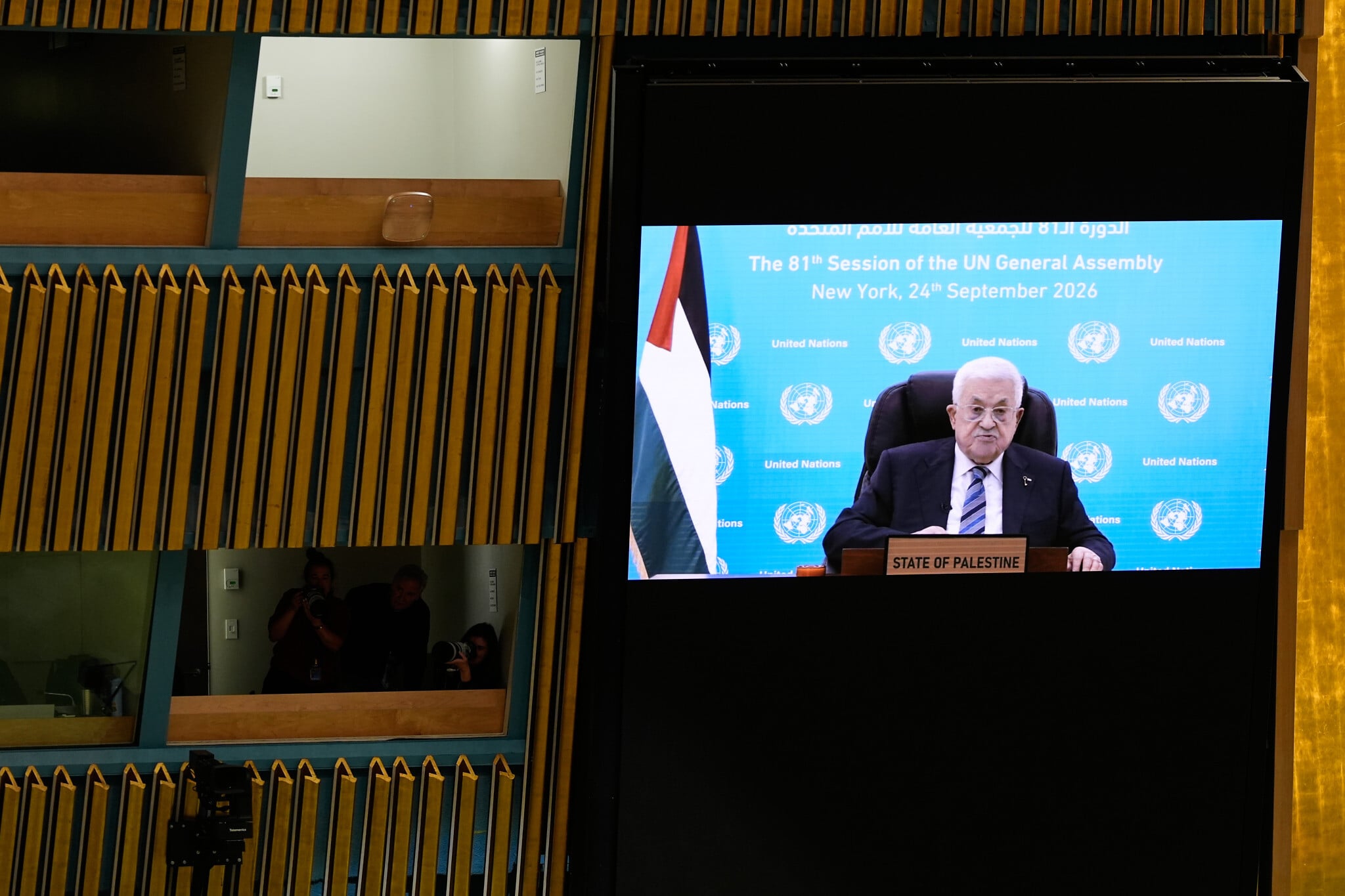
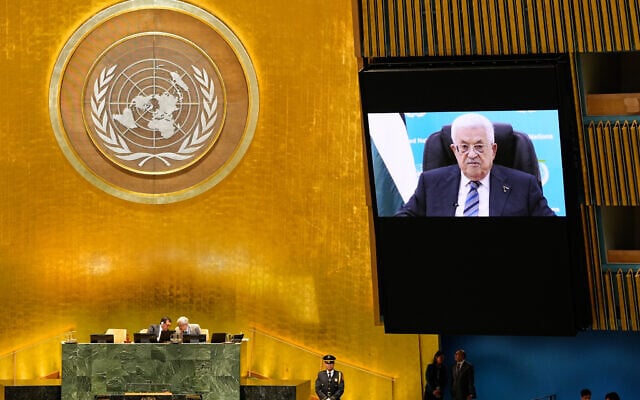
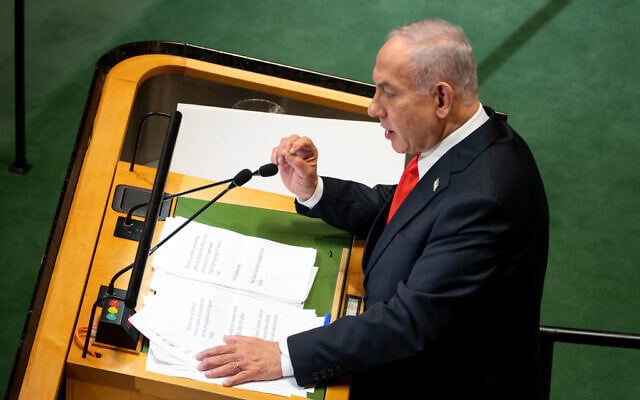
UNITED NATIONS — In a pre-recorded address played before the UN General Assembly on Thursday, Palestinian Authority President Mahmoud Abbas knocked US President Donald Trump’s administration for preventing him from attending the forum in person for the second year in a row.
Last week, the US announced that it was extending last year’s ban on Palestinian officials, arguing that Ramallah had violated US legislation that penalizes the PA if it targets Israel in international organizations, advances the unilateral recognition of a Palestinian state, pays stipends to terrorists or glorifies violence.
“We reject these unlawful punitive measures, and we reject the accusations and justifications on which they were based,” Abbas said. “We affirm that we have fulfilled our obligations, carried out a comprehensive national reform program, and upheld our commitment to international law, to shunning violence and terrorism,” the PA leader argued.
In his roughly 22-minute speech, Abbas bitterly criticized Israel for its policies against the Palestinians, insisting that Ramallah has completed the reforms demanded by the international community and recommitted to a two-state solution with a demilitarized Palestinian state alongside Israel.
Taking issue with the US visa ban, Abbas said the PA shouldn’t be punished for backing efforts to target Israel at the UN, the International Court of Justice, and the International Criminal Court, calling the strategy a “peaceful choice.”
He said the Trump administration’s ban violated US obligations as UN host country. Washington argues that it is allowed to restrict visas on national security grounds, but it decided to allow top officials from Iran, despite the ongoing conflict against the Islamic Republic.
‘Genocidal war’
After the brief opening section lamenting the US policy against the PA, Abbas spent most of the rest of his speech criticizing Israel.
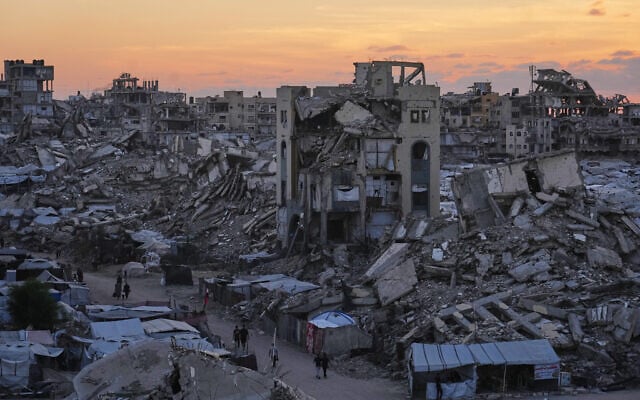
He accused it of launching a “genocidal war” against Palestinians in Gaza.
While Abbas has previously condemned Hamas’s October 7, 2023, onslaught that sparked the war three years ago, he made no mention of the Palestinian terror group in his speech at the UN General Assembly.
He also called out Israeli settlement expansion and “settler terrorism [that] is escalating under the protection of the occupation forces.”
Abbas then warned that “Jerusalem is being isolated and Judaized” — an accusation he has made in the past, which Israel argues is a demonstration of his refusal to recognize Jewish ties to the Holy Land.
The PA president went on to knock what he said have been attacks by Jewish extremists against Muslim and Christian holy sites in Jerusalem and the West Bank, as well as Israel’s efforts to shutter the UN Agency for Palestinian refugees and their descendants, UNRWA. Jerusalem argues that the agency responsible for providing education, healthcare and vocational training to Palestinians is irredeemably infiltrated by Hamas and exacerbates the refugee crisis rather than solving it.

Abbas urged the international community to urgently intervene to prevent Israel’s ongoing advancement of the controversial E1 settlement project, “which aims to separate the northern West Bank from the south and isolate East Jerusalem from its Palestinian surroundings, preventing the realization of a geographically contiguous Palestinian state.”
The PA president thanked Britain and 11 other Western countries that recently announced plans to sanction Israeli settlements and called on Trump to fulfill his commitment to Arab leaders last year to prevent Israel from annexing the West Bank. While Jerusalem has refrained from formally doing so, critics argue that its host of steps aimed at expanding its grip and presence throughout the West Bank amount to de facto annexation.
Gaza plan stuck
Abbas bemoaned the stagnation of US President Donald Trump’s 20-point plan for ending the Gaza war.
He recalled that the PA backed the plan, which kept Ramallah from governing the Strip until it carries out comprehensive reforms.
“Unfortunately, we have seen [the plan to rebuild Gaza] materialize on the ground. Israeli killing and aggression continue to claim the lives of men, women and children in Gaza,” he says.
Abbas noted that the mandate granted by the UN Security Council for Trump’s Board of Peace to oversee the postwar management of Gaza expires at the end of next year.
“The transitional period must not turn into a permanent or open-ended situation without a clear political and time horizon,” he says. “Rather, it must lead to the reunification of the Gaza Strip and the West Bank, including East Jerusalem, under the jurisdiction of the State of Palestine and its legitimate institutions, according to the principle of: one state, one government, one law, and one legitimate weapon.”
Reforms ‘complete’
Abbas claimed the PA has “completed the national reform program to which we committed before our people and the international community, strengthening institutional governance, public finances, transparency, accountability, combating corruption and the rule of law.”
He highlighted the reform of the PA’s controversial welfare system that critics dubbed pay-to-slay because it granted stipends to recipients based on the length of their prison sentence. The PA has scrapped that system in favor of one that is strictly need-based, but Israel and the US claim that payments to terrorists have continued.
Abbas also pointed to the PA’s reform of its education system, which has included the development of curricula in cooperation with the United Nations Educational, Scientific and Cultural Organization. A PA official has told The Times of Israel that Ramallah has been unable to print many of the new textbooks due to its financial crisis sparked by Israel, but that the virtual versions of the textbooks have been updated online.
Abbas noted the upcoming Palestinian legislative elections that have been scheduled for November 28, followed by presidential elections, though he didn’t provide a date for the latter.
Critics have questioned the seriousness of some of the reforms, amid speculation that elections will be postponed, as they have repeatedly in the past. Abbas has also elevated his son and body men to prominent positions within the PA and its security agencies.
Condemnation of terrorism and antisemitism
Abbas also stressed his rejection of terrorism and antisemitism during his speech.
“On behalf of the State of Palestine, I renew the commitments in which we believe: We want security and peace for all. We reject attacks against civilians by any party. We reject terrorism and extremism in all their forms. We combat antisemitism, racism and hatred. And we believe in a culture of peace, dialogue and coexistence,” Abbas said.
“We want a democratic Palestinian state that respects the rule of law and human rights, a non-militarized state that lives in security and peace alongside the State of Israel,” he continued.
Amid cross-political Israeli support for “encouraging the migration” of Palestinians from Gaza, Abbas insisted that Palestinians “will remain on their land.”
“They will not accept displacement, and they will not disappear. Neither military occupation, nor settlements and annexation, nor settler terrorism can constitute a solution or create lasting security,” Abbas asserted.
“At the same time, we will not continue waiting, and we will not accept what the governments of the Israeli occupying state decide for us. No lasting security can be built on the occupation of another people and the denial of their legitimate rights,” he said.
“Our vision for peace is clear… a Palestinian state alongside the State of Israel; and Palestinian-Israeli peace that opens the way toward peace, regional integration, cooperation, prosperity and security for all,” Abbas declared.


The Times of Israel Community.