

The writing is on the wall
Hebrew dailies call out failure to track down Duma killers, condemn Russia and Iran’s Syria presence and labeling of West Bank products
 Add ToI as a Preferred Source on Google
Marissa Newman is The Times of Israel political correspondent.
Ahead of Rosh Hashanah, the Friday Hebrew papers put out wake up calls to usher in the new year.
Yedioth Ahronoth urges the authorities to “wake up” and deal with the Duma firebombing attack, Israel Hayom condemns the US with regard to Iranian and Russian involvement in Syria, and calls out Europe on the labeling of West Bank products. Haaretz, meanwhile, features pages upon pages on wide-ranging Israeli attitudes towards religion, and pretty much everything else.
Yedioth Ahronoth leads with Defense Minister Moshe Ya’alon’s reported comments that Israel knows who the arsonists in the fatal Duma attack that killed a Palestinian toddler and his parents, but lacks sufficient evidence to indict them, under the headline “They know, and they aren’t acting.”
“Does the security establishment know who is responsible for the murder of the Dawabsha family? Defense Minister Moshe Bogie Ya’alon claimed the defense establishment already knows who carried out the appalling [attack], but the investigation is stuck due to lack of evidence,” it reports.
“Responding to the question if the attackers are among the detainees, Minister Ya’alon replied: ‘We’ll wait and see.’” The minister explained that the security establishment is certain beyond a shadow of a doubt that the detainees are connected to the attack, but they lack enough proof to put them on trial.
Columnist Ben-Dror Yemini lashes out at Ya’alon for his reported comments earlier that Israel was refraining from indicting the suspects to protect intelligence sources (Ya’alon later denied he made those remarks).
“They know but aren’t putting them on trial? Is he serious?… The entire world, Israelis, Jews and non-Jews, are looking at the Jewish state’s efforts in dealing with Jewish criminals. And what do we say? That we can’t harm our sources? Is this serious?”
“Mr. defense minister, Mr. prime minister, Mr. attorney general — wake up. Do you not understand what damage is caused to Israel with your dubious conduct of ‘we know who the killers are, but we have difficulties because of exposing intelligence sources?’ No one thinks the reason is your careful compliance with the legal process. The sense is, even if wrongly, that Israel is simply lazy and searching for excuses,” he writes.
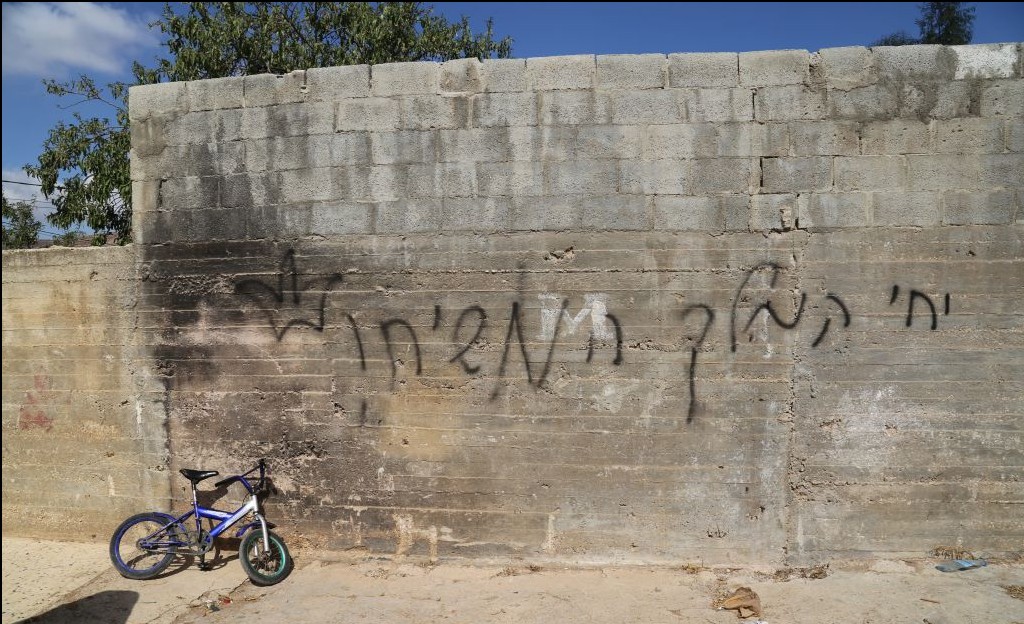
In its lead article, Yedioth does some detective work of its own, comparing the graffiti left on the walls of the Dawabsha home to that found on a convent in Latrun torched in September 2012, showing the similarities between some of the letters. It also juxtaposes photos of the graffiti from Duma and that from a different attack in November 2013.
Over in Israel Hayom, the daily is far more concerned about reports of Russian and Iranian reinforcements sent to Syria to help Bashar Assad’s regime combat rebels and the Islamic State.
“Iran today is dancing at every wedding in the Middle East: In Syria, it’s ‘dancing’ with the Russians to save Assad’s regime and in Iraq, after receiving a stamp of approval from the nuclear deal, it’s ‘dancing’ with the Americans in the fight against the Islamic State. What would we do without Iran? Or maybe the bigger question is — what do we do with Assad?” writes columnist Boaz Bismuth.
“The options today in Syria are between bad and worse… It’s safe to assume that the Syria crisis will last a long time. It’s a war between evil and evil that has turned Syria into a sort of Afghanistan. And the Americans? They are currently doing what is comfortable for them: attacking from the air at their leisure.”

Israel Hayom also spotlights the European labeling of West Bank products, highlighting Prime Minister Benjamin Netanyahu’s criticism.
Taking Netanyahu’s lead in likening the move to Holocaust-era discrimination, columnist Dan Margalit calls the labels “The yellow patch, circa 2015.”
“Labeling the products is a shameful boycott in its own right. Only the naive believe that it will distinguish between Israel and Judea and Samaria. It isn’t justified. It isn’t right…. in practice it will harm all Israeli exports,” he writes.
Ahead of Rosh Hashanah, Haaretz features a poll on life in Israel.
The survey finds that 70 percent of Israeli Jews believe in God, compared to 98% of Arabs in Israel who believe in a higher power. The poll notes a distinction between faith and religious lifestyle, with some 55% of respondents urging civil marriage in Israel, and 63% calling for public transportation on Shabbat. A majority of Israeli Jews said they keep kosher (51%), and 42% support gay marriage.
The poll found, among Jews, a correlation between religion and happiness. The ultra-Orthodox respondents reported the highest levels of happiness (78%), followed by the Orthodox (74%), traditional Israelis (64%), while the secular trailed behind at 59%.
Divided by religion, however, the Jews appear to be the unhappiest lot in the Jewish state. The Druze were found to be the happiest at a whopping 86%, followed by Christians (71%), Muslims (68%) and Jews (64%).
The survey also finds that Israelis primarily use cars rather than public transportation (67%), claim never to have smoked marijuana (82%), say less than half are satisfied with their jobs (47%), and most would choose a homemade meal over a restaurant (59%).
And despite the ongoing existential angst and Iranian Supreme Leader Ali Khamenei’s predictions that Israel won’t last another quarter-century, 74% believe Israel will be around in 100 years, and 82% of Israeli Jews consider themselves Zionists.
Some 1,028 respondents participated in the survey, 825 of them Jews, and 203 Arab.







The Times of Israel Community.