

6 days after rioters burn crossing, Gaza’s fuel lines to partially reopen
Defense Ministry says gasoline, diesel will begin flowing to the Strip next week, though at a reduced rate — as long as repairs hold
 Add ToI as a Preferred Source on Google
Judah Ari Gross is The Times of Israel's religions and Diaspora affairs correspondent.
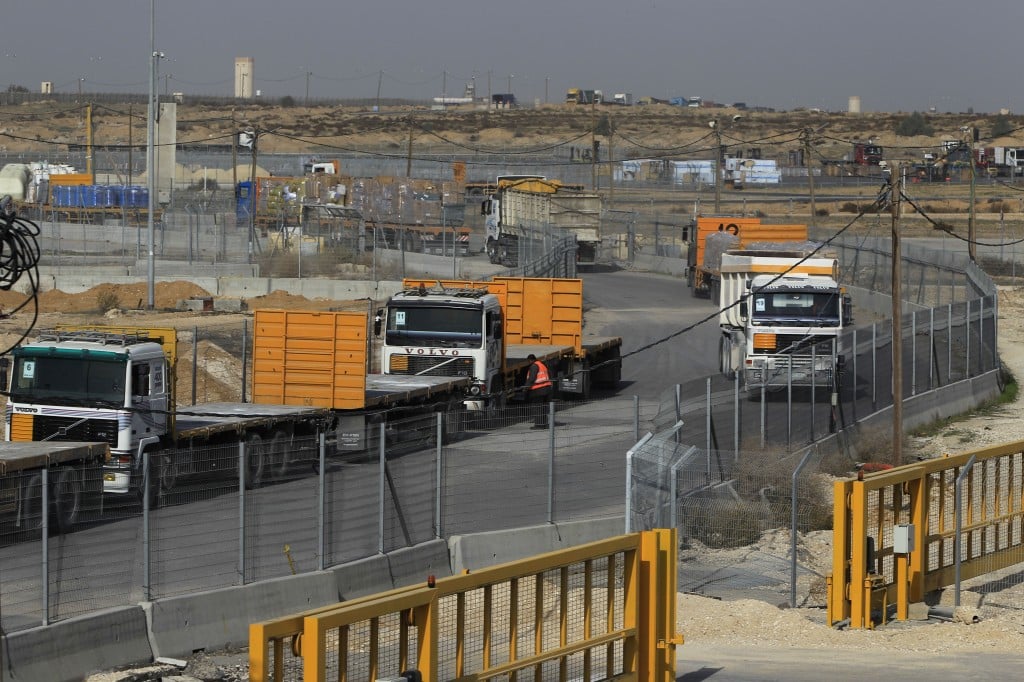
Less than a week after Palestinian rioters burned the fuel terminal at the Kerem Shalom Crossing into the Gaza Strip, the Defense Ministry announced on Thursday night that the flow of gasoline and diesel fuel into the coastal enclave was being partially restored.
Earlier in the day, engineers succeeded in sending a small amount of fuel through the two pipelines and hoped to bring the equipment back into partial service by the beginning of next week, after the Jewish festival of Shavuot on Sunday.
“The repair work on the gas pipeline concluded today, with the expectation that the system would come back to partial service after the Shavuot holiday,” the Defense Ministry said in a statement.
The Kerem Shalom Crossing serves as the main terminal for commercial goods and humanitarian aid into Gaza. Ordinarily, hundreds of trucks pass through the crossing each day. Its fuel terminal is also the only way to bring significant quantities of diesel and gasoline into the beleaguered coastal enclave.
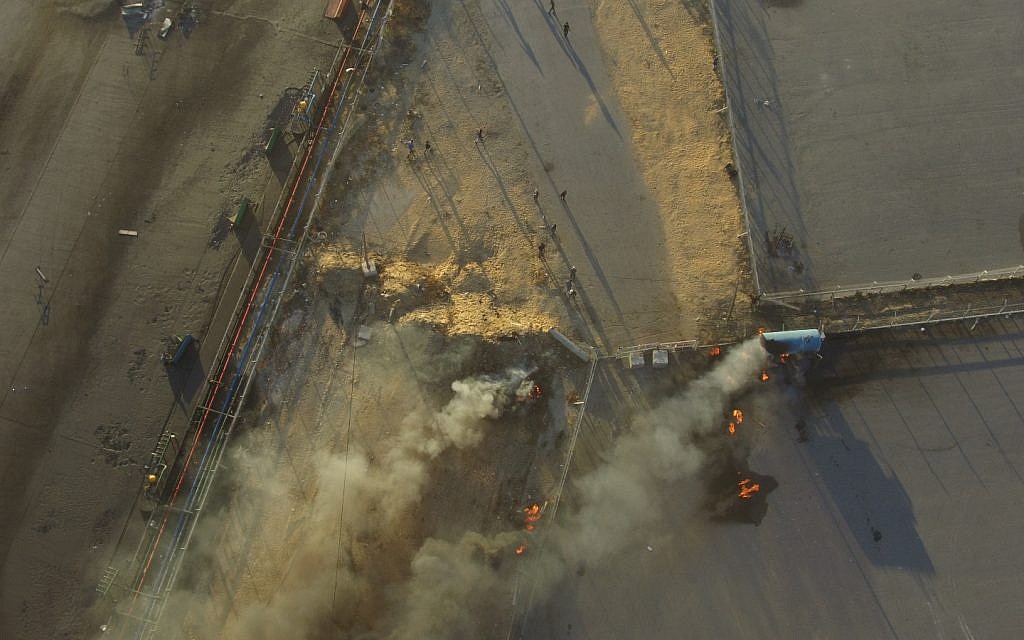
Three times this month, rioters from the Gaza Strip broke into the Palestinian side of the crossing and set fire to parts of the facility.
https://content.jwplatform.com/previews/rso8MGVv-U4CTA3JQ
Rioters first attacked the crossing on May 4. They broke through the gates and, apparently believing they were in Israeli territory, set fire to the fuel lines, according to Israeli officials. In actuality, they were on the Palestinian side of the crossing.
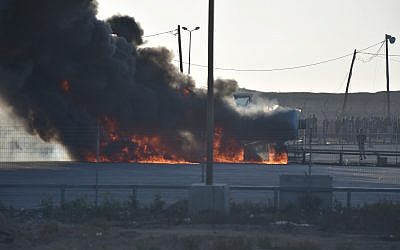
Last Friday, following a violent demonstration along the border, vandals entered Kerem Shalom and significantly damaged the fuel terminal, as well as a conveyor belt used to bring raw construction materials into Gaza and two other belts used to transport animal feed.
According to Israeli officials, the Hamas terrorist group directed the attack on the crossing. Its operatives instructed rioters “what to do, where to go,” a senior Israeli defense official told reporters on Sunday.
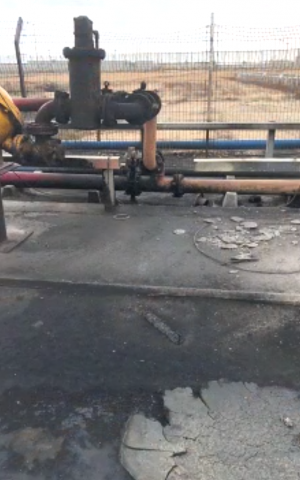
Palestinians attacked Kerem Shalom again on Monday, setting fire to parts of the facility for the third time, while it was still closed for repairs from the previous ransacking.
Israel had announced that it was closing the crossing on Saturday night in order to assess the damage and determine how to repair the equipment.
On Sunday, the deputy director of the crossing told reporters that it would take at least a week to bring the fuel terminal back online once the necessary replacement parts arrived.
Yet on Thursday night, after six days the Defense Ministry announced that engineers had succeeded in bringing the flow of fuel back online, at least partially.
“Today, 12 tankers worth of diesel fuel and one tanker full of gasoline were sent into the Gaza Strip as a test flow. Assuming there are no leaks, on the Monday after the holiday, the flow will continue,” the Defense Ministry said.
On Tuesday, Israel reopened the trucking lanes of the Kerem Shalom Crossing and began allowing through medical supplies and commercial goods, though in two cases Palestinian officials refused to accept the trucks.
Palestinian Authority officials, working on the Gaza side of the crossing, sent back 14 trucks worth of food and diapers on Tuesday, for unclear reasons. The next day, Hamas officials inside Gaza refused to accept two shipments of medical supplies, despite shortages in the Strip’s hospitals, because they were provided by the Israeli military.
While the inability to import medical equipment and other essential goods to the Gaza Strip due to the temporary closure of the crossing was a source of concern, international officials this week warned of the dire consequences of the lack of fuel.
On Sunday night, the United Nations said an alternative way of getting gasoline and diesel to Gaza must be found urgently, warning of dwindling supplies needed to run hospitals, pick up garbage, pump water, and treat sewage.
In its appeal, the UN Office for the Coordination of Humanitarian Affairs (OCHA) said “the impact of the destruction of the fuel and gas lines is already being felt,” noting that fuel reserves of hospitals, waste collection services and water and sanitation facilities would last only a few days.
The agency noted that in light of the severe electricity shortage in the Gaza Strip, which currently depends almost entirely on Israel for its two to four hours of power a day, the UN “has been providing over 220 critical health, water and sanitation, and solid waste facilities with 936,000 liters (250,000 gallons) of emergency fuel per month to run backup generators and vehicles.”
The disruption of supply at Kerem Shalom now puts those services in danger.
“To avoid a collapse of essential services, an alternative arrangement for the entry of fuel is urgently needed until the Kerem Shalom fuel pipelines are repaired,” the agency said.
It also said the lack of cooking gas and fuel would likely cause shortages in bread and other prepared food.
The Humanitarian Coordinator for the agency, Jamie McGoldrick, said, “Humanitarian operations depend on the Kerem Shalom Crossing to get assistance to those in need in Gaza. I call on demonstrators to avoid actions that negatively affect the functioning of Gaza’s main entry point for humanitarian goods and on relevant authorities to quickly repair any damage.”
The Associated Press contributed to this report.








The Times of Israel Community.