

ADL slams Trump’s order on religious freedom while OU commends it
Jewish civil rights group says measure is troubling as Orthodox Union praises president for upholding religious freedom for all Americans
 Add ToI as a Preferred Source on Google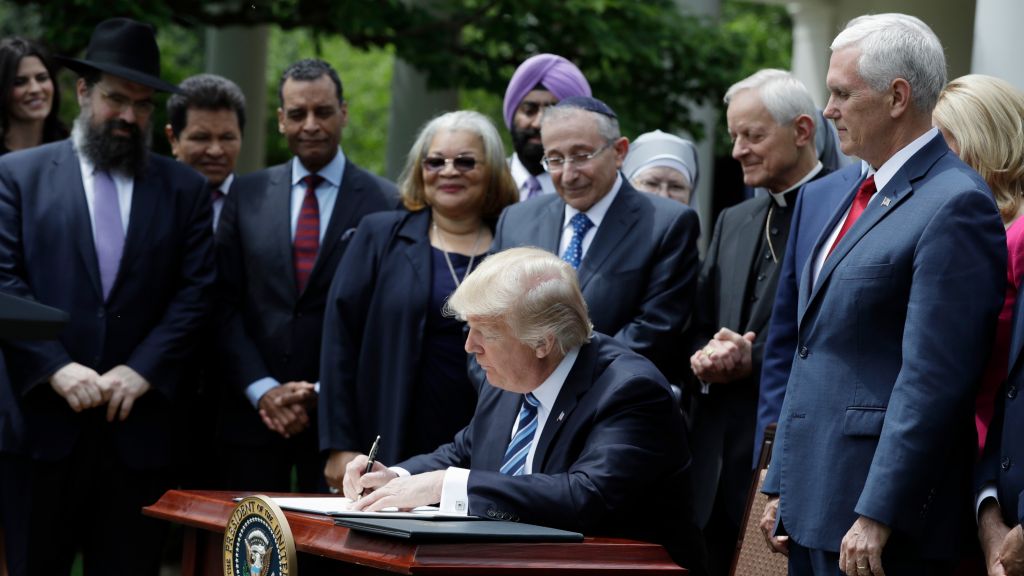
The Anti-Defamation League on Thursday criticized US President Donald Trump’s latest executive order on religious freedom that would weaken enforcement of an IRS rule barring churches and tax-exempt groups from endorsing political candidates.
The ADL said it was troubled by the executive order and concerned that “religious organizations may believe this order empowers them to engage in more political activity, even though it does not actually change the law to permit that.”
“If churches and other religious institutions read this order as an invitation to start politicking, they are mistaken,” said ADL CEO Jonathan A. Greenblatt. “What the Executive Order will do, unfortunately, is politicize the pews. And as an organization committed to ensuring religious freedom for all people, we know that separation of church and state is designed to protect both. This order weakens the foundations of the wall and could seriously damage the integrity and independence of houses of worship.”
The order, said the ADL in a statement, “will foster inappropriate religious entanglement with politics, campaign donations and special interests,” and “likely encourage divisive manipulation of religious organizations by campaign donors who are not subject to customary campaign finance laws.”
Meanwhile, the Union of Orthodox Jewish Congregations (OU) commended Trump for the order, saying it guaranteed “fair and equal treatment under the law for religious individuals and institutions” that address moral or political issues from a religious perspective.
“As a minority faith community in America, the Orthodox Jewish community depends upon robust legal protections for religious exercise. When these legal protections are weakened – as they were under the last administration – our community’s freedom is weakened, said Nathan Diament, the Orthodox Union’s executive director for public policy.
“We are grateful that President Trump has made it clear that his administration will promote and protect the religious liberty of Americans of all faiths wherever possible. We look forward to working with the White House, Justice Department and others to implement the principles laid out in today’s executive order,” he said.
Trump signed the order earlier Thursday asking the IRS to use “maximum enforcement discretion” over the rarely enforced regulation, known as the Johnson Amendment.
“This financial threat against the faith community is over,” Trump said. “No one should be censoring sermons or targeting pastors.”
Trump spoke to religious leaders at the Rose Garden, where he also announced he’ll visit Israel, Saudi Arabia and the Vatican — including a meeting with Pope Francis — on his first foreign trip.
His executive order also promises “regulatory relief” for groups with religious objections to the preventive services requirement in the Affordable Care Act, according to a White House official. Those requirements include covering birth control and could apply to religious groups that object to paying for contraception.
The White House has not yet released the full text of the order, but it appears to fall short of what religious conservatives expected from Trump, who won overwhelming support from evangelicals by promising to “protect Christianity” and religious freedom.
The Johnson amendment, named for then-Senator Lyndon Johnson, was put into force in 1954. The policy allows a wide range of advocacy on political issues, but in the case of houses of worship, it bars electioneering and outright political endorsements from the pulpit.
The IRS does not make public its investigations of such cases, but only one church is known to have lost its tax-exempt status as a result of the prohibition. The Church at Pierce Creek in Conklin, New York, was penalized for taking out newspaper ads telling Christians they could not vote for Bill Clinton in the 1992 presidential election. Even so, some religious leaders have argued the rule has a chilling effect on free speech.
While Trump’s action on the Johnson Amendment aims to please religious conservatives, not all of them are on board.
In a February survey of evangelical leaders conducted by the National Association of Evangelicals, which represents churches from about 40 denominations, 89 percent said pastors should not endorse political candidates from the pulpit. Nearly 100 clergy and faith leaders from across a range of denominations sent a letter last month to congressional leaders urging them to uphold the regulation. They said the IRS rule protects houses of worship and religious groups from political pressure.
Easing political activity rules for churches also raises questions about whether churches could be pulled into the campaign finance sphere and effectively become “dark money” committees that play partisan politics without disclosing donors.
The order’s health care provision could apply to groups like the Little Sisters of the Poor, who run more than two dozen nursing homes for impoverished seniors, and have moral objections to paying the birth control costs of women in their health plans. The Obama administration created a buffer meant to shield those groups, but they say it didn’t go far enough. They have continued to press their case in the courts, and last year the Supreme Court asked lower courts to take another look at the issue.






The Times of Israel Community.