

Al-Shabab storms Somali gov’t ministry, killing nine
Terror group attacks government compound in Mogadishu, detonates car bomb and shoots those inside
 Add ToI as a Preferred Source on Google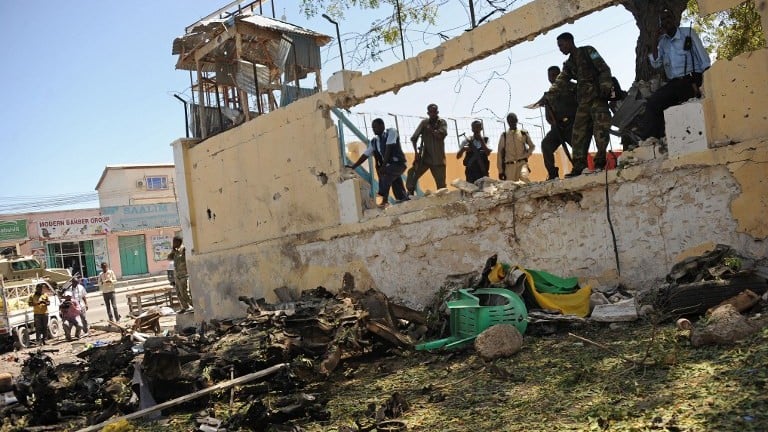
MOGADISHU, Somalia — Somalia’s al-Qaeda-linked al-Shabab militants on Tuesday blasted their way into the higher education ministry with a car bomb before storming the building, killing several people.
The exact death toll is still under dispute. A government spokesman, Ridwan Haji Abdiweli, puts it at 10 — eight civilians and two soldiers — but a spokesman for the police, Muhammad Dahir, puts the figure at nine.
“One policeman and eight civilians were killed in the attack, and a dozen others were wounded including a senior education ministry official,” Dahir told the AFP.
Police secured the Ministry of Higher Education office complex, said Capt. Muhammad Hussein, a senior police officer.
The attackers stormed the education ministry’s offices after a suicide car bomber detonated his vehicle at the gate, opening the way for gunmen to enter the fortified complex, said Hussein.
The assault on the walled compound, which also houses other government ministries, is the latest attack by suspected Islamic extremists of al-Shabab who are maintaining a series of attacks in the capital on government targets and the African Union forces who are supporting the government.
Smoke could be seen rising over the compound after the attack.
Security forces rushed to the scene and ambulances ferried wounded victims to hospitals.
Witness Idil Malim said bodies of those killed and wounded lay around the complex.
“There were several people lying dead at the scene,” he said.
Shabab spokesman Abdulaziz Abu Musab claimed responsibility, boasting that their gunmen had been in “fully in control” of the ministry, as well as entering a neighboring building housing the oil ministry.
As government forces retook the compound and fighting ended, the fate of the gunmen was not immediately clear — whether they had been killed in the assault or had managed to escape.
The building is in the K5 district of the capital, which has been hit by a string of similar attacks in recent months.
The Shabab rebels stage regular attacks in the capital as part of their fight against the country’s internationally backed government and African Union forces supporting it.
Complex attack
A car bombing to force entry into fortified buildings followed by an armed raid has become a trademark tactic of the Islamists.
Somalia has been unstable since the collapse of Siad Barre’s hardline regime in 1991, and the country’s new government is being supported by a 22,000-strong African Union force that includes troops from Burundi, Djibouti, Ethiopia, Kenya and Uganda.
Shabab fighters have carried out a string of revenge attacks in neighboring countries, notably Kenya and Uganda, in response to their participation in the AU force.
The group carried out its deadliest attack yet earlier this month, when Shabab terrorists massacred 148 people in a day-long siege of a university in Kenya’s northeastern town of Garissa.
The attack on the university was the Shabab’s bloodiest massacre and Kenya’s worst since the 1998 bombing of the US Embassy in Nairobi.
The Shabab warned of a “long, gruesome war” unless Kenya withdraws its troops from Somalia, as well as warning the government in Mogadishu it would continue to attack them on home soil.
Shabab fighters also carried out the Westgate shopping mall attack in Nairobi in September 2013, a four-day siege which left at least 67 people dead.
Last month Shahab gunmen in Mogadishu stormed the fortified Maka al Mukarama hotel, used by politicians, diplomats and businessmen.
Despite losing significant territory in recent months the Shabab group, whose name means “youth” in Arabic, still manages to launch frequent attacks as part of its fight to overthrow the government.
Last week the government in Mogadishu issued bounties for 11 top leaders of the Shabab, with $250,000 offered for the extremist’s chief, Ahmad Umar.
The Associated Press contributed to this report.








The Times of Israel Community.