

As Israeli kids go back to school (again), will COVID cause chaos?
Virus rates are falling, making some experts optimistic, but others say infection could quickly spike and mass quarantines could put the kibosh on classes

 Add ToI as a Preferred Source on Google
Nathan Jeffay is The Times of Israel's health and science correspondent
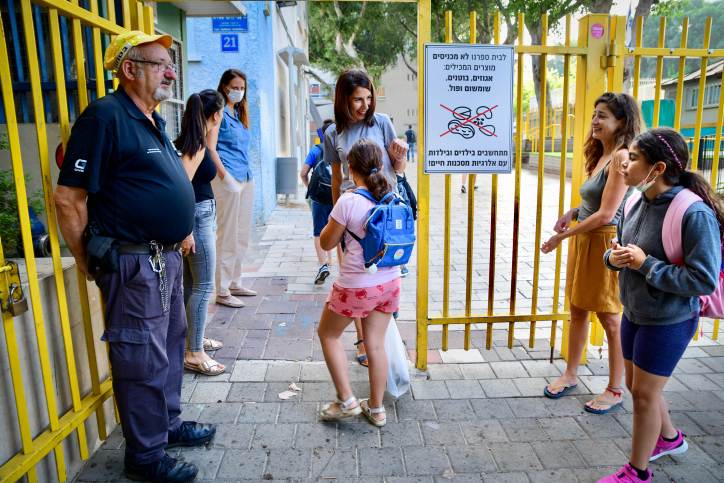
As Israel’s parents waved goodbye to their kids on Thursday with the reopening of school after the holidays, most had the same thought: Will school stay open, or will COVID quickly disrupt the academic year?
Children have been on vacation for much of September, concluding with the Jewish holiday of Sukkot, and are now returning after two weeks of falling virus numbers — both new daily cases and overall active cases.
There are just under 50,000 Israelis currently confirmed infected, compared to more than 80,000 two weeks ago. New daily cases stand at around 3,500, based on a three-day average. This is less than half the number in mid-September.
But experts are divided over whether the nation can assume that the fourth wave is waning, paving the way for uninterrupted schooldays, or instead should be bracing itself for possible new spikes.
Renewed outbreaks could result in children constantly in and out of quarantine, which is currently mandated after every contact between an unvaccinated person and a carrier — meaning a third consecutive school year interrupted by the pandemic.
“Our analysis says things are indeed going down, and indicators show there is real decay in the current wave,” leading coronavirus statistician Nadav Katz, part of an interdisciplinary team of analysts from the Hebrew University, told The Times of Israel.
“The statistics show us that the decline is real, and doesn’t just reflect a lack of testing or some other factor that skews the picture,” he said.
He predicted that the education system will be able to function well, and that despite the fact that quarantine rules are still in force, there won’t be large numbers of children in isolation. “We expect schools to stay open,” Katz said. “And the trend right now is there will be fewer kids going into quarantine, as things are in a downward spiral.”
But immunologist Prof. Tomer Hertz of Ben-Gurion University in Beersheba is more pessimistic, arguing that high case numbers and quarantines could lead to many children ending up at home and cause major interruptions to the school year.
“It’s safe to say there are going to be many many infected kids, and I do not think COVID is going to decline rapidly,” he told The Times of Israel on Wednesday.
Hertz suggested that the government was being shortsighted, saying it “seems to be placing all of its bets on the booster vaccines without backing other strategies.” He maintains that there is still significant risk of spread, and says limits should be placed on large gatherings like weddings and concerts where many people can become infected at once.

The government’s insistence that it is safeguarding the economy by avoiding new restrictions may doesn’t add up, he said.
“They are thinking everything is open and the economy can function, but if there are massive school quarantines that’s just not accurate as it can become, in reality, a sort of partial lockdown,” since many parents will be unable to go to work with their kids at home, posited Hertz.
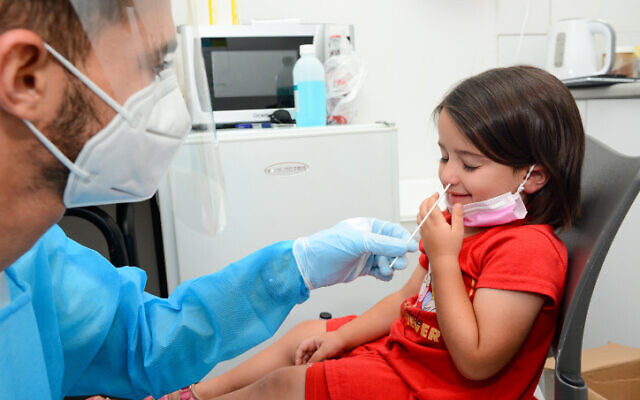
Hertz said it was a good move by the government to require home antigen COVID tests to be administered on Wednesday for every student under 12 in a bid to identify positive cases before they returned to school. However, he believes that far more comprehensive testing programs are needed in schools, on an ongoing basis.
He thinks there is too much confusion surrounding school policy, for example, on the issue of quarantine: the government is discussing eliminating automatic quarantine and instead repeatedly testing students who have been exposed to COVID while allowing them to go to school. Some parents and teachers have the impression this has already become blanket policy, but it has not. For the moment is just a small-scale pilot program in 300 classrooms, and some in the medical community are skeptical that it will become policy.
“It’s unclear what the strategy is for the education system,” Hertz said. “All the things to do with quarantine and kids are up in the air and teachers are confused, not knowing who to do.
“To add to a complicated picture in the country, serious cases are falling, but not as fast as we expected, and the Food and Drug Administration’s decision to not give boosters to all in the US is completely misunderstood by many Israelis, and being used as a justification by some who don’t want to take the vaccine.”
Katz acknowledges that the number of seriously ill patients is dropping slower than anticipated, but said this is a reflection more of high virus rates a few weeks ago than now. Many of the serious patients are unvaccinated young and middle-aged people who have been badly affected by the virus and end up hospitalized for a long time, he said.
He said that booster shots are showing major benefits, and believes that even without additional screening, the home COVID tests that parents have just performed on kids will help a smooth return to studies.
“The testing kits will create a bump of new cases over the next few days, because of positive results, but this is useful in catching and quarantining cases that aren’t otherwise being noticed, stopping the spread among kids, and helping the return to studies,” he said.










The Times of Israel Community.