

Biden looking for positive Bennett meet amid Afghan crisis, but not at any cost
White House going out of its way to ensure sit-down goes well, but will want answers regarding Palestinians and hasn’t given up on Iran nuke deal, despite assumptions in Jerusalem

 Add ToI as a Preferred Source on Google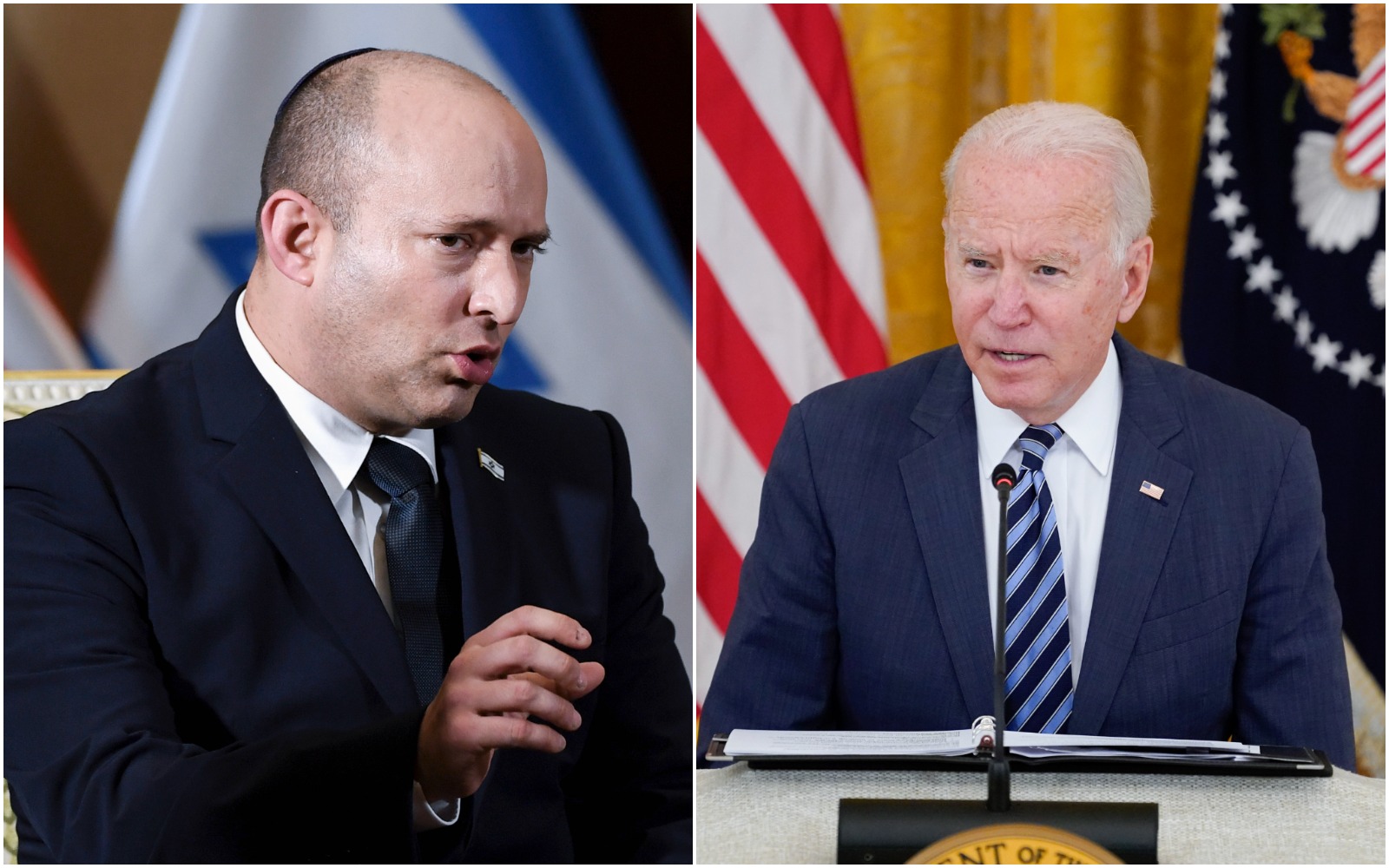
WASHINGTON — No matter how well Thursday’s White House meeting with Prime Minister Naftali Bennett goes for US President Joe Biden, it is unlikely to draw much attention away from the ongoing crisis in Afghanistan, where thousands of civilians who assisted the US-led coalition over the past two decades face being left behind in the now Taliban-controlled territory.
Nonetheless, the sit-down presents an opportunity for Biden to boast of a stable, reliable Middle East ally, after the one the US sought to establish in Afghanistan collapsed in a matter of days despite the exorbitant amount of time and money Washington had invested.
To achieve this, one might expect the president to take a conciliatory approach with Bennett, as the alternative could mean a public rift with Israel, further preventing the US leader from focusing on the foreign policy issues he’s placed a higher premium on — combating the growing influences of adversaries China and Russia.
At the same time, a senior US official cautioned against concluding that Biden would be willing to entirely disregard differences with Bennett on Iran and the Palestinians.
“The president is going to want answers on some of these key issues, and it would be incorrect to assume they can simply be glossed over because [US] national attention is elsewhere,” the official told The Times of Israel, speaking on condition of anonymity.
Misreading the situation
On the face of it, the stagnation of indirect talks between the US and Iran to revive the Iran nuclear deal, known as the Joint Comprehensive Plan of Action (JCPOA), gives Bennett and Biden one less issue to disagree on.
But a source familiar with the matter said growing assumptions in Israel that Biden has all but given up on the Iran nuclear deal are exaggerated and misguided.
“Biden is going to use the meeting to ask Bennett how Israel will react if there is a return to the JCPOA and how it will respond if there isn’t,” the source said. “He’s going to expect clear answers for both.”
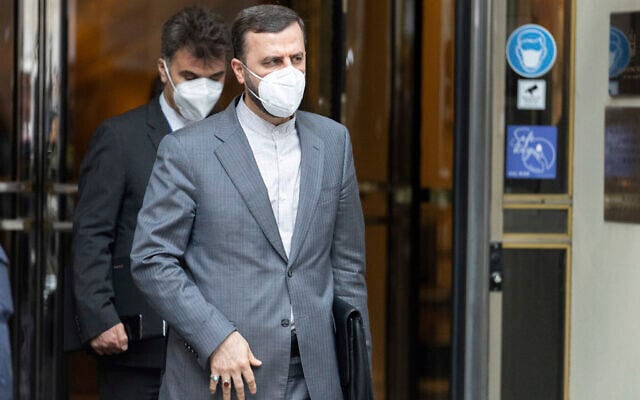
While Bennett’s opposition to the multilateral accord, which trades sanctions relief for curbs on Iran’s nuclear program, would have one assume that he’d prefer the latter scenario, the well-placed source speculated that Israel may find itself in favor of a revived JCPOA when properly judging the alternative. Jerusalem isn’t a party to the deal regardless and would be able to continue covertly acting to sabotage Tehran’s efforts, all while the program is “kept in a box” for the near future, the source explained.
However, the source acknowledged that amid criticism over his handling of the Afghan crisis, Biden may have little patience for efforts by the new hardline government in Iran to drag on negotiations in Vienna for much longer.
On the Palestinian issue as well, the source said that Bennett’s team may be misreading the Biden administration’s position.
“Yes, there’s recognition that the fragility of the new coalition prevents Bennett from making far-reaching gestures, and this was part of the reason why [Biden] agreed to hold off on reopening the consulate,” the source said, referring to the de facto mission to the Palestinians in Jerusalem that was shuttered by Trump in 2019.
“But Bennett’s team has talked for months about shrinking the conflict, and Biden is going to want to see some concrete proposals,” the source said. “There are some ideas they’ve been weighing, but we’re nearing the time for implementation.”
Somewhat of a formality
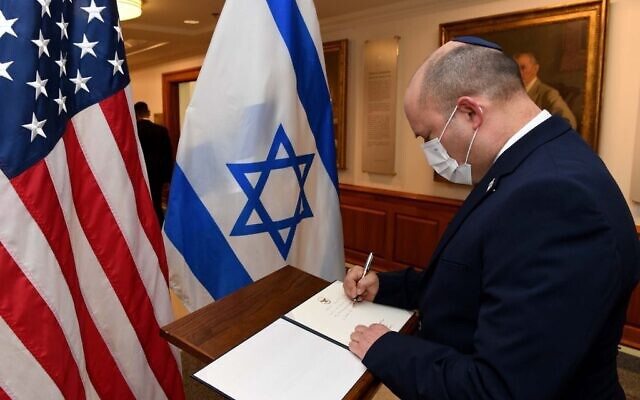
Still, the White House sit-down is likely to be heavy on formalities, particularly given that the pair have never met before. Biden is also known for placing a premium on personal relationships when crafting foreign policy, so it may take a meeting or two before the leaders delve into some of the finer details.
There will be much emphasis on issues on which the sides agree, and the meeting will be an opportunity for each to lavish praise on the other.
Already in the precursors to Thursday’s main event at the White House — Bennett’s meetings Wednesday with US Secretary of Defense Lloyd Austin and Secretary of State Antony Blinken — the prime minister repeated that the president is a “true friend” of Israel and that the Jewish state has no greater ally than the US.
Even more than Biden, the fledgling premier wants a harmonious visit as he seeks to establish himself as a responsible leader capable of maintaining bipartisan support for Israel in an increasingly polarized United States, after his Republican-tied predecessor Benjamin Netanyahu was widely seen as having forgone that effort.
Washington Institute for Near East Policy scholar David Makovsky speculated that Bennett may want to turn the charm offensive up a notch by going out of his way while the cameras are rolling at the White House on Thursday to stress how much Israel feels that it can count on the US as an ally.
“Amid the current crisis where questions have risen regarding the US ability to maintain commitments to allies abroad, one would think [this approach] would incur some gratitude from the Biden administration,” Makovsky said.
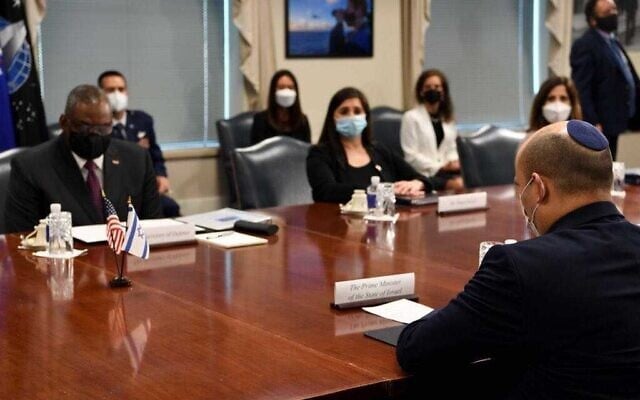
On the US side, Blinken and Austin were quick to highlight the premium it places on Israel’s security.
“The administration is committed to Israel’s security and its right to self-defense… That is unwavering. It is steadfast,” Austin told Bennett.
Biden officials have also made a point of emphasizing a favorite issue for Jerusalem — the Abraham Accords and efforts to develop and expand the normalization agreements between Israel and its Arab neighbors.
Speaking to reporters alongside Bennett on Wednesday, Blinken lauded “the relationships that Israel is developing in the region,” adding that the US looks forward to helping Israel build on those relationships.
But these remarks shouldn’t necessarily be mistaken for substantive progress on the issue.
Senior White House officials who briefed reporters on Tuesday were light on details, mainly repeating lines they’ve used since Biden entered office.
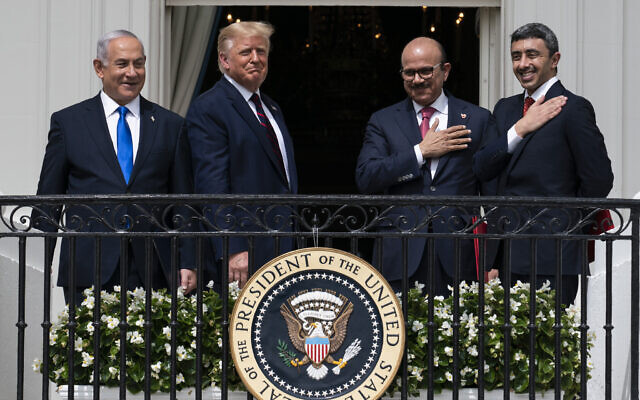
“We’ve done an awful lot of work behind the scenes in building upon the breakthroughs,” one of them said. “But also behind the scenes, there’s an awful lot of work going on to expand those arrangements to other countries.”
In the meantime, though, Washington hasn’t appointed a specific envoy to spearhead the issue, as was the case under the Trump administration. Moreover, Biden officials’ lack of enthusiasm regarding the sweetened deals the former president was willing to offer to potential Abraham Accords partners — like the sale of F-35 fighter jets to the UAE, the recognition of Moroccan sovereignty over the disputed Western Sahara region, or billions in debt relief for Sudan — indicates that they won’t be willing to go as far as it may be necessary to coax other reluctant Arab countries to normalize relations with the Jewish state.
Makovsky summarized the Biden administration’s approach for the meeting as two-pronged.
“They’re trying to create a level of intimacy and candor with a new Israeli government. At the same time, they don’t want to be the Obama administration where they’re leaking their disagreements to the media,” he said.
“They want to maintain this intimacy and to do so, that means they’re not going to tell the media what went on behind closed doors,” speculated Makovsky, who served on the Obama administration’s Israeli-Palestinian peace negotiations team.
He cautioned against interpreting “vanilla readouts” from this week’s meetings in Washington “to mean they just spoke about the weather.”
Let me be your lighthouse
Bennett recognizes the predicament in which Biden currently finds himself.
In a Tuesday interview with The New York Times, he appeared to assure the president that Israel will continue to be a reliable, dependable and capable ally even if Biden moves to disengage somewhat from the region.
“Israel is here… We are the precise anchor of stability, of willingness to do the job to keep this area safer,” Bennett said in his first interview to foreign media since taking over as prime minister.
“We could be this lighthouse in a storm, if you will,” he said.
Still, if the message is aimed at skirting responses that Biden is seeking on other issues, the president may be forced to tell Bennett, “thanks, but no thanks.”










The Times of Israel Community.