

Egyptian envoy: Peace with Israel only ‘partial’ without Palestinian state
At President’s Residence, Hazem Khairat calls on Jerusalem to support Hamas-Fatah reconciliation, accept Arab Peace Initiative
 Add ToI as a Preferred Source on Google
Raphael Ahren is a former diplomatic correspondent at The Times of Israel.
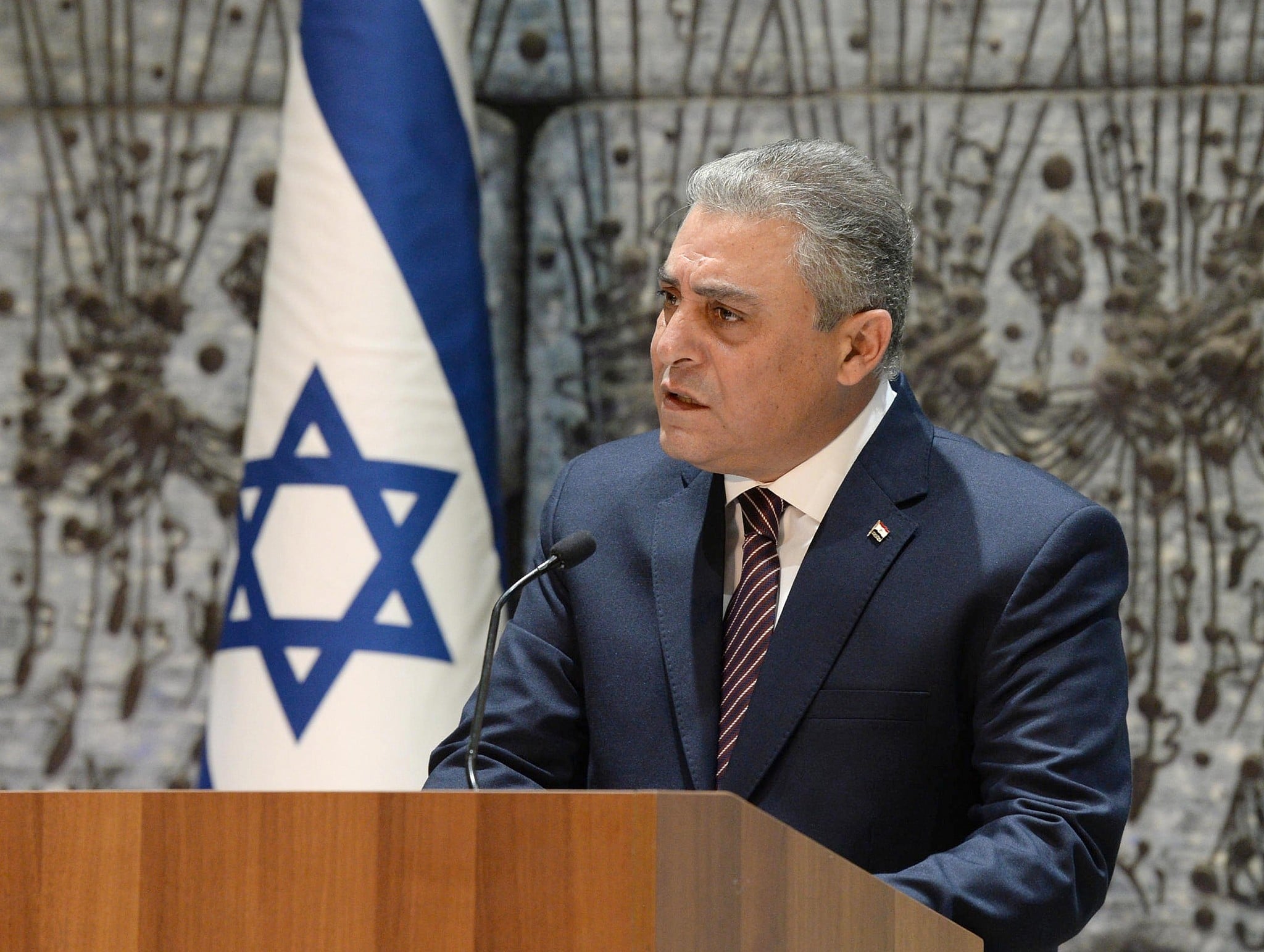
The peace treaty between Israel and Egypt remains incomplete as long as a Palestinian state has not been created, Cairo’s ambassador to Israel said Wednesday, urging Jerusalem to restate its commitment to a two-state solution and accept the terms of the Arab Peace Initiative.
At an event at the President’s Residence marking the 40th anniversary of Egyptian president Anwar Sadat’s groundbreaking speech to the Knesset, Hazem Khairat also urged Israel to support the reconciliation deal between Palestinian Authority President Mahmoud Abbas’s Fatah party and the terrorist group Hamas.
“In the absence to a just solution to the Palestinian problem, never will there be a durable and just peace,” Khairat said, paraphrasing Sadat’s November 20, 1977, speech. “We cannot attempt to achieve partial peace and export the whole problem to future generations.”
In his address to the Knesset, which paved the way for the signing of an Israeli-Egyptian peace treaty months later, Sadat had said that even if Israel achieved peace with all Arab states, “in the absence of a just solution to the Palestinian problem, never will there be that durable and just peace upon which the entire world insists today.”
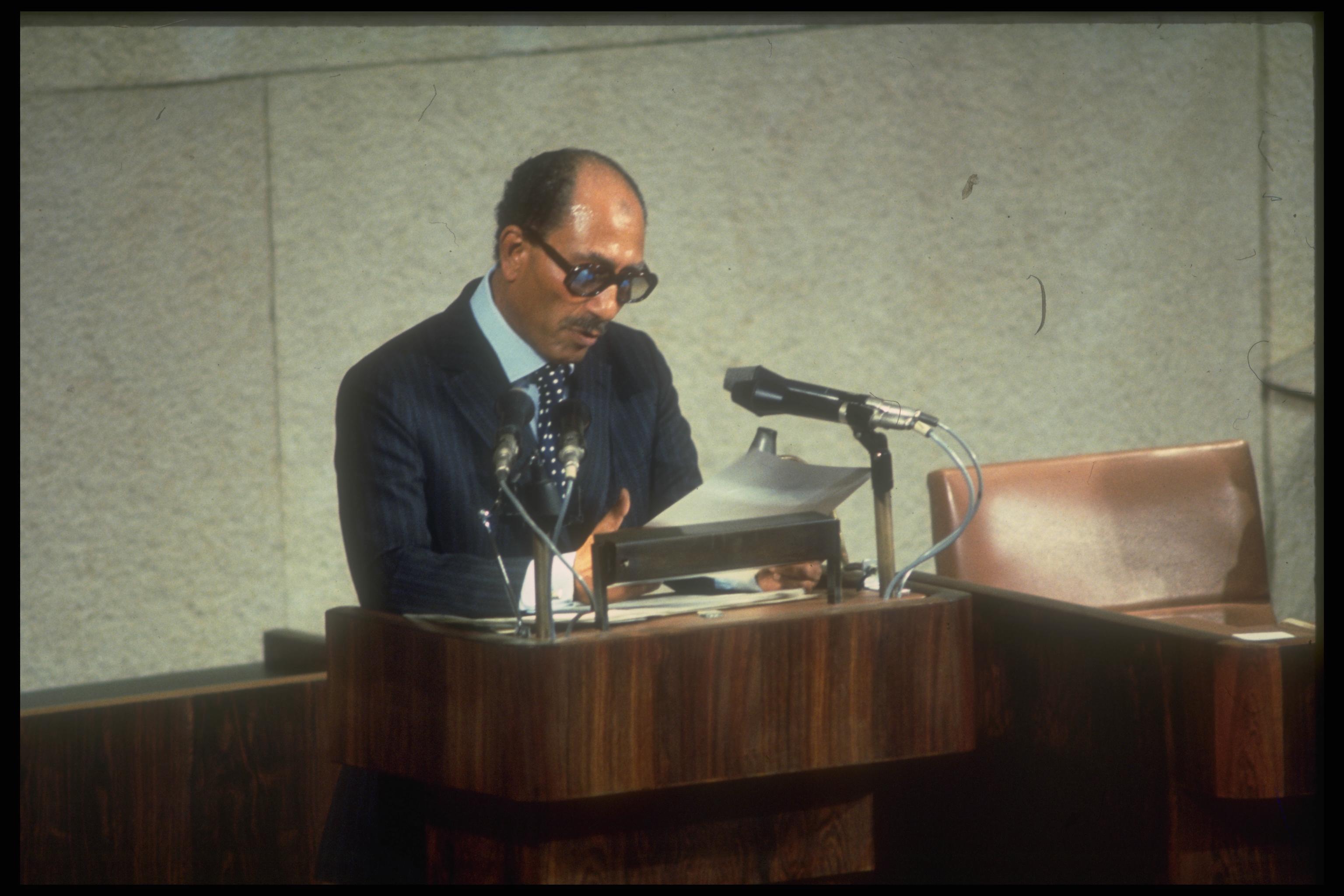
Khairat lauded Sadat as a courageous visionary, but dedicated considerable segments of his speech to the need for Israel to make peace with the Palestinians.
“We have to underscore that the Arabs still extend their hands in peace, which accordingly entails widening and deepening the scope of our mutual beneficial regional cooperation,” he said at the event, hosted by President Reuven Rivlin.
All the Arab states support the Arab Peace Initiative, which “still forms the most serious endeavor and the most appropriate example of what the regional approach should look like,” he added.
Under the initiative, which was first proposed by Saudi Arabia in 2002 and has since been endorsed by the entire Muslim world, all Arab and Islamic states would establish normal diplomatic relations with Israel after the successful conclusion of the peace process with the Palestinians.
“The Israelis and the Palestinians must commit to reaching peace, and the two-state solution remains the only possible way to meet the aspirations of Palestinians and Israelis,” Khairat said.
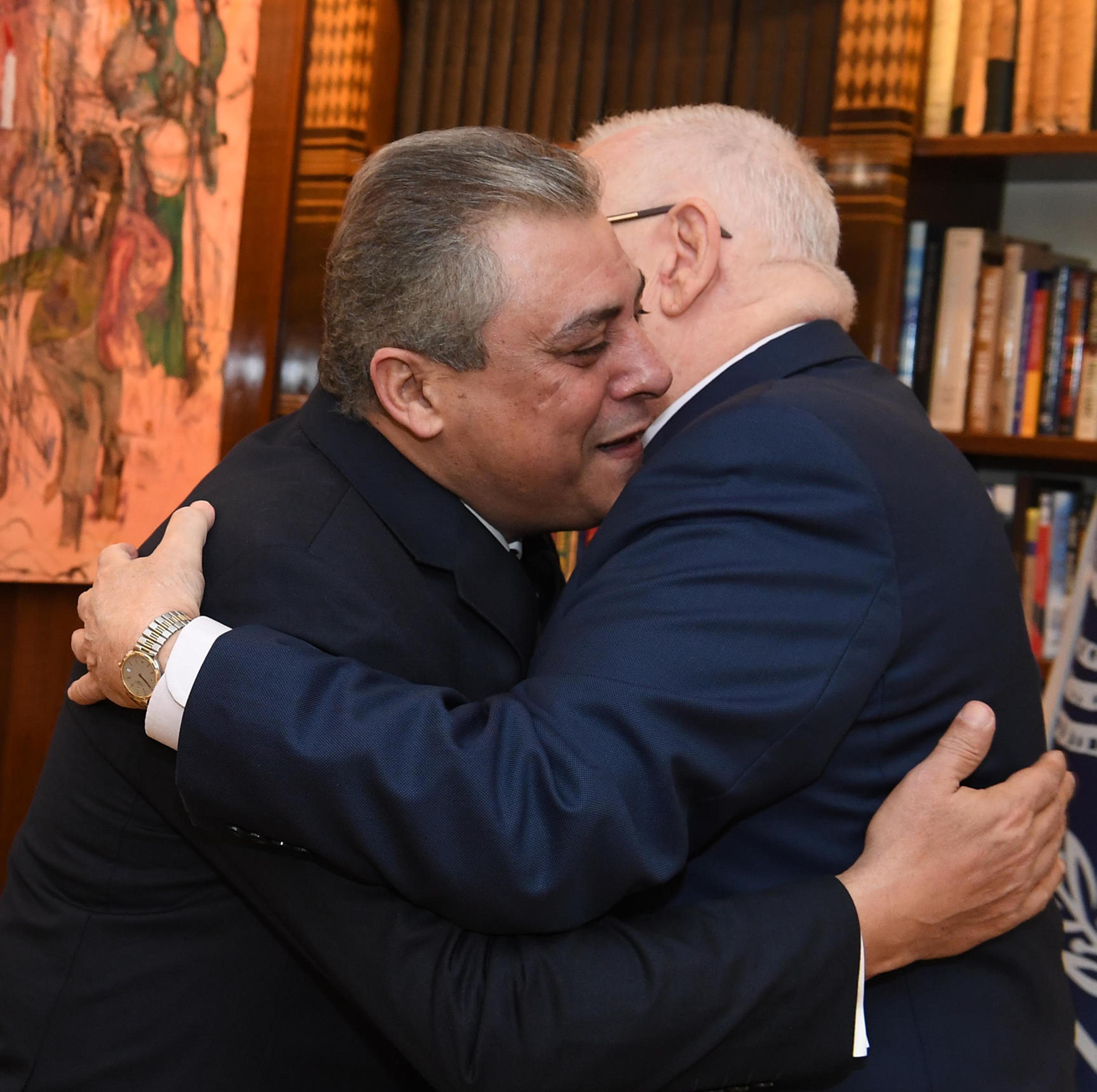
Egypt, as “the cradle of civilization and humanity,” bears responsibility for achieving peace in the region, “which should be based on land for peace, confidence-building measures, and security guarantees,” he declared.
Khairat also addressed the intra-Palestinian reconciliation talks, which are currently underway in Cairo. An end to the decade-old feud between Fatah and Hamas would not only alleviate the suffering of civilians in Gaza, he asserted, but also pave the way for the resumption of Israeli-Palestinian peace negotiations. “Your support and that of the international community for our efforts in this regard is of paramount importance.”
Egypt is adamant about “seizing the golden opportunity” to revive the Israeli-Palestinian peace talks, he said, citing the US administration’s declared goal to achieve a comprehensive final-status agreement.
“We strongly believe that the elements of success exist but they need further elaboration,” Khairat said.
The Israeli officials who spoke before Khairat focused their remarks on the historic significance of Sadat’s visit and the peace treaty that was signed subsequently, all but ignoring the stalled peace process with the Palestinians.
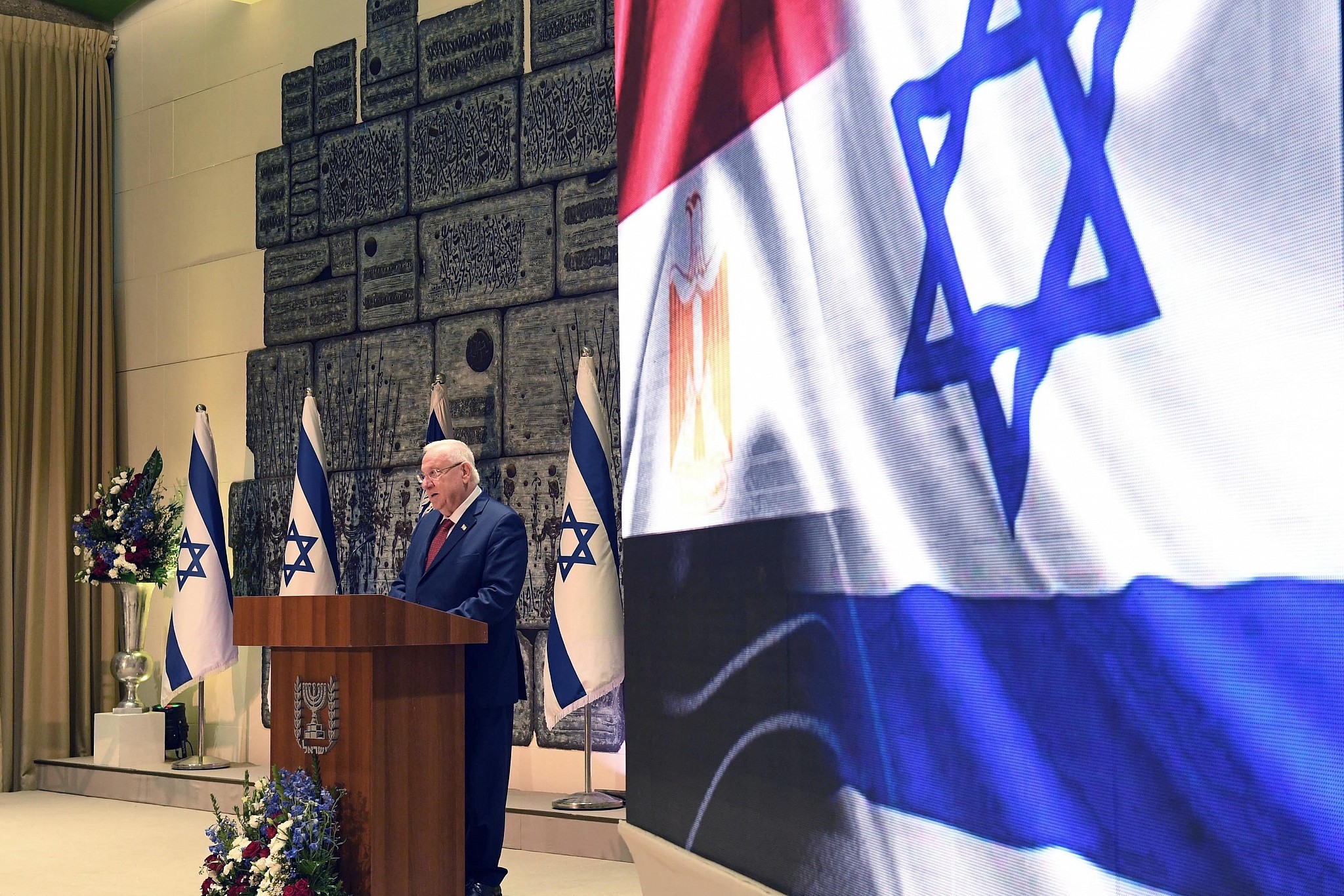
“On Saturday evening, on the nineteenth of November 1977, the Israeli Army Band played the Egyptian national anthem for the very first time. The world’s media watched with open mouths, as enemies became friends,” Rivlin recalled.
Four decades later, he said, Egypt is an “extremely important ally” of Israel. “Our connection is more important than words can say, and it can never be taken for granted.”
The meeting between Netanyahu and Egyptian President Abdel-Fattah el-Sissi on September 19 in New York was “historic,” he added. “An open meeting between the head of an Arab regional power, and the prime minister of Israel. A meeting that made it clear to the whole world that the connection between Israel and Egypt is very real and genuine, and can continue to grow.”
Foreign Ministry Director-General Yuval Rotem said he was only a teenager when Sadat arrived in Israel, but added that he would never forget how excited the entire nation was.
“The stunning visit of president Anwar Sadat, 40 years ago, is such a defining moment. It is inscribed in the hearts and minds of all Israelis. President Sadat inspired us all with optimism, hope and faith,” he said.
Rotem then asked the Egyptian ambassador to convey Israel’s “best wishes” to the family of Sadat, who was assassinated in 1981. “Please tell them that the people of Israel will never forget the warmth extended by president Sadat on his visit to Israel, and we will cherish his memory for all time,” he said.
Forty years after Sadat came to Jerusalem, the majority of the countries in the Arab League have yet to recognize the State of Israel, Rotem lamented, urging these nations to “learn from Sadat.”
Israel looks forward to the day when Arab and Muslim leaders will follow in Sadat’s footsteps, come to Jerusalem and address the people directly, Rotem said. “Any leader who chooses this path will be met with open arms and hearts in Israel.”








The Times of Israel Community.