

Far right jockeys for power in new Austrian government
With Freedom Party expected to join ruling coalition, Austria’s president says he reserves the right to reject certain ministers
 Add ToI as a Preferred Source on Google
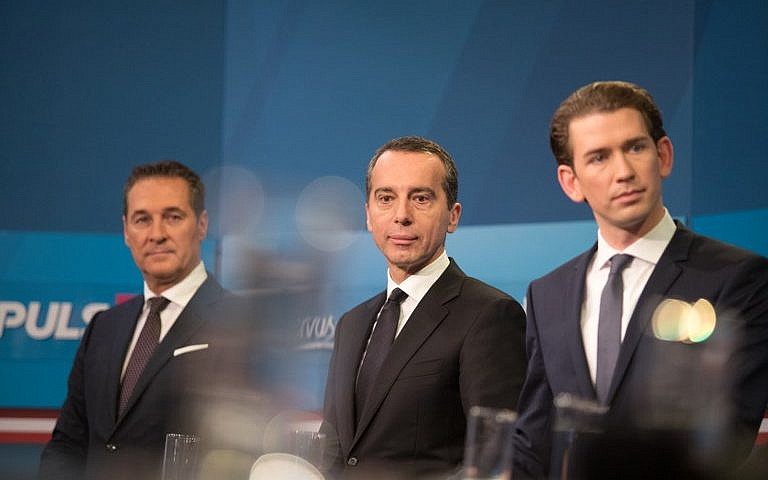
VIENNA (AFP) — Austria’s far right looked set Monday for a possible return to power in a coalition with conservative Sebastian Kurz, the world’s youngest leader-in-waiting, in a fresh triumph for European populists.
Such a rightward shift in the wealthy European Union member state would pose a fresh headache for Brussels as it struggles with Brexit and the rise of nationalists in Germany, Hungary, Poland and elsewhere.
The People’s Party (OeVP) — rebooted by Kurz as a more hardline “movement” — was projected to have won 31.7 percent of Sunday’s vote, with final results expected later this week.

In second place were the Social Democrats (SPOe) of incumbent Chancellor Christian Kern at 26.9 percent, closely followed by the eurosceptic Freedom Party (FPOe) at 26.0 percent.
Founded by ex-Nazis in the 1950s, the FPOe’s result is close to its all-time record of 26.8 percent in 1999 under then-leader Joerg Haider, and twice that of their allies the Alternative for Germany (AfD) last month.
Kurz, 31, forced the snap vote after becoming OeVP chief in May and ending the acrimonious decade-long coalition with the SPOe.
He attracted supporters in droves by depicting himself as a breath of fresh air, talking tough on immigration and vowing to slash taxes and red tape.
“With Kurz we have a new start for the country,” said Werner Schwab, 64, a gardener. “Although he is 31, he is an experienced, calm and disciplined person.”
President’s refusal right
Given Kurz’s thinly concealed dislike for Kern, another “grand coalition” of the two centrist parties that have long dominated is seen as unlikely — but not impossible.
This leaves the populist FPOe of Heinz-Christian Strache, 48, as Kurz’s most probable partner.
Media reports said the two parties were already engaged in intensive behind-the-scene talks, with the FPOe demanding key ministerial positions.
Another possibility, albeit remote, is a tie-up between the FPOe and the SPOe, whose campaign suffered a string of mishaps.
Kern said Monday he was open to talks but that the most likely government was between Kurz and Strache, given the “enormous overlaps in the programs.”
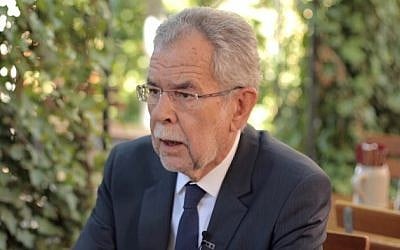
Any new cabinet needs to be approved by President Alexander Van der Bellen who in December narrowly beat far-right candidate Norbert Hofer to the largely ceremonial post.
The ex-Greens leader, 73, said Sunday he could refuse certain ministers.
“It’s the right of the president to do so if he doesn’t trust a person for certain reasons,” Van der Bellen said.
Far-right ‘normalization’
The OeVP — in power nonstop for 30 years — and FPOe already governed together between 2000 and 2007, turning Austria into a pariah.
But there would not be the same backlash now owing to what experts say is the “normalization” of Europe’s far-right.
France’s National Front (FN) called Austria’s election “another welcome defeat” of the EU, in a statement Monday.
Like the FN, AfD, and Geert Wilders in the Netherlands, the FPOe has stoked concerns about a record influx of migrants into Europe.
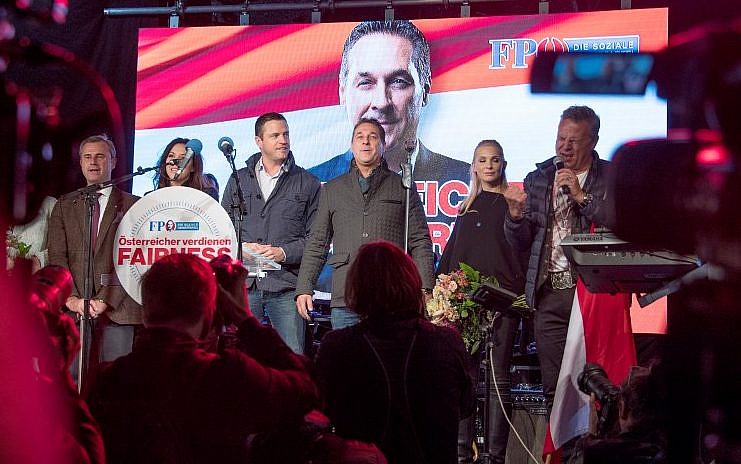
The party topped opinion polls until Kurz stole some of Strache’s thunder with his radical OeVP makeover.
As foreign minister, the rosy-cheeked Kurz claims credit for closing the Balkan migrant trail in 2016 that saw hundreds of thousands of refugees trek into western Europe.
“I promise I will fight for great change in this country,” Kurz told his supporters Sunday.
More EU tensions
Despite Kurz’s pro-EU pledge, observers say a right-wing alliance risks driving a wedge between Vienna and Brussels.
Vienna will hold the EU’s presidency in the second half of 2018, just when Brussels wants to conclude Brexit talks.
Kurz and his views on immigration and economic policy are “diametrically opposed” to those of France and Germany, according to Paris-based Austria expert Patrick Moreau.

The FPOe meanwhile wants EU sanctions on Moscow lifted and pushes for closer ties with eastern and central European countries.
But for EU Commissioner for Enlargement Johannes Hahn, an Austrian from Kurz’s party, the ballot “does not mean Austria is moving to the right.”
“It’s clear any government will have a very pro-European agenda because the main political parties are very much committed to the European Union,” he told reporters in Luxembourg.


The Times of Israel Community.