

Flug: Israel must invest more in human capital to remain competitive
Bank of Israel Governor says closing gaps in education system and labor market policy can increase productivity
 Add ToI as a Preferred Source on Google
Shoshanna Solomon was The Times of Israel's Startups and Business reporter
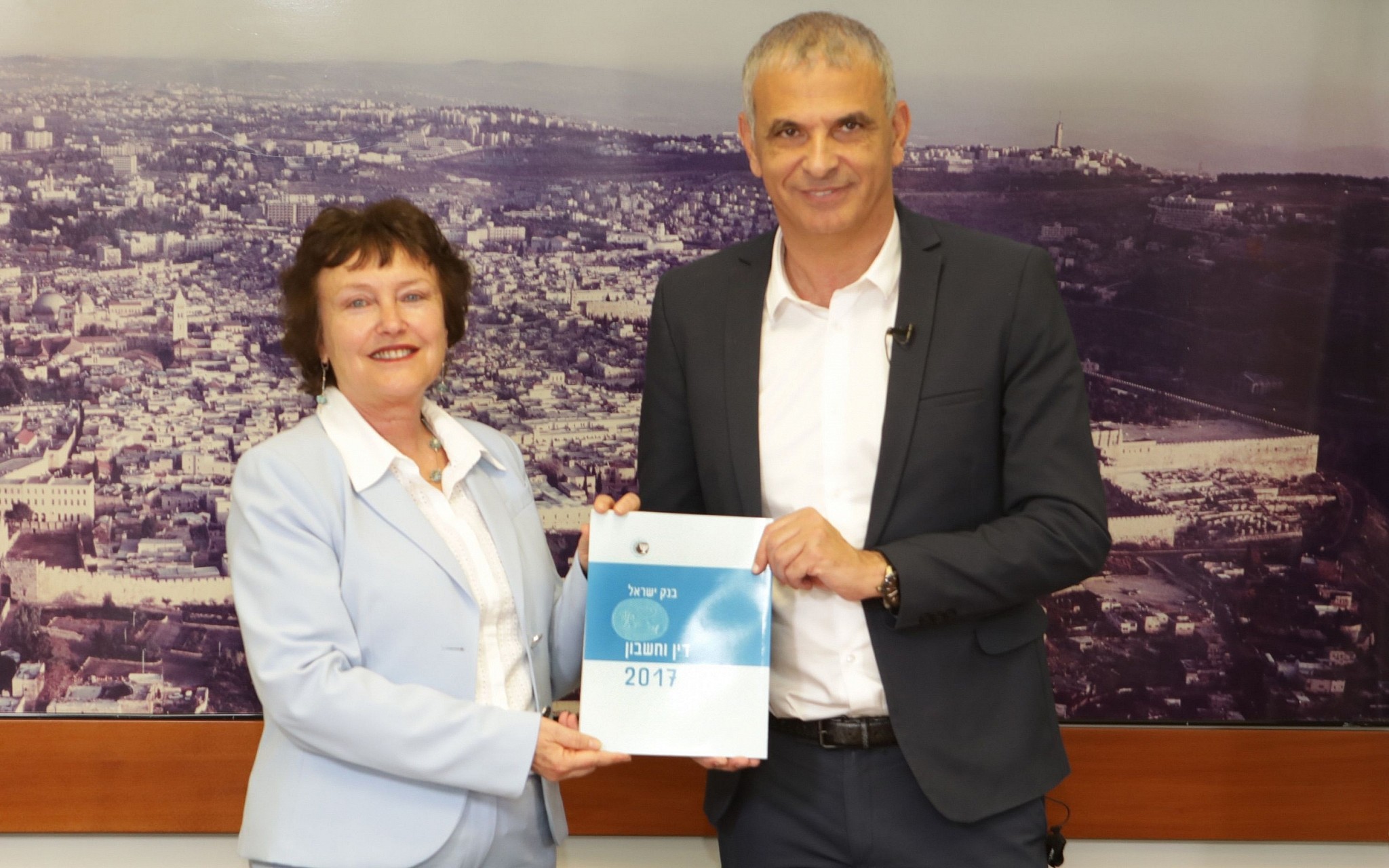
Narrowing the gaps between Israel and other advanced economies in terms of labor productivity, income inequality and the incidence of poverty are some of the main challenges facing Israeli policymakers, said the Governor of the Bank of Israel Wednesday, while presenting the central bank’s 2017 annual report to the government.
An “essential part” of dealing with these challenges is “improving the human capital of the overall population and reducing the gaps among its various groups,” Karnit Flug said in a cover letter to the report. For that purpose, the overall education system should be improved to yield better student achievements, and there should be a concerted effort made to reduce the knowledge gaps between students from various population and socioeconomic groups and varied geographic backgrounds.
“Israel will not be able to maintain its competitive edge” in a global economy that is highly competitive, she wrote, unless it consistently improves its human capital and expands the participation of a variety of population subgroups in its advanced industries. This, she added, can only be done with an improvement in the achievements of students from all backgrounds.
The report notes that there is a limitation of professional workers in the Israeli economy, particularly in the technology fields. In the software and computers field, the job vacancy rate is very high, and wages are increasing rapidly. The increase in demand for these workers is more rapid than the increase in supply. This is due to a shortage of graduates in the fields of engineering and sciences, and this shortage “limits the growth potential” of the Israeli economy.
The high-tech industry, one of the economy’s key growth engines, should not be the only focus of the government, Flug stressed.
According to the report, the non-technology-based industries in Israel, which actually account for the bulk of activity and employment, suffer from low productivity. Increasing productivity in the rest of the economy depends not only on improving achievements in the education system, but also on improving human capital through active labor market policy, including professional training.
“To increase productivity in the economy overall, broad investment in infrastructure is required — primarily public transportation. Such investment will also help in reducing inequality as it makes it easier for various population subgroups to access employment centers,” Flug wrote.

Flug also said that home prices increased this year at a rate slower than that of previous years and the number of transactions continued to decline — continuing the decrease that began at the end of 2016, as a result of government policies in recent years to increase the supply of land and to reduce investor demand.
“It is important that the government continue to act to create the conditions that allow a high level of supply, including through creating a large inventory of construction plans that are readily available for execution, particularly in areas of high demand, and through taking full advantage of the potential inherent in urban renewal,” she wrote.
The Israeli economy grew by 3.4 percent in 2017 and the unemployment rate continued to decline, reaching its lowest level in decades, the report said. The inflation rate for the full year was 0.4%, the first year since 2014 that the rate was positive. The low level of inflation was primarily due to the appreciation of the shekel and increased competition in the economy – as a result of government policy and a rise in online purchases and price reductions initiated by the government, Flug said.









The Times of Israel Community.