

Hamas willing to negotiate Israelis’ release, if 60 prisoners freed — report
Terror group representatives meet with Egyptian officials to discuss swap of soldiers’ bodies, freedom for captive Israelis held in Strip
 Add ToI as a Preferred Source on Google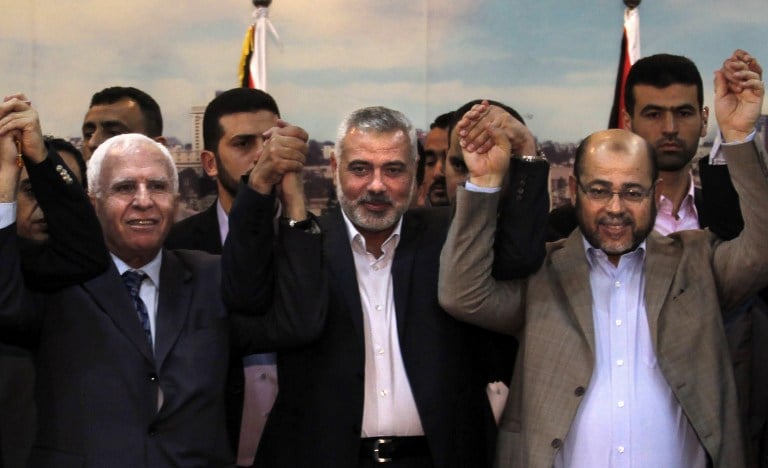
The Hamas terror group is reportedly willing to negotiate the release of two Israeli civilians and the remains of two IDF soldiers held in the Gaza Strip, if Israel releases 60 of the organization’s members from prison as a precondition to talks.
The Gaza-based group is currently holding the remains of IDF soldiers Staff Sgt. Oron Shaul and Lt. Hadar Goldin, who the army says were killed in the 2014 Gaza war, and is also believed to be detaining Avraham Mengistu and Juma Ibrahim Abu Anima, two Israeli men who crossed into Gaza on their own accord.
The Hamas terror group has long demanded Israel first release hundreds of Palestinians who were rearrested after they were freed in the 2011 Shalit deal before it would even enter into negotiations with Israel over a prisoner exchange.
According to a report in the Al-Araby Al-Jadeed newspaper, senior Hamas official Moussa Abu Marzouk discussed a prisoner swap with Egyptian officials last week, according to a translation Friday by Israel Radio.
Abu Marzouk hailed Egyptian mediation between Hamas and Israel, but set a precondition that it would only launch negotiations into the possible release of the bodies and the captured Israelis if Jerusalem freed 60 Hamas members who were released during the 2011 prisoner swap for captive Israeli soldier Gilad Shalit, but have since been rearrested by Israel.
A high-level Hamas delegation will soon travel to Cairo to meet with Egyptian officials, Israel Radio reported. The matter of the captive Israelis was expected to be raised at the meeting, the radio report said.
The Hamas terrorist group has slammed Jerusalem’s decision to stop returning bodies of Hamas militants killed while carrying out attacks, calling the directive “evidence of criminality and barbaric occupation” by Israel.
In a renewed effort to pressure Hamas into returning the two Israeli civilians and the remains of the two soldiers, the high-level security cabinet on Sunday ruled that Hamas terrorists killed while carrying out attacks against Israeli civilians or security forces would be buried quietly, instead of being returned to their families.
Hamas spokesman Fawzi Barhum on Sunday told AFP that the Israeli government’s decision on Hamas would “not give positive results,” without elaborating on the possible consequences.
The move by the security cabinet followed the release on Saturday by the Palestinian group of video footage showing a mock birthday party for Shaul, believed by the army to have been killed in the 2014 Gaza war.
“The political-security cabinet discussed standing policy on treatment of the bodies of Hamas terrorists killed during terror attacks and decided that they will not be returned, but will be buried,” a statement from Prime Minister Benjamin Netanyahu’s office read.
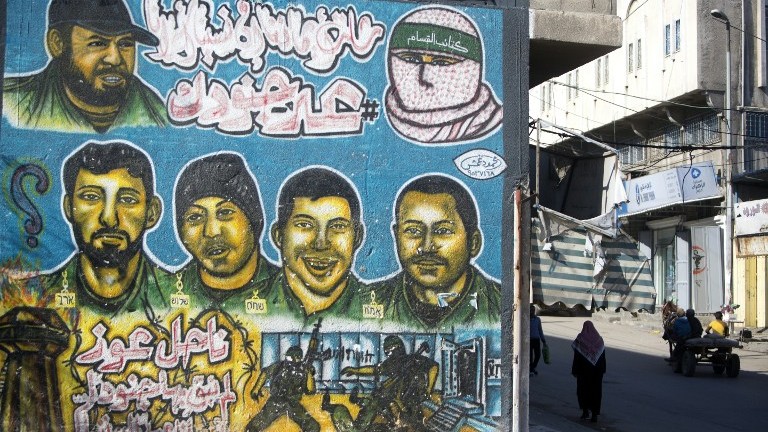
The statement did not elaborate on the burial plan, but said that the same meeting discussed ways of getting back the remains of soldiers killed in the 2014 Gaza war and obtaining the release of two Israeli civilians missing in Gaza and believed to be held by Hamas.
The statement said ministers adopted a “plan of action” but gave no details. Both votes were unanimous.
Following the decision, the parents of Goldin and Shaul expressed scant optimism that the new policy would lead to the returns of their sons’ remains.
In a Sunday evening statement, the Goldins called the measure “too little too late,” while the Shauls told Channel 10 that the family had “already given up on the things the Israeli government says on the matter.”
During the 2014 war between Israel and Hamas, dubbed IDF Operation Protective Edge, the bodies of soldiers Shaul and Goldin were seized by the terrorist group, which still holds them, by all accounts.
Though Israel has determined that there is no doubt that Shaul and Goldin died before their bodies were taken, Hamas has never admitted that the soldiers are dead.
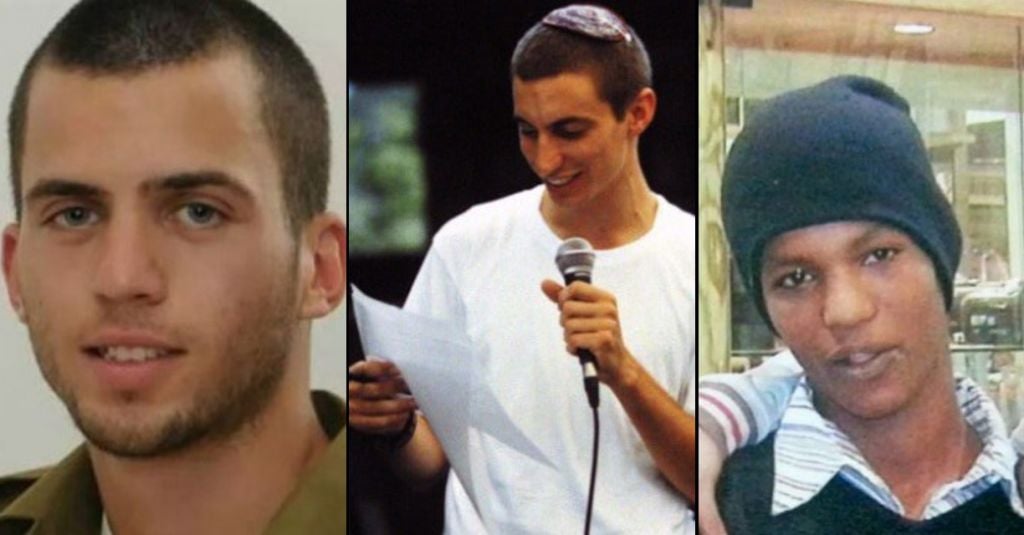
Over the weekend, Hamas published two videos aimed at increasing Israeli public pressure on its leaders to return the soldiers and mocking the government’s failure to secure their remains more than two years after the conflict ended.
In November, the Israeli army’s human resources chief said there were no breakthroughs on the horizon in the effort to return the bodies of the two soldiers.
A month earlier, a Hamas official denied rejecting an Israeli offer to free 18 Palestinians and hand over 19 bodies seized during the 2014 war in Gaza in exchange for the bodies of the two IDF soldiers who were killed in the 50-day conflict.
The terror group also poured cold water on a reported Israeli proposal to hand over Mengistu and Anima in exchange for dozens of Gazans who have been arrested after crossing into Israel illegally.
In the more than two years that Shaul and Goldin have been held in the Gaza Strip, the effort to return the bodies has remained a hot-button issue in Israeli society, with the soldiers’ families making repeated calls for the government to take a harsher stance against the terrorist group in Gaza.

Israel has often gone to great lengths to retrieve bodies of soldiers with unknown burial places, setting up a designated unit within the Manpower Directorate to find them and, in some cases, embarking on regular search missions.
For live soldiers, like Shalit who was captured by Hamas in 2006, and also for bodies of deceased fighters, Israel has often agreed to wildly lopsided exchanges with terrorist groups.
To secure the release of Shalit, for instance, Israel set free 1,027 terrorists from its prisons.
That policy is heavily debated on the Israeli street and in the upper echelons of the country’s security services. One side stresses the need for Israel to do everything within its power to bring back any soldier who falls into enemy hands, while the other argues that such a sentimental approach to individuals, and especially bodies, is ultimately a weakness, which can be and has been exploited by Israel’s enemies.






The Times of Israel Community.