

In immigrant section of Paris, few Jews remain among Muslim majority
Arabic is still spoken in the local kosher restaurant in the 18th arrondissement, where a Jewish presence is quickly becoming a thing of the past
 Add ToI as a Preferred Source on Google
Elhanan Miller is the former Arab affairs reporter for The Times of Israel
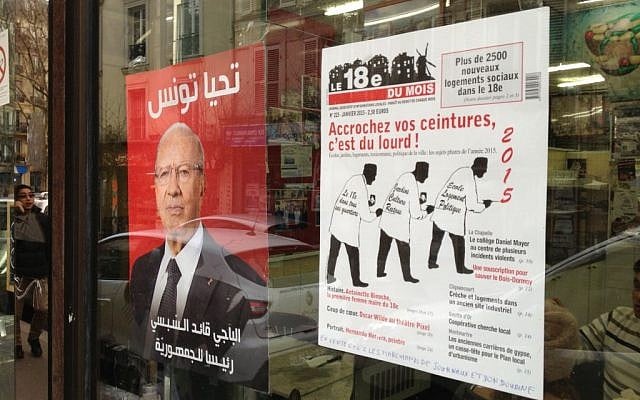
PARIS — A large poster of newly elected Tunisian president Beji Caid Essebsi greets diners at the entrance to the Kosher Tunisian restaurant Chez Guichi in Paris’s immigrant-dominated 18th arrondissement. “Long live Tunisia,” the poster reads in Arabic.
As he roasted beef kebabs on the open grill, the owner, Guichi, wearing a large, black kippa, was chatting in dialect with the lunch customers, Jews and Arabs, with Arabic covers of Beyonce playing in the background.
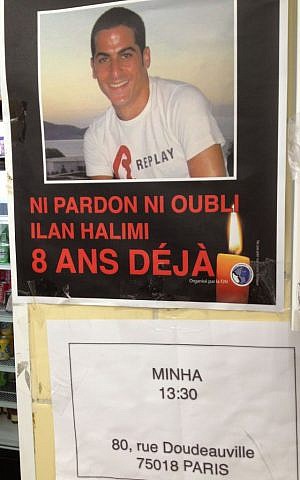
Next to the sink, where Jews traditionally wash their hands before breaking bread, a poster marked the eighth anniversary last January of the kidnapping and murder of Ilan Halimi, a Jewish Parisian of Moroccan decent, by a Muslim gang.
The bundle of contradictions that is Chez Guichi represents a world that was once, and is no more. Waves of Jewish immigrants — first Eastern Europeans at the turn of the 20th century and then North Africans in the 1960s and 1970s — have all but abandoned the working-class neighborhood, which now mostly houses Muslim immigrants from Sub-Saharan Africa and the Maghreb.
Jews and Arabs alike are reluctant to speak of the rising tension between the two communities, though all admit its pervasiveness. At el-Walid Halal butcher, the man behind the counter refuses to speak to the press without his boss’s permission. “I went to the demonstration yesterday,” he says. “We want to remain neutral.”
At Cafe Hotel de L’Univers, the Algerian-born vendor blamed “communautarisme” — the uniquely French sociological term denoting the deliberate dissociation of immigrant communities from society at large — for the recent wave of Islamist violence. He described his community as “ghettoized,” complaining of the bad level of education in Paris’s impoverished suburbs.
“The world has become crazy,” he said. “Why can’t we live together? Jews and Arabs lived together during the time of the Prophet. They traded with each other.”
[mappress mapid=”5006″]
At the Khalid Ibn Walid mosque on rue Myrha, named after a companion of the Prophet Muhammad who conquered and Islamized the Persian empire in the early seventh century, the doorman allowed this reporter to enter the sanctuary, but not to interview any of the worshipers inside ahead of early-afternoon prayers.
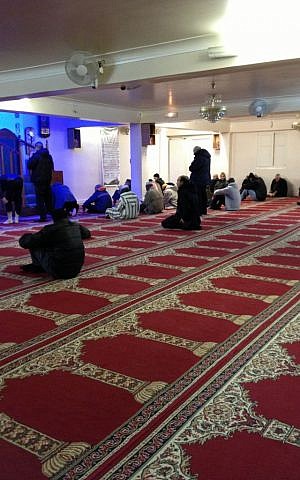
“We all share one faith, but it is Satan, Iblis, who separated Jews and Arabs,” he said.
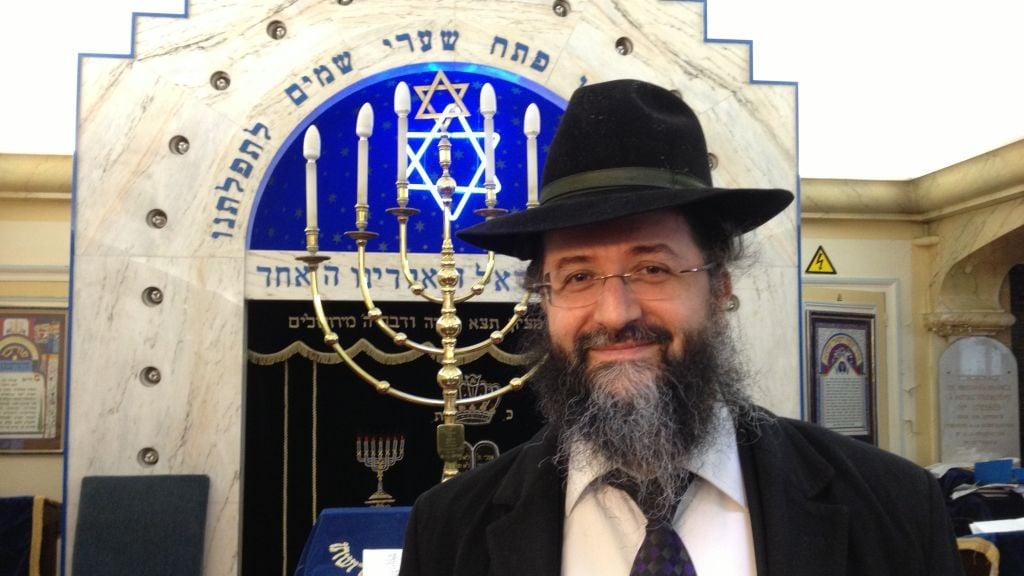
At around the same time, Minha services begin at the Kedouchat Levy Synagogue around the corner, on Doudeauville Street. Established in 1935 by Eastern European Jews who settled in the neighborhood after fleeing the Kishinev Pogrom in 1903, the synagogue is hidden at the back of a residential courtyard protected by an electric code and eight surveillance cameras.
Mevorah Zerbib, who has been serving as community rabbi for the past 28 years, estimated that approximately 70 percent of his community has left the neighborhood over the past two decades, mostly for Israel.
Some of the worshipers, mostly from the less-devout group of Ashkenazi Jews who come mostly for the High Holidays, have written him letters explaining why they could no longer attend.
“Every year I get messages saying, ‘The neighborhood has changed so much, my wife doesn’t want us to go anymore,'” the rabbi said. He, however, believes that the neighborhood is safer than elsewhere in Paris, because troublemakers would be reluctant to carry out a terror attack close to home.
Zerbib’s own experience does not necessarily prove that point. Six years ago, a man spat in his face in the Metro; and a number of congregants have been attacked over the years outside the synagogue. The largest anti-Israel demonstration in Paris during Operation Protective Edge took place just around the corner.
“When things heat up in Israel, we immediately feel it here,” he noted. In the aftermath of last week’s attack, a member of his congregation showed him a Jewish takeoff on the slogan “Je Suis Charlie” in solidarity with the Charlie Hebdo massacre. The Jewish version reads “je suis parti,” or “I have left,” with a picture of an El Al airplane.
“Many people are considering immigration, but it’s not as if life in Israel is easy,” he said. “We’ve been thinking about it for a while, but the intensity of recent events has made these thoughts more immediate.”
At the end of services, Zerbib acknowledged a Tunisian rabbi named Matzliah Mazouz, murdered by a Muslim assassin in the capital of Tunis this week 44 years ago. He also mentioned the great Jewish sage Moses Maimonides, who fled the extremist Almohad dynasty in Cordoba, Spain, in 1148.
“Maimonides had an extremely difficult life, but nevertheless wrote the most spectacular books,” Zerbib told his community. “So we, too, should not despair.”







The Times of Israel Community.