

In Vienna, Kerry and Zarif won’t say if sanctions will lift Saturday
With UN atomic agency expected to confirm Iran has met deal terms, top diplomats say they are ‘working on’ finalizing details of its implementation
 Add ToI as a Preferred Source on Google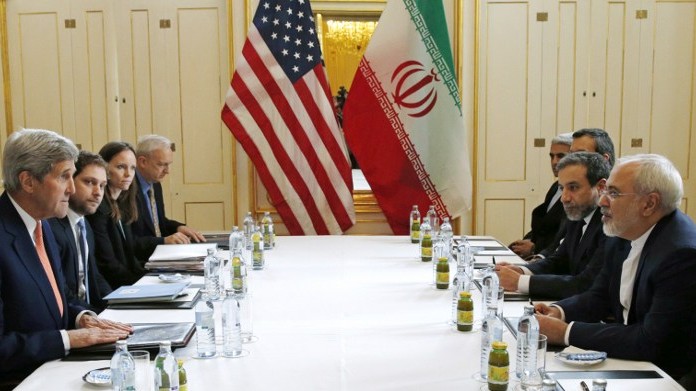
US Secretary of State John Kerry was meeting with Iranian Foreign Minister Mohammad Javad Zarif in Vienna Saturday, with the end of Western sanctions against Tehran on the table.
Despite Zarif’s optimistic comments earlier on Iranian state TV that “All oppressive sanctions imposed against Iran will be annulled today,” both he and Kerry deflected a question about whether their deal would be implemented later in the day.
“We’re trying,” said Zarif.
“We’re working on it,” added Kerry, seated across the table from Zarif in an ornate room at a luxury Vienna hotel.
In his earlier comments to Iranian television, Zarif said the deal between his country and the six world powers would hold, telling Iranian media that all parties would “not allow the outcome of these talks to be wasted.”
Zarif had earlier suggested that the UN atomic agency was close to certifying that his country has met all commitments under its landmark nuclear deal with six world powers.
Zarif, who led Iran in nuclear talks with the United States, Britain, China, France, Russia and Germany, said the deal had removed from the Middle East “the shadow of a baseless confrontation.”
“It proved that we can solve important problems through diplomacy, not threats and pressure, and thus today is definitely an important day,” he added. The deal, he said, proved that “the naysayers are always wrong.”
Financial and other penalties imposed on Iran are set to be lifted once the UN agency says Tehran has fulfilled its obligations to restrict its nuclear programs in the deal reached last summer.
Certification by the International Atomic Energy Agency (IAEA) would allow Iran to immediately recoup some $100 billion in assets frozen overseas. The benefits of new oil, trade and financial opportunities from suspended sanctions could prove far more valuable for Tehran in the long run.
Kerry and EU foreign policy chief Federica Mogherini were in Vienna, headquarters to the IAEA, for separate meetings with Zarif.
The agreement, struck after decades of hostility, defused the likelihood of US or Israeli military action against Iran, something Zarif alluded to.
“Our region has been freed from shadow of an unnecessary conflict that could have caused concerns for the region,” he said. “Today is also a good day for the world. Today will prove that we can solve important problems through diplomacy.”
Iran insists all of its nuclear activities are peaceful. But under the July 14 deal, Iran agreed to crimp programs which could be used to make nuclear weapons in return for an end to sanctions. The agreement puts Iran’s various nuclear activities under IAEA watch for up to 15 years, with an option to re-impose sanctions should Tehran break its commitments.
Copyright 2016 The Associated Press.





The Times of Israel Community.