

Inane and outdated, state-funded TV campaign ads gun for scraps of attention
The first batch of election commercials provide mostly bombast and sloganeering, but also some genuine entertainment and WTF moments
 Add ToI as a Preferred Source on Google
Raoul Wootliff is a former Times of Israel political correspondent and Daily Briefing podcast producer.
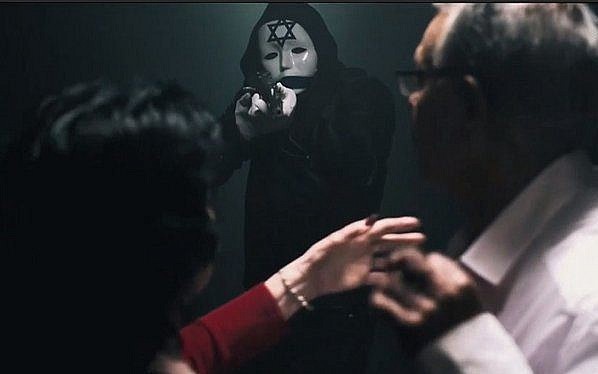
Wearing a mask with a blue Star of David, a hooded assassin guns down an elderly couple dancing the waltz in the middle of a curious crowd.
The scene is, thankfully, not real-life. Unfortunately, it is also not taken from the new season of the highly acclaimed Israeli series Fauda, or from any television drama at all. Rather, it is the final shot from one of the Responsibility for the Founders party’s television campaign ads, which aired Tuesday as part of an outdated Israeli election ritual known in recent years for producing similarly bizarre spectacles.
“Israel is re-adopting targeted assassinations,” the blood-red text flashes across the screen after the couple falls to the floor — murdered, apparently, by the Jewish state.
“Assassinations… of our parents,” a baritone voice proclaims, before encouraging viewers to cast a vote for Responsibility for the Founders, “the only party that cares about those who matter.”
If this is the first time you’ve heard of the party, you are likely joining nearly every other viewer who watched the campaign ad live on the Kan public broadcaster Tuesday evening.
Keeping with Israeli election laws last amended in the 1960s, campaign commercials for each of the 43 parties running in the April 9 elections began to air on Israeli television Tuesday. Running first in the evening and then again from 11 p.m. to midnight, the broadcasts opened a complicated schedule that will see all parties represented on all major channels by Saturday night, just nine days before the national ballot.
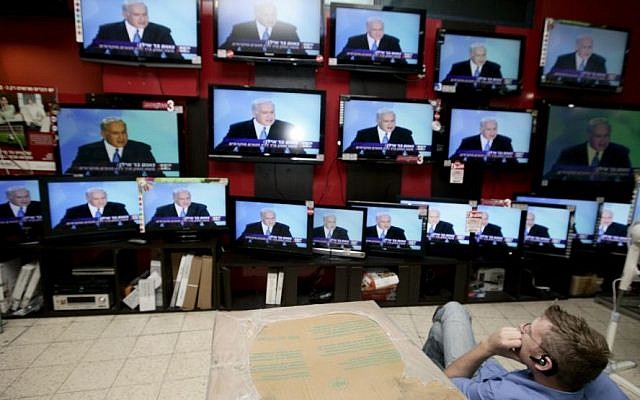
Unlike in the US, radio and television ads in Israel are highly regulated. According to the Elections Law (Propaganda Methods) of 1959, each party registered in the election is eligible to at least seven minutes of state-funded TV airtime over the week and a further 15 minutes on the radio. Additionally, incumbent parties get an extra two minutes of screen time and four minutes of airtime per serving Knesset member.
The system was created to give parties like Responsibility for the Founders or any of the other 30 or so factions currently polling well below the electoral threshold a fair playing field in the battle for the voting public’s attention. But the law was created for an era when television was the exclusive and ubiquitous medium to view video footage and families would gather around the tube for their only chance to see the parties’ ads.
Today, with the advent of the internet and the public’s almost constant exposure to political advertising via every social media platform available, the law is not only archaic but largely obsolete. With zero regulation for online campaigning, the once-fair playing field is now hopelessly skewed, as larger parties funnel hundreds of thousands of shekels into spreading campaign videos, often directly into likely voters’ feeds, via Facebook and Instagram.
According to Gadi Wolfsfeld, a professor of political communications at the Interdisciplinary Center in Herzliya, the TV ads can nonetheless still help small parties looking for a vital springboard into the mainstream.
“If there’s an especially dramatic or provocative commercial and it gets covered in the news media, and of course social media, that can have an effect,” Wolfsfeld said in an interview Tuesday. “This is especially important for smaller parties, because smaller parties don’t normally get coverage — whether in the traditional news media or digital media. Therefore, only by being provocative can they get coverage to what they’re saying.”
As a result, recent years have seen increasingly outlandish and inane videos airing on television, all hoping to capture the public’s eye, if not quite their imagination. Some parties simply rerun the internet ads they have already been using for months, others produce specific ads and messages tailored for the TV audience.
Tuesday’s ads, broadcast consecutively for 62 minutes, provided mostly bombast and sloganeering, but also some genuine entertainment.
Likud
The ruling party’s first television ads assumed a more statesmanlike tone than those Likud has been running on the internet, setting aside both the negative attacks on rival Benny Gantz and those on state institutions involved in the criminal cases against Prime Minister Benjamin Netanyahu.
Instead, Likud ran a series of clips playing up Netanyahu as “Strong, Right (wing), Successful,” the slogan which accompanies each video. In one, the point is even made by President Donald Trump, with his message announcing his decision to move the US embassy to Jerusalem, an ostensible triumph for the prime minister.
In another, Netanyahu can be seen delivering a passionate argument for a hawkish security policy toward “enemies,” saying his motivation is “to build the ability to go after them, to destroy them and to win the war, if it is forced on us. This is what I am doing here.”
While not mentioning his political opponents, the video nonetheless plays on the anti-leftist warnings Netanyahu has made through the campaign.
Rather than using high-quality footage of one of the many speeches on the subject he has made, it features a pixelated clip of him from a 2016 Knesset debate, in which his words are clearly intended not only as a warning to Israel’s enemies but as a critique of then-Meretz leader Zahava Galon, whom he appears to be berating. The message: Not only will Netanyahu fight Iran and Hezbollah, but also the leftist world view that allows them to thrive.
Blue and White
The Blue and White party and its leader, Benny Gantz, have clearly experimented with messaging in the online videos they have produced in the past two months. They have, simultaneously and confusingly, boasted of the number of terrorists killed under the former IDF chief’s command, gloated that he “sent Gaza back to the Stone Age,” promised a hopeful and peace-seeking leadership, blamed Netanyahu for the disengagement, slammed the prime minister for authorizing funds to Hamas and, more recently, taken him to task over the corruption allegations he faces.
The highlight of the party’s first TV offering appeared to be another experiment, but one that may not have quite hit the mark.
After the opening text of the one-minute clip declares, “Not everything is politics,” the shot opens on the senior leadership of the party — Gantz, Yair Lapid, Moshe Ya’alon and Gabi Ashkenazi — leaning into each other over a coffee table in apparently deep discussion. Acting as if the scene was real and the cameraman just happened to catch them in action, they pretend to be engaged in a conversation (peppered with a few reminders that they, minus Lapid, each commanded the IDF) about Israel’s woes, using carefully crafted lines plucked from their respective stump speeches.
After concluding that Netanyahu is to blame (“Bibi is simply dismantling the unity of our society,” Ashkenazi says. “Dismantling, completely,” agrees Gantz), they move on to how they want to run the country differently and all begin to nod in far-too-earnest agreement. “We will do it differently,” smiles Gantz as the scene closes, perhaps referring to his next ad.
ביבי מפרק
אנחנו נחבר pic.twitter.com/dQbI3WcD4O— בני גנץ – Benny Gantz (@gantzbe) March 27, 2019
The other clip aired by Blue and White did indeed take a different approach. With dramatic action-hero music and uniformed photos of Gantz as chief of staff, the second video not only adopted a different format but also a somewhat contradictory message.
After hearing the four Blue and White buddies shooting the breeze about how untrustworthy the prime minister is, now we are specifically asked to trust “what Netanyahu really thinks about Benny Gantz.”
“I am sure that you will continue to offer your ability and your skills and the experience you have amassed, for the good of the people and of the country,” Netanyahu can be heard saying in audio taken from a speech delivered when Gantz finished his term as chief of staff.
“We will take it from here,” reads the closing text that swooshes onto the screen alongside a photo of Gantz (who moments earlier said he will do things differently) gazing into the middle distance, perhaps a hint of more confusing messaging to come.
Other notable mentions
Facing the likelihood of its worst ever election showing ever, the Labor Party, Israel’s once stalwart soft-left faction, appears to be increasingly swinging in all directions, including in its ads aired Tuesday.
Labor started its slot with a throwback to the great Israeli election ads of yore — sweeping shots of fields, hospitals and sparkling cities, as party leader Avi Gabbay and his top candidates each appear onscreen promising to “fulfill our collective potential.” After that, it is all pretty negative.
Continuing its recent efforts to bring back voters lost to Blue and White, Labor runs a classic attack ad against its centrist rivals, splicing quotes from Gantz and his running mates praising Netanyahu and Likud with ominous photos of the prime minister. “If it looks right-wing and sounds right-wing, it is right-wing. When you vote Blue and White, you vote for the right,” the voice actor booms. Another video brought the same negativity (read in the same voice) against Netanyahu, showing images of rockets and destroyed houses and claiming that the prime minister only cares about his own legal woes.
Last week the New Right party received a ribbing over its online video featuring Justice Minister Ayelet Shaked as a model advertising a faux perfume called “Fascism.” The ad, which the party said was meant as a joke, mocked left-wing concerns that it seeks to weaken Israel’s judiciary.
On Tuesday, New Right again used Shaked to sell her overhaul of Israeli jurisprudence, but this time with a punchy and dynamic clip that makes the same point a lot better. As quotes from left-leaning politicians come onscreen warning that she will weaken the Supreme Court, Shaked can be seen sitting behind a desk with aides hurriedly handing her important-looking files to read over and sign. Shaked then silences the barrage of criticism, looks up at the camera, and says, “I’ve only just begun.”
רק התחלנו… pic.twitter.com/2nxsnT4ta9
— איילת שקד Ayelet Shaked (@Ayelet__Shaked) February 5, 2019
Former prime minister Menachem Begin made a surprise cameo in not one but two ad campaigns, though neither of them was produced by his own Likud party.
First, following an image of the legendary right-wing leader alongside his own, Kulanu chairman Moshe Kahlon looks into the camera and tells voters that he, like Begin, “truly cares about the people of this country” and, like Begin, “entered politics only to serve the people.”
Then, unexpectedly, a clip of Begin opens an ad for the left-wing Meretz party, which uses his famous Knesset outburst praising peace over war to argue against further military operations in Gaza and claims that, like Begin, Meretz will push to “change the reality in the Middle East.”
The most colorful faction to register in the April election was undoubtedly the Pirate Party, whose leaders turned up at the Central Elections Committee decked in tricorn hats and plastic hooks.
But amid the other parties’ high-production-value efforts to sway voters, it was the Pirate’s stunningly simple video — a static image of two skulls and crossbones next to the party slogan (which uses a double entendre meaning both “a ballot slip to vote” and “a ballot slip for diarrhea”) as someone rambles about why “the internet” should be the prime minister — that may have stolen the night.



The Times of Israel Community.