

Iraqi Kurdistan sees sudden massive influx of Syrian refugees
According to UN, approximately 30,000 civilians from northeast Syria have crossed the border since Thursday
 Add ToI as a Preferred Source on Google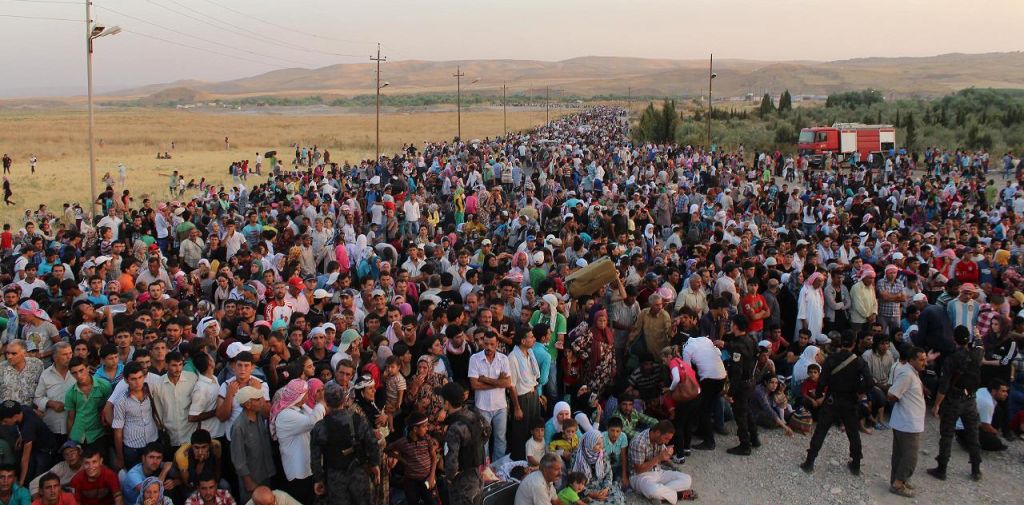
BAGHDAD — In a mass exodus, around 30,000 Syrians have fled their homeland’s bloody civil war over the past five days and streamed across the border into neighboring Iraq’s northern self-ruled Kurdish region, the UN refugee agency said Monday.
The huge influx of people, many of whom are Syrian Kurds escaping escalating violence in northeastern Syria, has left aid agencies as well as Iraqi Kurdistan’s regional government scrambling to accommodate them all. The men, women and children who made the trek join some 1.9 million Syrians who already have found refuge abroad in what has become a massive strain on neighboring countries.
“Syrian refugees are still pouring into Iraq’s northern Kurdish region in huge numbers and most of them are women and children. The reason behind this sudden flow is still not clear,” said Youssef Mahmoud, a spokesman for the U.N. refugee agency in Iraq’s Kurdish region.
“Today, some 3,000 Syrian refugees crossed the borders and that has brought the number to around 30,000 refugees since Thursday,” he said. The latest wave has brought the number of Syrian refugees in the Kurdish region to around 195,000, he added.
The UN High Commissioner for Refugees has set up an emergency transit camp in Irbil, the capital of Iraq’s Kurdish autonomous region, to house some of the new arrivals. Some of the refugees were reportedly staying in mosques or with family or friends who live in the area, according to the agency.
On Friday, the first day after the massive influx began, Adrian Edwards of the UN refugee agency UNHCR told a press conference in Geneva that “the factors allowing this sudden movement are not fully clear to us at this stage.”
According to Reuters, the refugees have crossed into Kurdistan using a newly-constructed pontoon bridge over the Tigris River at Peshkhabour, some 430 kilometers (260 miles) northwest of Baghdad.
[mappress mapid=”4256″]
Edwards was quoted by Reuters as saying that the recent refugee influx was one of the largest since the Syrian civil war began.
More than 100,000 people have been killed in Syria since the conflict began in March 2011 and later exploded into a civil war.
At one camp near Irbil, dozens of refugees carrying their bags, belongings and babies roamed through rows of tents, footage shot by AP Television News showed. Some men lined up to get blocks of ice from a pickup truck. Nearby, children huddled around a truck to get watermelon distributed by the regional security forces.
UNHCR said it is sending 15 truckloads of supplies — 3,100 tents, two pre-fabricated warehouses and thousands of jerry cans to carry water — from its regional stockpile in Jordan. It said the shipment is already on the way and should arrive by the end of the week.
Kurds are Syria’s largest ethnic minority, making up more than 10 percent of the country’s 23 million people. They are centered in the poor northeastern regions of Hassakeh and Qamishli, wedged between the borders of Turkey and Iraq. There are also several predominantly Kurdish neighborhoods in the capital, Damascus, and Syria’s largest city, Aleppo.
Those Kurdish areas have been engulfed by fighting in recent months between Kurdish militias and Islamic extremist rebel factions with links to al-Qaida. Dozens have been killed on both sides. Following the assassination of a prominent Kurdish leader late last month, a powerful Kurdish militia said it was mobilizing to expel Islamic extremists.
Earlier this month, the president of Iraq’s autonomous Kurdish region, Massoud Barzani, vowed to defend Syria’s Kurds. He did not offer details on how he would do so, but Iraqi Kurdistan boasts a powerful and experienced armed force known as the peshmerga.
An armed intervention would carry enormous risks, and appears unlikely. Still, the pledge along with the fighting shows the potential of Syria’s conflict to spread to neighboring countries and shift into a full-blown regional war.
The Kurdish-rebel rift is just one layer in Syria’s increasingly complex and bloody civil war that has killed more than 100,000 people, ripped apart the country’s delicate sectarian fabric and destroyed the nations’ cities and towns. President Bashar Assad’s regime has used warplanes, tanks and ballistic missiles to try to pound rebellious areas into submission.
The Britain-based Syrian Observatory for Human Rights said regime forces in the coastal province of Latakia recaptured nine villages on Monday as well as all of the hilltop military observation posts that rebels seized two weeks ago.
Anti-Assad fighters, most of them from al-Qaeda-linked rebel factions, swept through a string of villages in Latakia, a mountainous province along the Mediterranean coast and the heartland of President Bashar Assad’s Alawite sect. Those advances were some of the most significant rebel gains in months against government forces, which have been on the offensive in central Syria and around Damascus.
The rebel gains have not shifted the strategic balance in the area, but they did embarrass the regime in a region that has been under tight government control since the Syrian revolt began more than two years ago.
Assad’s forces have launched a counteroffensive to try to dislodge the rebels, and activists say fighting continues to rage in several villages still held by the rebels in the mountainous region.







The Times of Israel Community.