

Israel thinks again about an apology to Turkey
As Panetta begins his Israel talks amid mounting concern over Iran and Syria, there’s a new awareness in the prime minister’s circle of the advantages of healing ties with Ankara

 Add ToI as a Preferred Source on Google
David Horovitz is the founding editor of The Times of Israel. He is the author of "Still Life with Bombers" (2004) and "A Little Too Close to God" (2000), and co-author of "Shalom Friend: The Life and Legacy of Yitzhak Rabin" (1996). He previously edited The Jerusalem Post (2004-2011) and The Jerusalem Report (1998-2004).
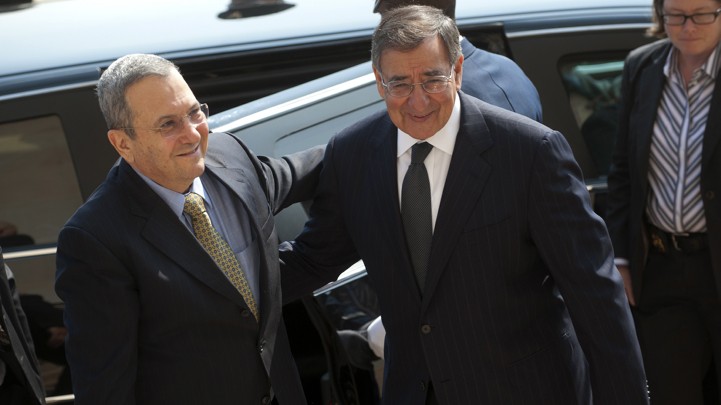
As US Defense Secretary Leon Panetta arrived in Israel on Tuesday night, the Iranian nuclear drive was, as ever, high on the agenda for his talks with Israeli leaders. So too, unsurprisingly, was the bloodshed in Syria, and concerns over President Bashar Assad’s chemical weapons falling into the hands of Hezbollah, Al-Qaeda, or other terror groups.
But a third subject — extremely relevant to those first two familiar hot-button issues — was also the source of intensified focus: the unresolved crisis in Israel’s relations with Turkey.
On her visit here two weeks ago, Secretary of State Hillary Clinton is understood to have urged Israel’s leaders to do what is necessary, however unpalatable, to heal the rift with Ankara. Panetta was bringing a similar message. And in the prime minister’s circle, there is growing awareness these days of how important it is to try to fix the relationship.
Prime Minister Benjamin Netanyahu has hitherto balked at apologizing to Turkey for the deaths of nine of its citizens in the Mavi Marmara incident — the May 30, 2010, flash point when Israeli naval commandos opened fire after being attacked by club-wielding thugs aboard the vessel that sought to bust Israel’s naval blockade of Gaza.
Netanyahu feels strongly that an apology would almost amount to a betrayal of those commandos, who resorted to live fire because they felt their lives to be in danger. Defense Minister Ehud Barak, no less concerned to do the right thing by the IDF, nonetheless has been convinced for some time that the advantages of a healed partnership with Ankara outweigh the disadvantages — including the sense of injustice and humiliation — of saying sorry.
The argument advanced by the US and long accepted by Barak has been that the hostility felt by Turkey is harming wider Israeli interests, and most notably undermining international solidarity in the battle to thwart Iran — Israel’s most pressing regional concern.
The new factor is the escalated chaos in Syria — and the heightened concern over chemical weapons falling into dangerous and irresponsible hands — a casus belli, according to Foreign Minister Avigdor Liberman. It is in that light that Israeli-Turkish ties take on even more importance: Israel’s air strike in northeast Syria in 2007 — subsequently acknowledged abroad as having destroyed a North Korean-built nuclear reactor — was described in foreign reports as having involved a route back from the target that passed through Turkey. The IAF was reported to have jettisoned fuel tanks and munitions close to the Syria-Turkey border.
Flying such a route might not be necessary to deal with a chemical weapons threat. But far better, if Israel feels the imperative to strike at chemical weapons stores or convoys, to do so with a mollified Turkey across the border than with a Turkey still highly hostile to Israel and well-placed to intervene.
Netanyahu said in a Channel 2 interview on Tuesday night that he was “not eager” to order military action to defang the chemical weapons threat, but that “Israel does not rule out the possibility.”
Assad’s non-conventional weaponry is said to be stored at some 40 locales, and currently to be under relatively secure control. But Hezbollah and al-Qaeda operatives are active in Syria. And the situation, as Assad battles for survival, is fluid, dangerous and thoroughly unpredictable.
That’s why Panetta, while doing his best to reassure Israel about US determination to stop Iran, and consulting and coordinating over Syria, is also engaged in some reasoning, and even some urging, about Turkey.






The Times of Israel Community.