

Lag B’Omer bonfires spark air pollution spike
Pollution up tenfold in parts of Bnei Brak, Jerusalem
 Add ToI as a Preferred Source on Google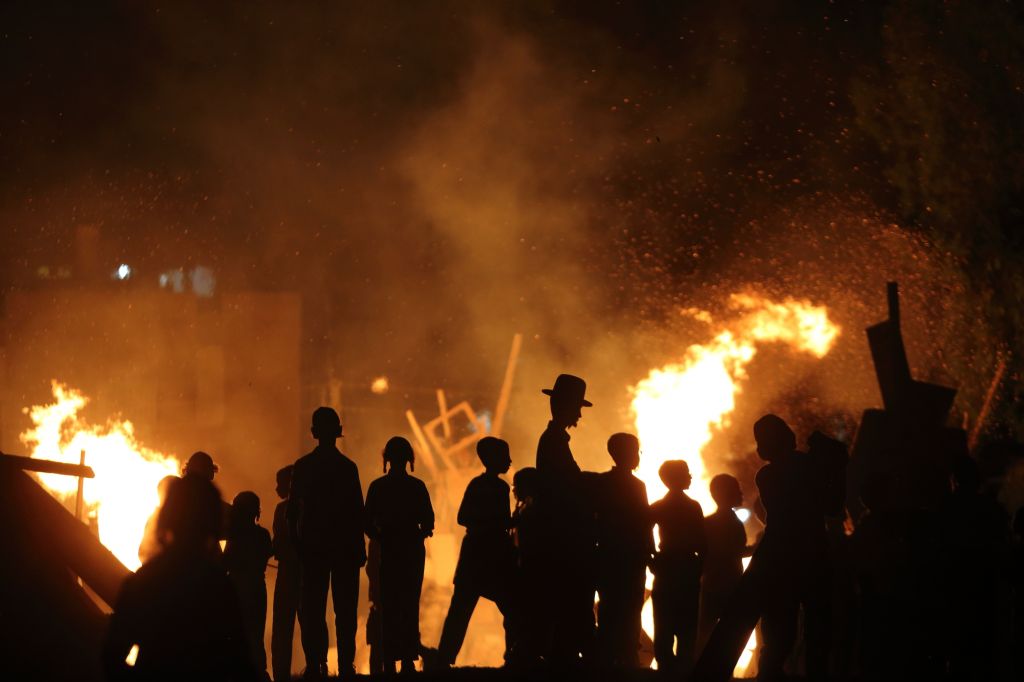
Air pollution rates throughout Israel soared Wednesday night due to the bonfires lit to mark the Lag B’Omer holiday, data from the Environmental Protection Ministry showed.
The ministry’s air-quality monitoring stations recorded air pollution rates as much as ten times the normal average rate on a clear day.
The Jewish holiday, which marks the death of a 2nd century Talmudic sage, is traditionally marked with bonfires in Israel.
While the religious neighborhoods in Jerusalem and the Tel Aviv region had the most polluted air, the air-pollution rate was actually lower in the more populated center of the country because there is less open space to light fires in, the ministry said.
Environmental agencies distinguish between two categories of pollutants based on size: coarse particles, which are between 2.5 and 10 micrometers (from about 25 to 100 times thinner than a human hair), and fine particles, which are smaller than 2.5 micrometers (100 times thinner than a human hair). Fine particles are more dangerous because they are made of more toxic material, travel farther and can go more deeply into the lungs.
According to Environmental Protection Ministry data, the air in part of the ultra-orthodox city of Bnei Brak, near Tel Aviv, contained 10.1 times the average amount of fine particles inhaled on an ordinary day. The air in Jerusalem’s Shmuel Hanavi neighborhood contained 10.4 times the average amount.
The Environmental Protection Ministry launched an advertising campaign in Bnei Brak before Lag B’Omer to raise awareness of the severe air pollution caused by the bonfires.
The campaign culminated in a pedal-powered, smokeless bonfire that used light instead of flame, which was lit in the presence of Bnei Brak Mayor Hanoch Zeibert.
Air-pollution concentrations began rising in Israel on Wednesday night, peaking between 10:30 p.m. and 4:30 a.m., according to the data.
Although the pollution levels decreased significantly on Thursday morning, a strong odor remained because the particles were trapped by fog.
Studies conducted in past years show a spike in emergency-room visits because of the decline in air quality caused by the Lag B’Omer bonfires.
Lag B’Omer, which is observed on the 18th day of the Hebrew month of Iyar and the 33rd day of the Omer — the seven-week period between the festivals of Passover and Shavuot — is the anniversary of the death of Rabbi Shimon bar Yohai, a prominent sage and mystic who lived in ancient Israel in the second century CE.










The Times of Israel Community.