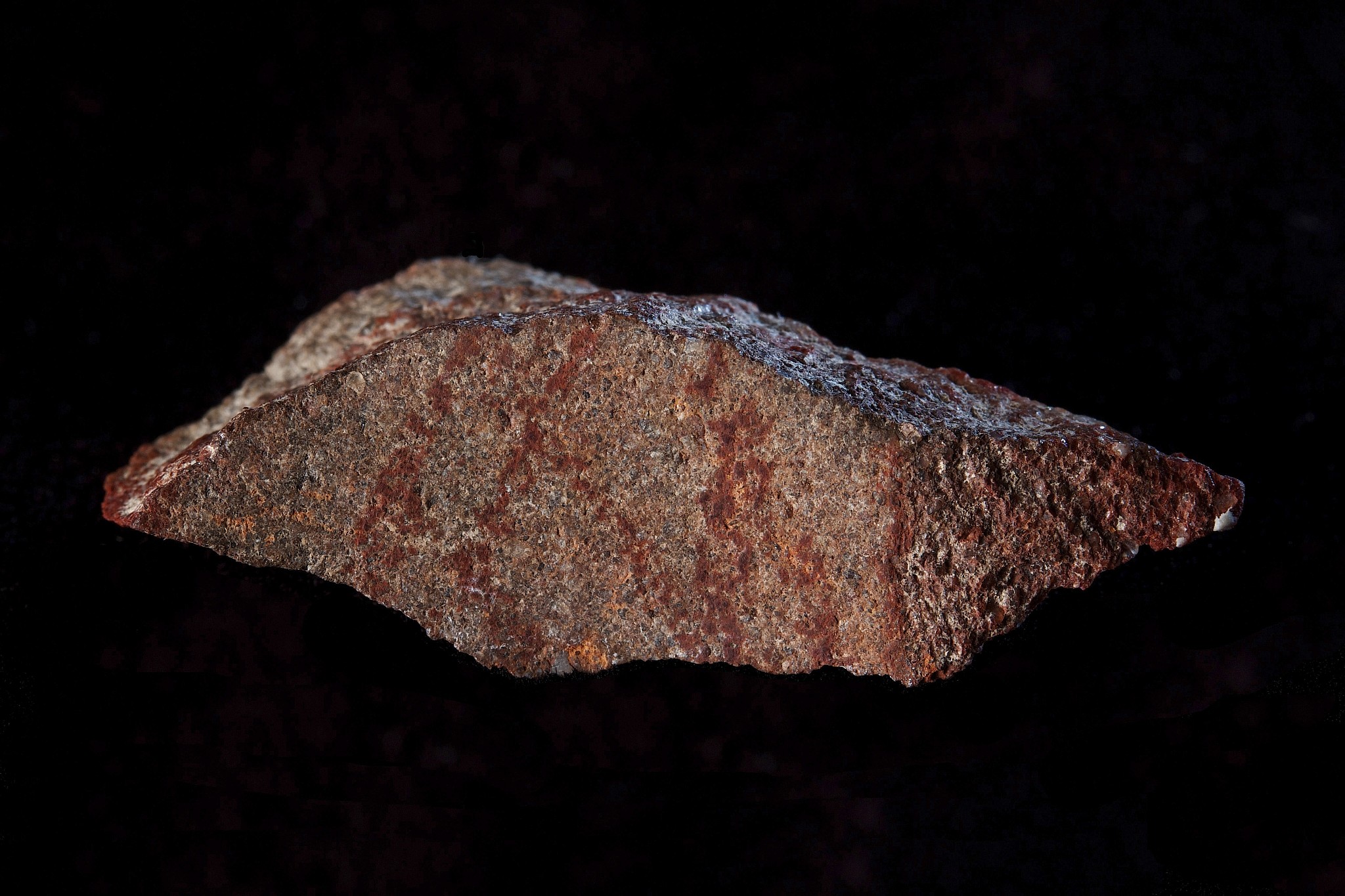
It looks a bit like a hashtag, but it’s 73,000 years old. And scientists say this tiny sketch found in a South African cave is the oldest known drawing.
It’s not the earliest deliberate design; some abstract engravings are far older. But the drawing shows early humans in southern Africa could produce designs on various surfaces with different techniques.
The collection of crisscrossed lines was found in the Blombos Cave about 190 miles (300 kilometers) east of Cape Town. It is at least 30,000 years older than any other known drawing, researchers say in a report released Wednesday by the journal Nature.
It was created with a sharpened flake of ochre, a pigment widely used in the ancient world, said Christopher Henshilwood of the University of Bergen in Norway.
The drawing is basically six red lines crossed by three other slightly curved lines. It appears on a tiny flake of mineral crust measuring only about 1.5 inches (39 millimeters) long and about half an inch (15 millimeters) tall. It’s evidently part of a larger drawing because lines reaching the edge are cut off abruptly there, researchers said.
Similar patterns are engraved in other artifacts from the cave, and the hashtag design was produced widely over the past 100,000 years in rock art and paintings, he said. So the newly found sketch is probably not just a collection of random scratchings.
The finding gives evidence that early humans could store information outside the brain and supports the argument that early members of our species “behaved essentially like us” before they left Africa for Europe and Asia, he said.
This undated photo provided by Craig Foster in September 2018 shows a drawing made with ochre pigment on silcrete stone, found in the Blombos Cave east of Cape Town, South Africa. In a report released on Wednesday, September 12, 2018, scientists say this tiny 73,000-year-old sketch found in a South African cave is the oldest known drawing. (Craig Foster via AP)
— AP
Help us report truthfully on social media
As a multimedia journalist, my job is to take the quality, fact-based journalism produced by The Times of Israel newsroom and make it accessible across every platform — from Instagram posts to podcasts to short-form videos.
This is how many, especially young people, consume news these days. But misinformation is rampant on social media. Our team at ToI produces accurate, responsible short-form reporting on Israel and the Jewish world.
If you believe in the importance of factual social media journalism, please consider joining our reader support group, The Times of Israel Community. Your financial support is essential to sustain responsible multimedia reporting.
We’re really pleased that you’ve read X Times of Israel articles in the past month.
That’s why we started the Times of Israel - to provide discerning readers like you with must-read coverage of Israel and the Jewish world.
So now we have a request. Unlike other news outlets, we haven’t put up a paywall. But as the journalism we do is costly, we invite readers for whom The Times of Israel has become important to help support our work by joining The Times of Israel Community.
For as little as $6 a month you can help support our quality journalism while enjoying The Times of Israel AD-FREE, as well as accessing exclusive content available only to Times of Israel Community members.
Thank you, David Horovitz, Founding Editor of The Times of Israel


 From
From  Add ToI as a Preferred Source on Google