A Namibian delegation has taken possession of the remains of 27 countrymen whose bones were taken by German colonial forces more than a century ago for pseudo-scientific racial experiments seen as a precursor to the Holocaust.
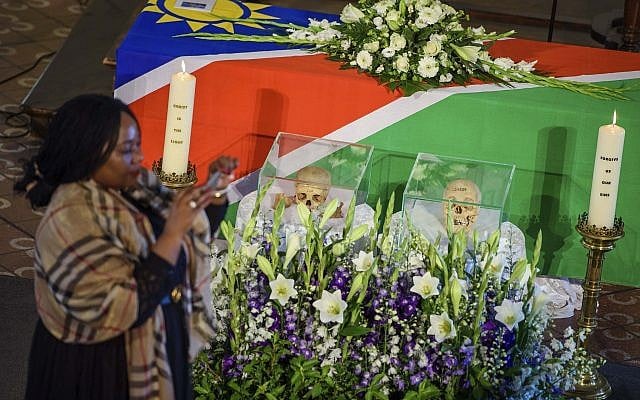
At a church ceremony in Berlin, two skulls in glass boxes along with a coffin covered with a Namibian flag are placed in front of the altar ahead of the handover.
The repatriation of the remains is a reminder of Germany’s short-lived past as a colonial power in Africa which included the bloody suppression of a Herero and Nama uprising between 1904 and 1908 that left tens of thousands dead.
The skulls of two people killed in the the Herero and Nama uprising between 1904 and 1908 are flanked by candles during a ceremony in Berlin Wednesday, August 29, 2018 before the repatriation of the remains to Namibia. (Gregor Fischer/dpa via AP)
“We intend to do something today we should have done many years ago, namely to give back mortal human remains of people who became the first victims of the first genocide of the 20th century,” German Lutheran Bishop Petra Bosse-Huber tells the fully packed church.
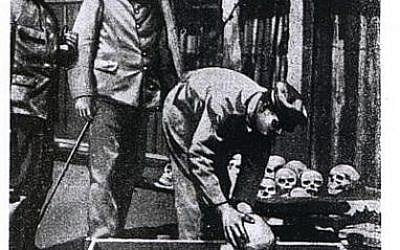
Herero skulls are packed into boxes by German South-West-Africa troops, to be sent to the pathologic institute in Berlin, so that they might be used for scientific measurements. The skulls were from Herero’s killed in action or of those hung. (Courtesy)
Germany is returning 19 skulls, five full skeletons and bone and skin fragments that were stored in hospitals, museums and universities for decades.
In the early 20th century, German scientists tried to prove the “racial superiority” of white Europeans over black Africans by, for example, analyzing the facial features of the skulls, well before Nazi-era scientists conducted similar experiments on Jews and others.
As a multimedia journalist, my job is to take the quality, fact-based journalism produced by The Times of Israel newsroom and make it accessible across every platform — from Instagram posts to podcasts to short-form videos.
This is how many, especially young people, consume news these days. But misinformation is rampant on social media. Our team at ToI produces accurate, responsible short-form reporting on Israel and the Jewish world.
If you believe in the importance of factual social media journalism, please consider joining our reader support group, The Times of Israel Community. Your financial support is essential to sustain responsible multimedia reporting.
We’re really pleased that you’ve read X Times of Israel articles in the past month.
That’s why we started the Times of Israel - to provide discerning readers like you with must-read coverage of Israel and the Jewish world.
So now we have a request. Unlike other news outlets, we haven’t put up a paywall. But as the journalism we do is costly, we invite readers for whom The Times of Israel has become important to help support our work by joining The Times of Israel Community.
For as little as $6 a month you can help support our quality journalism while enjoying The Times of Israel AD-FREE, as well as accessing exclusive content available only to Times of Israel Community members.
Thank you, David Horovitz, Founding Editor of The Times of Israel


 From the Liveblog of
Wednesday, August 29, 2018
From the Liveblog of
Wednesday, August 29, 2018
 Add ToI as a Preferred Source on Google